After studying this material, students should be able to:
- Explain why traditional air quality forecasting is computationally expensive
- Describe how AI generative models can replace or supplement traditional chemistry-based models
- Identify the key components of the NVIDIA Earth-2 framework used for pollution forecasting
- Evaluate real-world applications of AI-driven environmental modeling
- Understand the scalability of AI models from supercomputers to desktop systems
Step-by-Step Study Material
Step 1: Understanding the Problem — Why Air Quality Forecasting Is Hard
The Core Challenge
Traditional Air Quality Model =
    Weather Model + Chemistry Equations
         ↓
    Very Slow & Expensive
         ↓
    Less Detail + Less Frequent Updates
Key facts to understand:
- Air pollution causes approximately 30,000 deaths per year in the UK alone
- Traditional models use chemistry-based simulations that require enormous computing power
- Adding chemistry to weather models makes them significantly slower
- This limits:
- Spatial resolution (how detailed the map is)
- Update frequency (how often forecasts refresh)
- Accessibility (who can afford to run them)
Why This Matters
Think of it like trying to render a high-definition video on a very old computer — you either wait a very long time or you reduce the quality. Traditional pollution models face the same trade-off.
Step 2: The AI Solution — Generative Downscaling Models
What Is a Generative Model in This Context?
A generative model learns patterns from existing data and can create new, detailed outputs without running expensive physics simulations from scratch.
Traditional Approach:
Raw Data → Run Full Chemistry Simulation → Detailed Output
(Slow, expensive)

AI Approach:
Raw Data → Trained AI Model → Detailed Output
(Fast, cheap after training)
Key Concept: Downscaling
| Term | Meaning |
|---|---|
| Downscaling | Taking low-resolution data and generating high-resolution detail |
| CorrDiff | NVIDIA's generative downscaling model used here |
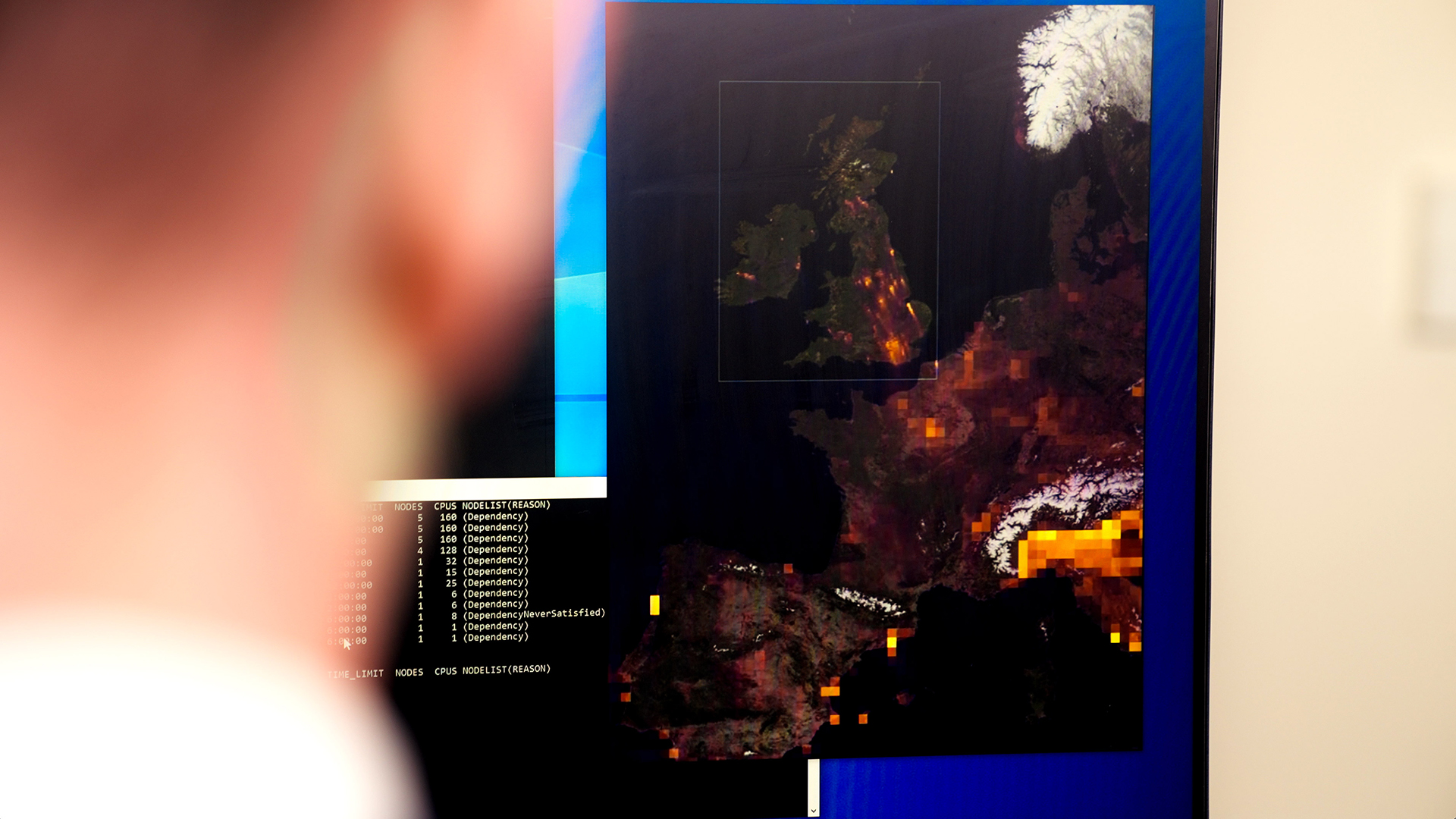
| Resolution achieved | 2–3 square kilometers across the UK |
Analogy:
Downscaling is like using AI to sharpen a blurry photograph — the AI fills in realistic detail based on patterns it has learned, rather than requiring a new high-resolution photo to be taken.
Step 3: The NVIDIA Earth-2 Framework — Key Components
Component 1: Earth-2 CorrDiff
- Purpose: Generative downscaling of pollution fields
- Function: Takes coarse simulation data and produces high-resolution pollution maps
- Achievement: Trained successfully on the first attempt
- Training data: One year of UK pollution data at hourly intervals
Component 2: Earth-2 StormCast
- Purpose: Time-dependent forecasting
- Function: Enables forecasts that directly incorporate real air quality observations
- Advantage: Moves from static snapshots to dynamic, evolving predictions
CorrDiff = Spatial Detail (Where is pollution high?)
StormCast = Temporal Detail (When will pollution be high?)
         ↓
Combined = Detailed maps that evolve over time
Step 4: The Hardware Journey — From Supercomputer to Desktop
Training Phase: Isambard-AI Supercomputer
| Specification | Detail |
|---|---|
| Location | Bristol, UK |
| Hardware | 5,448 NVIDIA GH200 Grace Hopper Superchips |
| AI Performance | 21 exaflops |
| Nodes used | Single 8-GPU node |
| Training time | 2 days |
Key insight: Despite being a massive supercomputer, only a single 8-GPU node was needed — demonstrating the efficiency of the AI approach.
Inference Phase: DGX Spark Desktop
Supercomputer (Training)          Desktop (Inference)
Isambard-AI              →        NVIDIA DGX Spark
National facility                 Sits on a desk
Thousands of GPUs                 GB10 Grace Blackwell chip
2 days to train           →       Runs predictions locally
Why this matters:
- Democratizes access to powerful environmental modeling
- Cost entry point: "a few thousand dollars" vs. national supercomputer budgets
- Researchers can now retrain models in their own offices
Step 5: Real-World Applications
Application 1: Public Health Alerts
Pollution Model predicts high pollution tomorrow
         ↓
Healthcare system identifies at-risk patients
         ↓
Proactive alerts sent to asthma patients in affected areas
         ↓
Patients take precautions before exposure occurs
Application 2: Policy Scenario Modeling
- Governments can simulate: "What happens to pollution if we ban diesel vehicles in city centers?"
- Models can test future policy changes before implementation
- Provides evidence-based decision support
Application 3: Real-Time Emergency Response
Wildfire detected
    ↓
Edge AI devices collect real-time air quality data
    ↓
Data fed into pollution model
    ↓
Real-time decisions made about evacuations, health warnings
Application 4: Street-Level Resolution (Future Goal)
- Current resolution: 2–3 km²
- Future goal: Street-scale resolution
- Method: Incorporating additional open data sources
Step 6: Open Science and Global Scalability
The Open Source Vision
University of Manchester develops workflow
         ↓
Releases open-source training data + workflows
         ↓
Any country or city uses local data
         ↓
Trains their own pollution model with a "small burst" of supercomputer time
         ↓
Global network of local pollution models
This addresses a critical equity issue:
Wealthy nations currently have better environmental monitoring. Open workflows could give every country access to the same quality of air quality intelligence.
Step 7: The Agentic Future — Where This Is Heading
What Is an Agentic Interface?
An agentic system is one where a user asks a plain-language question and a chain of AI models automatically handles all the complex steps to deliver an answer.
User (clinician or government official) asks:
"What will pollution be like in this neighborhood tomorrow?"
         ↓
Agentic system automatically:
  1. Retrieves current air quality observations
  2. Runs weather forecast model
  3. Runs CorrDiff for spatial detail
  4. Runs StormCast for time evolution
  5. Synthesizes results
         ↓
Delivers clear, science-grounded answer
No technical expertise required from the end user.
Summary: Concept Map
PROBLEM
Air pollution kills 30,000/yr in UK
Traditional models = slow + expensive
         ↓
SOLUTION
AI Generative Models (Earth-2 framework)
         ↓
KEY TOOLS
CorrDiff (spatial detail) + StormCast (time detail)
         ↓
HARDWARE JOURNEY
Train on supercomputer (2 days) → Run on desktop
         ↓
APPLICATIONS
Healthcare alerts | Policy modeling | Emergency response
         ↓
FUTURE
Open source globally + Agentic interfaces
Self-Check Questions
- Why are traditional chemistry-based air quality models computationally expensive?
- What is the difference between CorrDiff and StormCast in terms of their function?
- What does "downscaling" mean in the context of pollution modeling?
- Why is it significant that the model can run on a desktop after being trained on a supercomputer?
- Name three real-world applications of this pollution forecasting system
- What is an agentic interface and how would it change who can use this technology?