Step-by-Step Teaching
STEP 1: The Core Problem — Why Traditional Robots Struggle
Traditional Robot Workflow:
New Task → Collect Data → Retrain Model → Validate → Deploy
         ↑_______________________________________________|
                    (Repeat for EVERY change)
Think of it like this:
Imagine hiring an employee who needs months of retraining every time you rearrange the office furniture
Key limitations:
- Fixed programming = rigid behavior
- New product arrives → significant reprogramming required
- Layout changes → more data collection needed
- Each change = expensive time and engineering resources
STEP 2: The Breakthrough Concept — In-Context Learning
What is In-Context Learning?
| Traditional Learning | In-Context Learning |
|---|---|
| Requires new training data | Uses a single video as input |
| Model weights get updated | No weight updates |
| Takes hours/days | Works immediately |
| Task-specific retraining | Generalizes from demonstration |
How S1's In-Context Learning Works:
Step 1: Operator records video of desired task
           ↓
Step 2: Video fed to S1 as a "prompt"
           ↓
Step 3: Model interprets:
        • Demonstrated INTENT
        • OBJECTS involved
        • ACTION SEQUENCE
           ↓
Step 4: Maps understanding → Robot actions
           ↓
Step 5: Robot executes task (NO retraining needed)
Why This Matters — The Numbers:
1 video demonstration ≈ 380 hands-on training examples
                      ≈ 50-100 hours of manual collection

S1 success rate:    66% per step
Comparable AI:       9% per step
                   ─────────────
Improvement:        7x better
Real example: Plant potting task — from recording demonstration to autonomous robot execution in just 11 minutes
STEP 3: Understanding Foundation Models in Robotics
What is a Robot Foundation Model?
Think of it like ChatGPT but for robot actions:
Language Model:          Robot Foundation Model:
Text input               Video/sensor input
↓                        ↓
Understands language     Understands physical tasks
↓                        ↓
Generates text output    Generates robot movements
Key Capabilities of S1:
- ✅ Handles tasks lasting up to 10 minutes
- ✅ Executes dozens of manipulation steps
- ✅ Composes skills in new sequences never seen before
- ✅ Recovers from errors when objects move
- ✅ Works across multiple robot types (embodiments)
Example tasks S1 can learn from one video:
- 🌱 Plant potting
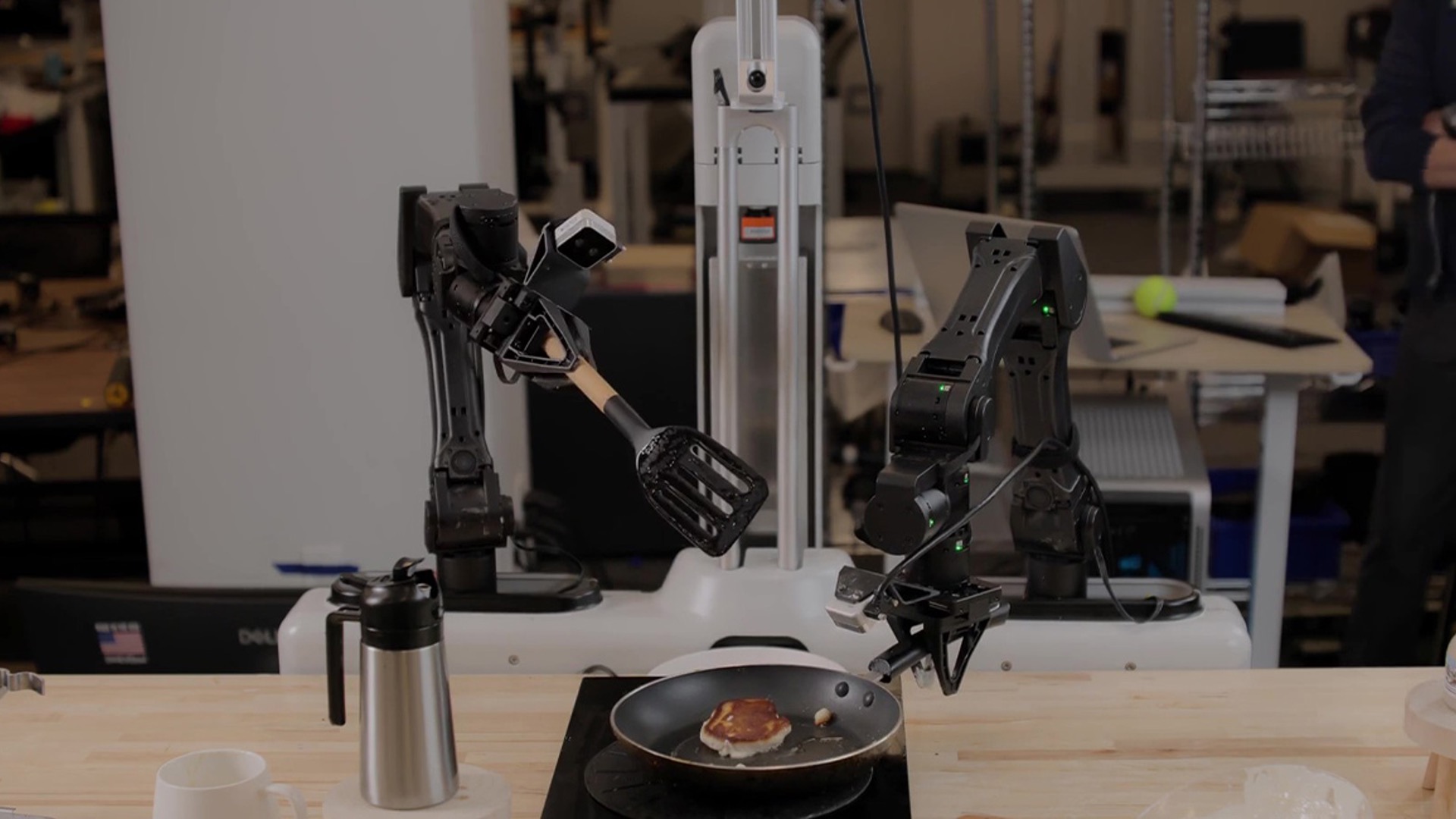
- 🥞 Pancake making
- ☕ Pour-over coffee brewing
- 📦 Kit assembly
STEP 4: The AI Development Pipeline
This is the complete journey from idea to factory deployment:
Stage 1: Data Generation
NVIDIA Cosmos (World Foundation Models)
├── Converts video → structured descriptions
├── Diversifies training data
└── Cosmos Curator: annotates, filters, organizes data at scale
Stage 2: Simulation & Training
NVIDIA Omniverse + Isaac Sim
├── Creates physically accurate virtual environments
├── Tests edge cases safely (no real robot damage)
└── Generates synthetic training data

NVIDIA Isaac Lab (Reinforcement Learning)
├── Powered by Newton physics engine
├── Models: forces, contact, collision, pressure
└── Reduces simulation-to-reality gap
Stage 3: Optimization & Deployment
NVIDIA Nsight Tools
└── Finds performance bottlenecks during training

NVIDIA TensorRT SDK
└── Optimizes inference speed for real-time robot response
The Complete Pipeline Visualized:
Raw Data/Video
     ↓
[Cosmos] → Structured, diverse training data
     ↓
[Isaac Sim] → Safe virtual testing environment
     ↓
[Isaac Lab] → Reinforcement learning with physics
     ↓
[Nsight] → Performance optimization
     ↓
[TensorRT] → Fast real-world inference
     ↓
Physical Robot Deployment
Key insight: These aren't separate systems — they're connected stages of one unified pipeline
STEP 5: Real-World Application — From Lab to Factory
The Simulation-to-Reality Gap Problem
Problem: Robots trained in simulation often fail in real world
         because physics isn't perfectly modeled

Solution: Newton physics engine accurately models:
          • How robots TOUCH objects
          • How robots GRIP objects
          • Force and pressure dynamics
          • Collision behavior
Real Deployment Example — NVIDIA Blackwell Assembly:
Task: High-precision electronics assembly
Partners: Skild AI + NVIDIA + Foxconn

Robot performs:
1. Install busbar and limit block
2. Fasten 16 screws precisely
3. Adapt to disturbances mid-task
4. Track sequence across multiple steps
5. Recover when scene differs from plan
Required capabilities:
- Precise motion control
- Contact-aware manipulation
- Sequence memory
- Error recovery
STEP 6: Connecting the Concepts — The Big Picture
Why This Represents a Paradigm Shift:
OLD PARADIGM:              NEW PARADIGM:
"Program robots"           "Teach robots"
     ↓                          ↓
Fixed instructions         Learning from experience
     ↓                          ↓
Breaks with change         Adapts to change
     ↓                          ↓
Engineer-dependent         Operator-accessible
The Flywheel Effect:
More deployments
      ↓
More real-world experience data
      ↓
Better model performance
      ↓
Faster future deployments
      ↓
(cycle continues)
Skild reached $100M annual revenue in just 10 months with 60+ deployment partnerships — evidence this approach works commercially
Summary: Key Concepts to Remember
| Concept | Simple Definition |
|---|---|
| In-context learning | Robot learns new task from one video, no retraining |
| Foundation model | General-purpose AI brain adaptable to many tasks |
| Simulation-to-reality gap | Difference between virtual training and real-world performance |
| Reinforcement learning | Robot improves through trial and error in simulation |
| Long-horizon tasks | Complex tasks with many sequential steps over time |
| Embodiment | The physical robot body the AI controls |
Self-Check Questions
- What makes in-context learning different from traditional robot training?
- Why is simulation important before real-world deployment?
- What problem does the Newton physics engine solve?
- How does one video demonstration compare to manual training examples?
- Explain the development pipeline in your own words from data to deployment