After studying this material, you should be able to:
- Explain why organizations choose in-house LLM serving over hosted APIs
- Describe the four core architectural decisions in building an LLM serving platform
- Identify production challenges that only emerge under real load
- Understand how constrained decoding works and why it matters
- Apply these architectural patterns to evaluate or design similar systems
Step-by-Step Study Material
Step 1: The Big Picture — Why Run LLMs In-House?
The Default Approach
Most organizations use hosted APIs (like OpenAI's API):
Your App → API Call → OpenAI Servers → Response
Netflix's Approach
Netflix runs the full stack internally:
Your App → Netflix's own routing → Netflix's own GPU servers → Response
Why bother?
| Reason | Explanation |
|---|---|
| Cost | At scale, per-token API costs compound enormously |
| Latency | Removing external network hops reduces response time |
| Data Privacy | Sensitive user data never leaves Netflix infrastructure |
| Customization | Full control over model behavior, constraints, and logic |
| Quality | Fine-tuned models can outperform general-purpose ones |
Key Insight: The payoff is that moving from a hosted model to a self-hosted fine-tuned model requires minimal code changes — same API, different backend.
Step 2: Understanding the Infrastructure Architecture
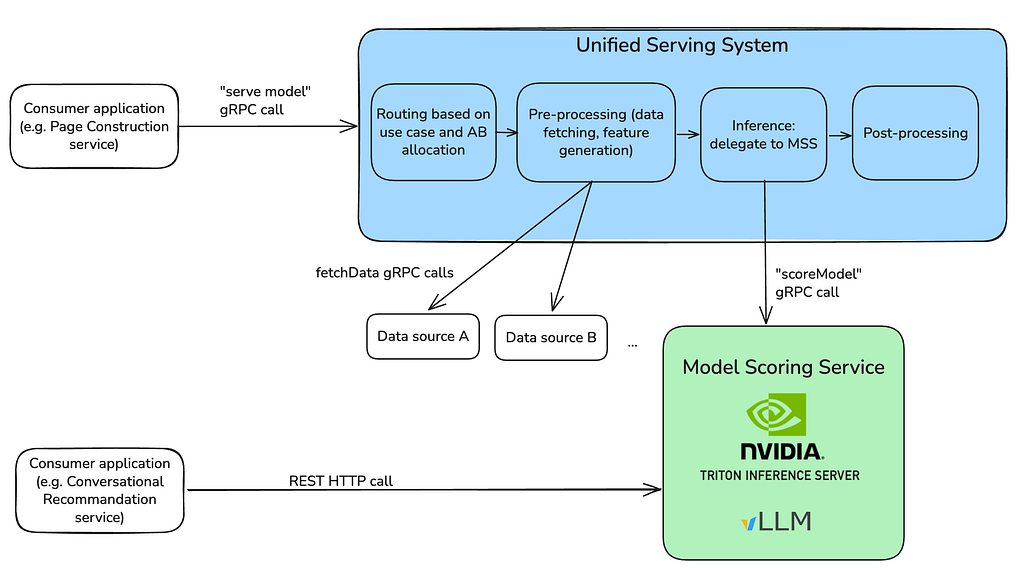
Before the four decisions, you need to understand the existing system Netflix built upon.
The Serving Stack (Bottom to Top)
┌─────────────────────────────────────────┐
│         Downstream Applications         │
└────────────────┬────────────────────────┘
                 │
    ┌────────────┴────────────┐
    │   gRPC Path             │   HTTP Path (newer LLM apps)
    │   (JVM Serving System)  │
    └────────────┬────────────┘
                 │
    ┌────────────▼────────────┐
    │  Model Scoring Service  │  ← Shared inference backend
    │  (MSS)                  │    Supports XGBoost, TF, PyTorch, LLMs
    └────────────┬────────────┘
                 │
    ┌────────────▼────────────┐
    │  NVIDIA Triton          │  ← Manages model loading,
    │  Inference Server       │    batching, GPU scheduling
    └────────────┬────────────┘
                 │
    ┌────────────▼────────────┐
    │  Java Control Plane     │  ← Deployment, versioning,
    │                         │    health checks, autoscaling
    └─────────────────────────┘
Where Models Actually Run
- Small CPU models → Run in-process (no network call overhead)
- Large GPU models → Delegated to MSS remotely
Analogy: Think of MSS like a shared kitchen in a restaurant. Individual stations (applications) prep ingredients locally, but all cooking on the big stoves (GPUs) happens in the shared kitchen.
Step 3: The Four Core Decisions
These decisions are presented in dependency order — each one constrains the next.
Decision 1: Engine Selection
The Question: Which inference engine should power LLM serving?
Original Choice: TensorRT-LLM
- Already integrated with Triton
- High performance at the time
Why They Switched to vLLM
By mid-2025, two things changed:
- Performance gap closed — Open-source engines caught up to specialized stacks
- Workload diversified — They now needed to handle:
┌─────────────────────────────────────────────┐
│ Workload Types                              │
├─────────────────────────────────────────────┤
│ • Embedding generation                      │
│ • Prefill-only inference (ranking/retrieval)│
│ • Autoregressive decoding (text generation) │
│ • Custom models with per-step constraints   │
└─────────────────────────────────────────────┘
vLLM won on operational fit, not just raw speed.
Key Concept — Operational Fit: A system isn't just about peak performance. It's about how well it integrates, how easy it is to maintain, and how well it handles your specific workload mix.
Decision 2: Model Packaging
The Question: How do you package models for vLLM inside Triton?
Triton offers two packaging approaches. The core trade-off is:
Tight Coupling          vs.          Loose Coupling
─────────────────                    ──────────────
Model artifacts tied                 Model artifacts
to frontend version                  independent of
                                     frontend version
The Production Problem They Hit:
When model artifacts are tightly coupled to the frontend, upgrading the serving engine requires repackaging every model — a maintenance burden that grows with the number of models.
Lesson: Packaging decisions that seem minor in development become significant maintenance costs in production at scale.
Decision 3: API Surface Design
The Question: How should callers interact with the LLM serving system?
Design Goal: No Special Snowflakes
Netflix's principle: Every model — XGBoost or LLM — is scored via the same interface.
This means:
- Same client libraries
- Same health checking
- Same deployment pipelines
The Dual API Strategy
Callers
  │
  ├──► gRPC (existing path — all model types)
  │
  └──► HTTP / OpenAI-compatible API (new path — LLM ecosystem)
Why OpenAI-compatible API?
The OpenAI API has become the de facto standard. This means:
- Inference engines speak it
- Orchestration frameworks speak it
- Evaluation tools speak it
- Client libraries speak it
Adopting it means Netflix gets ecosystem compatibility for free.
The Production Bug They Found
Problem:
Caller sends request with response_format: JSON
         ↓
OpenAI-compatible frontend accepts it ✓
         ↓
response_format silently dropped before reaching vLLM ✗
         ↓
vLLM generates without JSON constraints
         ↓
Caller receives malformed JSON with NO error
Fix: They patched the frontend (using git-subtree) to translate response_format into vLLM's guided decoding parameters.
Key Lesson: "Accepted by schema" ≠ "actually enforced." Silent failures are more dangerous than loud ones.
Decision 4: Deployment / Rollout Strategy
The Question: How do you update models without dropping requests?
The Challenge: GPU deployments take longer to start than CPU services, and the I/O schema may change between versions.
Two Rollout Strategies
Strategy A: Red-Black Deployment
Old Version (Red) ──► Still serving traffic
New Version (Black) ──► Spins up fully
                         ↓
                    Traffic switches atomically
                         ↓
Old version terminates
- ✅ Cheaper
- ✅ Simpler
- ⚠️ Requires version-agnostic model (no schema changes)
Strategy B: Versioned Deployment
Old Version ──► Continues serving old schema
New Version ──► Serves new schema simultaneously
                 ↓
            Gradual traffic migration
                 ↓
Old version retires
- ✅ Handles breaking interface changes
- ❌ More expensive (two versions running simultaneously)
- ❌ More complex coordination
Netflix's Recommendation:
Embed variable configurations (like tensor shapes) directly into the model → use Red-Black (cheaper). Reserve Versioned for unavoidable breaking changes.
Step 4: Operational Details That Surprised Them
These are the "design phase didn't anticipate" lessons — arguably the most valuable part.
Surprise 1: Boot Sequence Complexity
Bringing up a vLLM-on-Triton instance requires coordinated steps:
Boot Sequence:
1. Extract model package
2. Install custom vLLM plugins (via Python entry_points)
3. Clean Prometheus multiprocess directory
4. [Non-routine steps involving model loading]
5. Gate gRPC port until engine is READY
The gRPC port only opens after the engine is fully ready — preventing traffic from hitting an uninitialized instance.
Surprise 2: Observability Gap
The Problem:
vLLM metrics ──► Written to disk as .db files
Triton metrics ──► Exposed via its own Prometheus endpoint

Neither knows about the other.
Triton's bridge only surfaces 9 of 40+ vLLM metrics.

Missing: token throughput, KV cache utilization,
         prefix cache hit rates
The Fix: A lightweight HTTP proxy that merges both:
/metrics endpoint
      │
      ├── Fetches Triton metrics via HTTP
      └── Reads vLLM metrics from disk (MultiProcessCollector)
              │
              └── Returns combined output
                  (existing dashboards work unchanged)
Key Lesson: When integrating two systems, observability gaps are invisible until production. Always audit what metrics are actually being collected vs. what you think is being collected.
Step 5: Constrained Decoding — Pushing Logic Inside the Model
The Problem It Solves
Without constraints:
Model generates output
    ↓
Business logic checks if output is valid
    ↓
If invalid → retry or repair
    ↓
Wasted compute + added latency
With constrained decoding:
At each token generation step:
    ↓
Constraint logic runs INSIDE the decode loop
    ↓
Only valid tokens are eligible
    ↓
Output is compliant by construction
How It Works: State Machine + Token Masks
Request arrives with constraints
    ↓
Each request gets its own logits processor
    ↓
At each decode step:
    State Machine evolves based on tokens generated so far
         ↓
    Emits a token-eligibility mask
         ↓
    Only eligible tokens can be selected
         ↓
    Next token generated
Analogy: Imagine autocomplete that physically cannot suggest words that would make your sentence grammatically wrong — not just unlikely, but impossible.
Step 6: The Scaling Problem and Its Evolution
vLLM V0: The CPU Bottleneck
GPU: Produces logits for entire batch (fast, parallel)
         ↓
CPU: Copies logits from GPU (transfer overhead)
         ↓
CPU: Runs constraint logic for Request 1
CPU: Runs constraint logic for Request 2  ← Sequential!
CPU: Runs constraint logic for Request 3  (GIL prevents parallelism)
...
Result: CPU time grows linearly with batch size.
Batch Size:  1    10    50    100
CPU Time:    1x   10x   50x   100x  ← Linear scaling = bad
This bottleneck is invisible in single-request benchmarks — it only appears under realistic concurrency.
vLLM V1: The Fix
GPU: Produces logits for entire batch
         ↓
CPU: Processes ALL requests' constraints TOGETHER (batch-level)
     Implemented in C++ with multi-threading (bypasses GIL)
         ↓
Result: CPU time stays roughly flat as batch size grows.
Batch Size:  1    10    50    100
CPU Time:    1x   1.2x  1.5x  1.6x  ← Flat scaling = good
Trade-off: V1's API is more complex — requires explicit tracking of batch membership changes via update_state(batch_update).
Two New Problems That Emerged in V1
Even after solving the performance problem, stateful constraint logic introduced new issues:
Problem 1: State Consistency
- Batch membership changes dynamically (requests finish, new ones join)
- Constraint state machines must stay synchronized with actual batch state
- A mismatch = wrong constraints applied to wrong request
Problem 2: Error Isolation
- If one request's constraint logic throws an error, it could affect the entire batch
- Need careful error boundaries so one bad request doesn't corrupt others
Step 7: Synthesis — The Full System View
┌─────────────────────────────────────────────────────────┐
│                    Caller Applications                   │
└──────────────────┬──────────────────┬───────────────────┘
                   │ gRPC             │ HTTP (OpenAI API)
┌──────────────────▼──────────────────▼───────────────────┐
│              JVM Serving System / MSS                    │
│         (routing, A/B testing, pre/post-processing)      │
└──────────────────────────┬──────────────────────────────┘
                           │
┌──────────────────────────▼──────────────────────────────┐
│                    NVIDIA Triton                          │
│              (model loading, batching, GPU scheduling)   │
│                                                          │
│  ┌─────────────────────────────────────────────────┐    │
│  │                    vLLM Engine                   │    │
│  │  ┌──────────────────────────────────────────┐   │    │
│  │  │  Custom Logits Processors (C++, batched) │   │    │
│  │  │  State machines per request              │   │    │
│  │  └──────────────────────────────────────────┘   │    │
│  └─────────────────────────────────────────────────┘    │
└─────────────────────────────────────────────────────────┘
                           │
┌──────────────────────────▼──────────────────────────────┐
│              Observability Layer                          │
│    Merged /metrics: Triton + vLLM (40+ metrics)         │
└─────────────────────────────────────────────────────────┘
Key Takeaways Summary
| Concept | Core Lesson |
|---|---|
| Engine Selection | Operational fit matters as much as peak performance |
| Model Packaging | Coupling artifacts to frontend = maintenance debt |
| API Design | Standardize on ecosystem norms (OpenAI API); test silent failures |
| Rollout Strategy | Version-agnostic models enable cheaper deployments |
| Observability | Integration gaps hide metrics; audit what's actually collected |
| Constrained Decoding | Push constraints inside the loop; don't pay for invalid generations |
| Scaling | Single-request benchmarks hide concurrency bottlenecks |
| Production Surprises | Design phase assumptions always need production validation |
Self-Check Questions
- Why does Netflix expose both gRPC and OpenAI-compatible HTTP APIs?
- What is the GIL, and why did it cause problems in vLLM V0's logits processing?
- When would you choose Versioned rollout over Red-Black?
- Why is a silent API failure (like the
response_formatbug) more dangerous than a loud one? - What two metrics sources needed to be merged, and why didn't Triton's built-in bridge suffice?