Step-by-Step Study Material
Step 1: Understanding the Problem Space
What is Batch Compute?
Batch compute refers to workloads that:
- Run to completion (unlike long-running services)
- Are queued and executed based on priority and available capacity
- Need resource management across multiple teams/applications
Example batch workloads:
├── Data processing jobs
├── ML training runs
├── Report generation
└── ETL pipelines
Netflix's Original Solution: CMB (Compute Managed Batch)
Built in 2018, CMB provided:
| Feature | Description |
|---|---|
| Tenant hierarchy | Grouping mechanism for organizations |
| Priority queuing | Ordered execution |
| Capacity management | Per-tenant resource allocation |
| Titus integration | Runs on Netflix's container platform |
Step 2: Core Concepts — Tenants and Capacity
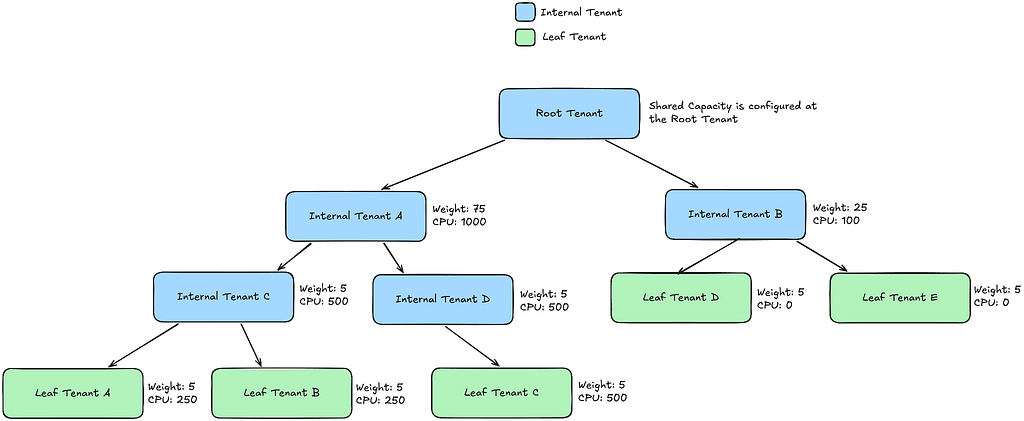
Tenant Types
Think of tenants like a company org chart:
Organization (Internal Tenant)
├── Team A (Internal Tenant)
│   ├── App 1 (Leaf Tenant) ← actually runs jobs
│   └── App 2 (Leaf Tenant)
└── Team B (Internal Tenant)
    └── App 3 (Leaf Tenant)
Key Rule: Only leaf tenants submit actual jobs. Internal tenants organize and share capacity downward.
Two Types of Capacity
Reserved Capacity
┌─────────────────────────────────────┐
│         Reserved Capacity           │
│                                     │
│  Internal Tenant → shared across    │
│  all subtree leaf tenants           │
│                                     │
│  Leaf Tenant → exclusively yours,   │
│  NOT shared with others             │
└─────────────────────────────────────┘
Shared Capacity
┌─────────────────────────────────────┐
│    Global Shared Capacity Pool      │
│                                     │
│  • Any tenant can "burst" into it   │
│  • No reservation required          │
│  • Fair-shared at admission time    │
│  • ⚠️ No preemption in old CMB      │
└─────────────────────────────────────┘
Critical Limitation of CMB: Once a job was admitted, it ran to completion — even if fair-share demand shifted dramatically. This caused poor resource utilization.
Step 3: Why Migrate? — Identifying the Pain Points
CMB's Growing Problems
Problem 1: Built before modern Kubernetes ecosystem matured
    → Open-source tools now offer what CMB built custom

Problem 2: Feature development was difficult
    → CMB was too far removed from underlying Kubernetes clusters
    → Adding preemption was especially cumbersome

Problem 3: No preemption
    → Resources couldn't be reclaimed once allocated
    → Lower-priority jobs could block higher-priority ones
What the Kubernetes Ecosystem Now Offers
Modern tools provide out-of-the-box:
- ✅ Fair sharing
- ✅ Hierarchical tenants
- ✅ Capacity management
- ✅ Priority queuing
- ✅ Preemption
Step 4: The Solution — Introducing Kueue
What is Kueue?
Kueue is a cloud-native job queueing system for Kubernetes batch workloads.
Key Kueue Concepts and How They Map to CMB
| CMB Concept | Kueue Equivalent | Purpose |
|---|---|---|
| Internal Tenant | Cohort | Groups ClusterQueues, enables resource sharing |
| Leaf Tenant | ClusterQueue + LocalQueue | Actual job admission and queuing |
| Capacity Configuration | Resource Flavors + Nominal Quotas | Defines available resources |
Visual Mapping
CMB Structure          →      Kueue Structure
─────────────────────────────────────────────
Internal Tenant        →      Cohort
  └── Leaf Tenant      →      ClusterQueue
        └── Jobs        →      LocalQueue → Workloads
Step 5: The Migration Architecture
Old Flow vs New Flow
OLD FLOW (CMB):
User → CMB Queue → CMB Scheduler → Titus Cell

NEW FLOW (Netflix Batch / Kueue):
User → Titus Endpoint → Kueue Router → Kueue-enabled Cell
                              ↑
                         (Kueue handles
                          queuing & scheduling)
Key Architectural Insight
Netflix uses Titus federation — a single endpoint that routes jobs across multiple Kubernetes clusters (cells). The Kueue router directs jobs to the appropriate Kueue-enabled cell.
Migration Process (Operator Perspective)
The migration was designed to be:
- Simple: Toggle a button in the UI per tenant
- Reversible: Easy rollback if issues arise
- Automatic under the hood:
Click "Enable Kueue" on tenant
         ↓
Internal Tenants  → converted to Cohorts
Leaf Tenants      → converted to ClusterQueue + LocalQueue
Capacity Config   → converted to Resource Flavors + Nominal Quotas
Step 6: The Game Changer — Fair Sharing and Preemption
What Changed with Kueue
Preemption-Based Fair Sharing
Scenario: Team A has reserved capacity but isn't using it
                    ↓
Kueue allows Team B to borrow that idle capacity
                    ↓
When Team A needs it back → Team B's jobs are PREEMPTED
                    ↓
Team A reclaims its reserved resources
This is fundamentally different from CMB where borrowed resources could never be reclaimed.
Reading the Kueue Configuration
apiVersion: kueue.x-k8s.io/v1beta2
kind: ClusterQueue
metadata:
  name: "team-a-cq"        # This team's ClusterQueue
spec:
  preemption:
    reclaimWithinCohort: Any          # Can reclaim from ANY tenant in cohort
    withinClusterQueue: LowerPriority # Can preempt lower-priority jobs within own queue
Breaking down the preemption rules:
| Setting | Value | Meaning |
|---|---|---|
reclaimWithinCohort | Any | Reclaim reserved capacity from any borrowing tenant |
withinClusterQueue | LowerPriority | Higher-priority jobs can bump lower-priority ones |
Business Benefits
For Tenants:
├── Use more idle capacity from other reservations
├── Submit more jobs without risk of starvation
└── Faster turnaround for business-critical (high-priority) workloads

For Netflix Platform:
└── Significant increase in average resource utilization
Step 7: Synthesis — The Big Picture
Why This Migration Matters
Before (CMB)                    After (Kueue)
─────────────────────────────────────────────────
Custom-built scheduling    →    Kubernetes-native
No preemption              →    Priority preemption
Static resource allocation →    Dynamic fair sharing
Hard to extend             →    Ecosystem-backed
Poor utilization           →    Significantly higher utilization
Broader Impact
- Learnings shared with ML training infrastructure teams
- Foundation for more Kubernetes-native workloads at Netflix
- Millions of batch jobs now managed by Kueue in production
Quick Knowledge Check
Test yourself with these questions:
-
What is the difference between a leaf tenant and an internal tenant?
Leaf tenants submit actual jobs; internal tenants organize hierarchy and share capacity downward
-
Why was preemption impossible in CMB?
Once admitted, jobs ran to completion regardless of changing fair-share demand
-
What does
reclaimWithinCohort: Anymean in practice?A tenant can reclaim its reserved capacity from any other tenant currently borrowing it
-
What Kueue object replaces a CMB internal tenant?
A Cohort
-
What is the key utilization benefit of preemption-based fair sharing?
Idle reserved capacity can be lent out and reclaimed, preventing waste while maintaining guarantees