After studying this material, you should be able to:
- Explain why traditional recommendation systems have limitations and why LLMs offer a promising alternative
- Describe GenRec's architecture, training framework, and key design decisions
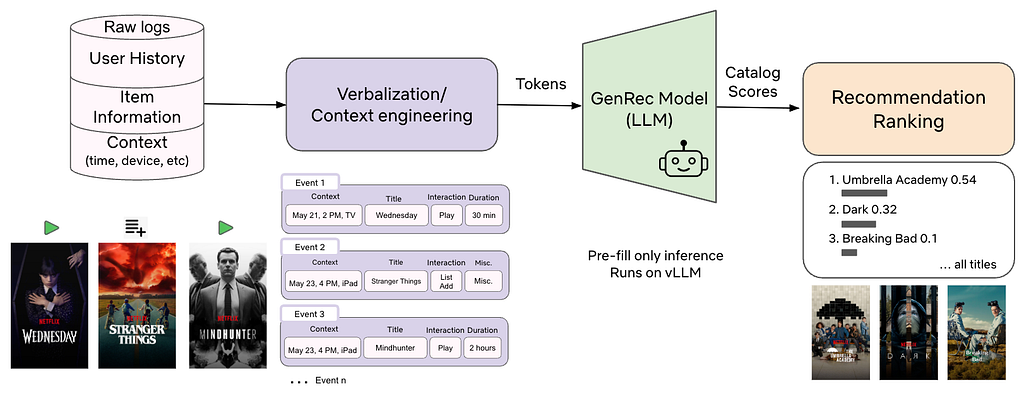
- Understand how verbalization replaces feature engineering in LLM-native recommendation
- Analyze the trade-offs between quality, cost, and scalability in LLM-backed recommenders
- Evaluate what "LLM-native recommendation" means as a broader paradigm shift
Step-by-Step Study Material
Step 1: The Problem — Why Traditional Recommenders Struggle
What exists today
Traditional recommendation systems like Netflix's production ranker are built on:
Traditional Stack Components:
├── Thousands of hand-crafted features
│   ├── User features (age, location, preferences)
│   ├── Item features (genre, duration, language)
│   └── Interaction features (watch history, ratings)
├── Specialized architectures
│   ├── Two-tower models
│   ├── DLRM-style networks
│   └── Custom attention blocks
└── Task-specific pipelines per surface/content type
The core pain points
| Problem | Consequence |
|---|---|
| Thousands of engineered features | Expensive to maintain |
| Custom architecture per task | Hard to scale to new content types |
| Heavy feature infrastructure | Slow to onboard new use cases |
| Sparse ID-based representations | Diminishing returns at scale |
Key Insight: Adding a new content type (e.g., podcasts) could require feature engineering, architecture changes, infrastructure work, AND experimentation — all from scratch.
Step 2: Why LLMs Are Attractive for Recommendation
What LLMs bring to the table
LLMs offer capabilities that traditional recommenders lack:
LLM Strengths for Recommendation:
├── Broad world knowledge (understands content relationships)
├── Strong language understanding (interprets metadata naturally)
├── Shared semantic space (represents users + items together)
└── Natural-language steering (prompts can guide behavior)
But off-the-shelf LLMs fail as recommenders
Simply using a general-purpose LLM doesn't work because:
- ❌ Popularity bias — over-recommends globally popular content
- ❌ Hallucination — suggests items not in the catalog
- ❌ No business awareness — ignores content balance requirements
- ❌ Limited personalization — doesn't know your specific users
The Gap: Raw LLMs have the right capabilities but lack the domain alignment needed for production recommendation.
Step 3: GenRec's Core Idea
The solution in one sentence
GenRec post-trains an internal Netflix foundation LLM on Netflix-specific data and objectives, adding a catalog-aware ranking head to produce personalized recommendations.
Formal task definition
Input:  (u, τ, t, H)
         │   │  │  └── Interaction history
         │   │  └───── Time
         │   └──────── Context (device, surface, locale)
         └──────────── User

Output: π (ranking over catalog C)
         └── π(i) = position assigned to item i

Optimized for: Long-term member utility (not just clicks)
Step 4: The Two-Phase Training Framework
This is the architectural heart of GenRec. Think of it as general → specific.
Phase 1: Foundation Adaptation
┌─────────────────────────────────────────┐
│  Open-Source LLM                        │
│         ↓                               │
│  Train on Netflix proprietary corpora   │
│         ↓                               │
│  Netflix-aware backbone                 │
│  (updated infrequently, shared widely)  │
└─────────────────────────────────────────┘
              ↓
Phase 2: Ranking Specialization
┌─────────────────────────────────────────┐
│  Netflix-aware backbone                 │
│         ↓                               │
│  Post-train on ranking-specific data    │
│  + ranking objectives                   │
│         ↓                               │
│  GenRec: production-ready ranker        │
└─────────────────────────────────────────┘
Why two phases?
| Phase | Purpose | Update Frequency |
|---|---|---|
| Phase 1 | General Netflix knowledge | Infrequent (shared backbone) |
| Phase 2 | Ranking-specific behavior | More frequent (task-specific) |
Analogy: Phase 1 is like a medical school education (broad foundation). Phase 2 is like a residency in cardiology (specialized application).
Step 5: Verbalization — Replacing Features with Language
The paradigm shift
Traditional systems convert user behavior into dense numerical vectors.
GenRec converts user behavior into natural language text.
Traditional Approach:
User History → [0.82, 0.14, 0.67, ...] → Model

GenRec Approach:
User History → "User watched Stranger Things for 45 min,
                gave Squid Game a thumbs up, added
                The Crown to their list..." → LLM
What gets verbalized
Netflix generates hundreds of billions of interaction events:
Interaction Types:
├── Views and plays
├── Watch duration
├── Thumbs up / thumbs down
├── Add to list
└── Abandons (stopped watching early)
These are converted into single-turn or multi-turn conversations between a simulated user and recommender.
Each conversation turn contains:
- User message: Verbalized history + context
- Assistant message: Recommendation response
Important: At inference time, the model does NOT generate assistant messages. The conversational format is only used during training to support the language modeling objective.
Step 6: Context Engineering — The New Feature Engineering
The token budget problem
Verbalizing everything is impractical at Netflix scale. The context window becomes the new "feature budget."
Naive Verbalization:
All history → Exceeds token limit → Too expensive ❌

Context Engineering:
Selective history → Fits token budget → Efficient ✅
Context engineering strategies
Context Engineering Toolkit:
├── Prioritization
│   └── Recent + high-signal interactions first
├── Compression
│   └── Summarize or drop older history
├── Prompt Structure
│   └── Maximize shared prefixes for caching
└── Goal: Compact, high-information prompt
The verbalization compaction finding
Experiments showed context tokens could be reduced to ~⅓ of original budget with negligible quality degradation, yielding a similar reduction in serving cost.
This is a critical result: careful context design preserves quality while dramatically cutting cost.
Step 7: Multi-Objective Training Loss
GenRec is trained with three combined objectives:
Total Loss = Ranking Loss (weighted) + LM Loss + Alignment

     ┌─────────────────────────────────────────────┐
     │  1. RANKING OBJECTIVE (Primary)             │
     │  Cross-entropy loss over catalog             │
     │  Positives = high-value engagements          │
     │  (long plays, strong explicit feedback)      │
     └─────────────────────────────────────────────┘
                        +
     ┌─────────────────────────────────────────────┐
     │  2. LANGUAGE MODELING OBJECTIVE             │
     │  Next-token prediction over verbalized text  │
     │  Preserves language understanding            │
     │  Enables future text-generation use cases    │
     └─────────────────────────────────────────────┘
                        +
     ┌─────────────────────────────────────────────┐
     │  3. REWARD-WEIGHTED ALIGNMENT               │
     │  Scale ranking loss by reward signal         │
     │  High-value engagement → larger weight       │
     │  Low-value engagement → smaller weight       │
     └─────────────────────────────────────────────┘
Why reward weighting?
Without alignment, the model might:
- Over-favor binge-watching behavior
- Focus too heavily on one content type
- Optimize for clicks rather than satisfaction
Reward signals come from two types of separate reward models:
- Long-term satisfaction signals (retention, member utility)
- Business constraint signals (content type balance)
Why not full RL? Reward-weighted training is simpler and cheaper than full reinforcement learning (e.g., GRPO). GenRec uses this as a practical middle ground, noting RL-style methods show additional gains but at higher cost.
Step 8: Architecture — The Catalog-Aware Ranking Head
Architecture Overview:

Input: Verbalized context (text)
         ↓
┌─────────────────────────┐
│  Decoder-only           │
│  Transformer backbone   │  ← From Phase 1
│  (next-token prediction)│
└─────────────────────────┘
         ↓
┌─────────────────────────┐
│  Catalog-aware          │
│  Ranking Head           │  ← Scores only in-catalog items
│                         │
│  Item Embeddings        │  ← Jointly trained
└─────────────────────────┘
         ↓
Output: Ranked list of Netflix catalog items
Key design choices
| Choice | Reason |
|---|---|
| Decoder-only Transformer | Follows foundation LLM architecture |
| Catalog-aware head | Prevents hallucination of out-of-catalog items |
| Joint training of all parameters | End-to-end optimization |
| Sampled softmax for large catalogs | Efficient training/inference at scale |
Step 9: Serving at Scale
The cost drivers
Serving Cost ∝ Model Size × Context Length × Inference Mode
Three cost control strategies
Strategy 1: Prefill-only inference
  → No autoregressive decoding needed
  → Much faster than text generation

Strategy 2: Prefix caching
  → Shared prompt prefixes cached and reused
  → Reduces redundant computation

Strategy 3: Context compression
  → Reduce tokens to ~⅓ with negligible quality loss
  → Direct proportional cost reduction
Infrastructure note: GenRec is served using vLLM on Netflix's internal LLM stack — the same infrastructure used for general LLM serving, not a custom RecSys stack.
Step 10: Results — Does It Actually Work?
Offline results
GenRec vs. Production Ranker (Offline):

Training data used:  ~40× FEWER labeled examples
MRR improvement:     +1.6%
Trend:               Metrics continue improving with more data
Online A/B test results
Test scope:    ~10% of Netflix traffic
Duration:      ~4 weeks
Surfaces:      Batch-compute recommendation surfaces
Configuration: Low-data, low-signal (conservative setup)

Result: Statistically significant gains on BOTH
        ├── Short-term online metrics
        └── Long-term online metrics
The headline finding: GenRec matches or exceeds a mature production system that took years to build, using far fewer labels and input signals.
Step 11: The Broader Paradigm Shift
This is the "so what" — what GenRec signals about the future of recommendation systems.
Five dimensions of change
1. FEATURE ENGINEERING → CONTEXT ENGINEERING
   Old: Design features manually
   New: Decide what signals to include in the prompt

2. TASK-SPECIFIC ARCHITECTURES → SHARED BACKBONE
   Old: Custom model per task
   New: One foundation model, differentiated by data + objectives

3. SPARSE ID REPRESENTATIONS → SCALING LAWS
   Old: Diminishing returns from more data
   New: More data + larger models = consistent improvement

4. CUSTOM RECSY INFRA → LLM INFRA
   Old: MLP/factorization-based serving stacks
   New: GPU-accelerated, vLLM/Triton-based serving

5. MANUAL STEERING → NATURAL LANGUAGE STEERING
   Old: Hard-coded business rules
   New: Natural language prompts guide behavior
Summary comparison table
| Dimension | Traditional RecSys | LLM-Native RecSys |
|---|---|---|
| Input representation | Dense features/embeddings | Verbalized text |
| Architecture | Task-specific | Shared backbone |
| Scaling behavior | Diminishing returns | Follows scaling laws |
| Business alignment | Hard-coded rules | Reward-weighted training |
| Infrastructure | Custom MLPs/factorization | LLM serving stack |
| Onboarding new tasks | High engineering cost | Context + objective design |
Concept Map: GenRec at a Glance
                    ┌─────────────────┐
                    │   User Request  │
                    │  (u, τ, t, H)   │
                    └────────┬────────┘
                             │
                    ┌────────▼────────┐
                    │  VERBALIZATION  │◄── Context Engineering
                    │  (History →     │    (prioritize, compress,
                    │   Natural Text) │     cache prefixes)
                    └────────┬────────┘
                             │
              ┌──────────────▼──────────────┐
              │     GENREC MODEL            │
              │  ┌─────────────────────┐    │
              │  │  Phase 1 Backbone   │    │
              │  │  (Netflix-aware LLM)│    │
              │  └──────────┬──────────┘    │
              │             │               │
              │  ┌──────────▼──────────┐    │
              │  │  Catalog-aware      │    │
              │  │  Ranking Head       │    │
              │  └──────────┬──────────┘    │
              └─────────────┼───────────────┘
                            │
                   ┌────────▼────────┐
                   │  RANKED OUTPUT  │
                   │  (in-catalog    │
                   │   items only)   │
                   └─────────────────┘

Training Objectives:
  ├── Ranking Loss (cross-entropy)
  ├── Language Modeling Loss
  └── Reward Weighting (alignment)
Quick Review Questions
Test your understanding:
-
Why can't you just use an off-the-shelf LLM as a recommender?
It hallucinate items, ignores business constraints, has popularity bias, and lacks personalization.
-
What problem does the catalog-aware ranking head solve?
It constrains outputs to only in-catalog Netflix items, preventing hallucination.
-
What is "context engineering" and why does it matter?
It's the process of selecting, compressing, and structuring user history within a token budget — the LLM equivalent of feature engineering.
-
Why use reward-weighted training instead of full RL?
It's simpler and more cost-efficient while still providing effective alignment to long-term satisfaction and business goals.
-
What does the 40× data efficiency result tell us?
The LLM backbone's pre-existing world knowledge and language understanding compensates for less task-specific labeled data.