After studying this material, you should be able to:
- Explain why traditional multi-stage recommender pipelines have limitations
- Describe how GenPage reframes homepage construction as a generative sequence problem
- Understand the tokenization strategy, training pipeline, and inference techniques used
- Analyze the trade-offs between different design choices (WBC vs RL, prompt enrichment vs scaling)
- Evaluate the real-world results and what they imply for future recommender systems
Step-by-Step Study Material
Step 1: The Problem — Why Homepage Construction Is Hard
What a Netflix Homepage Actually Is
Before understanding GenPage, you need to appreciate the complexity of what is being built.
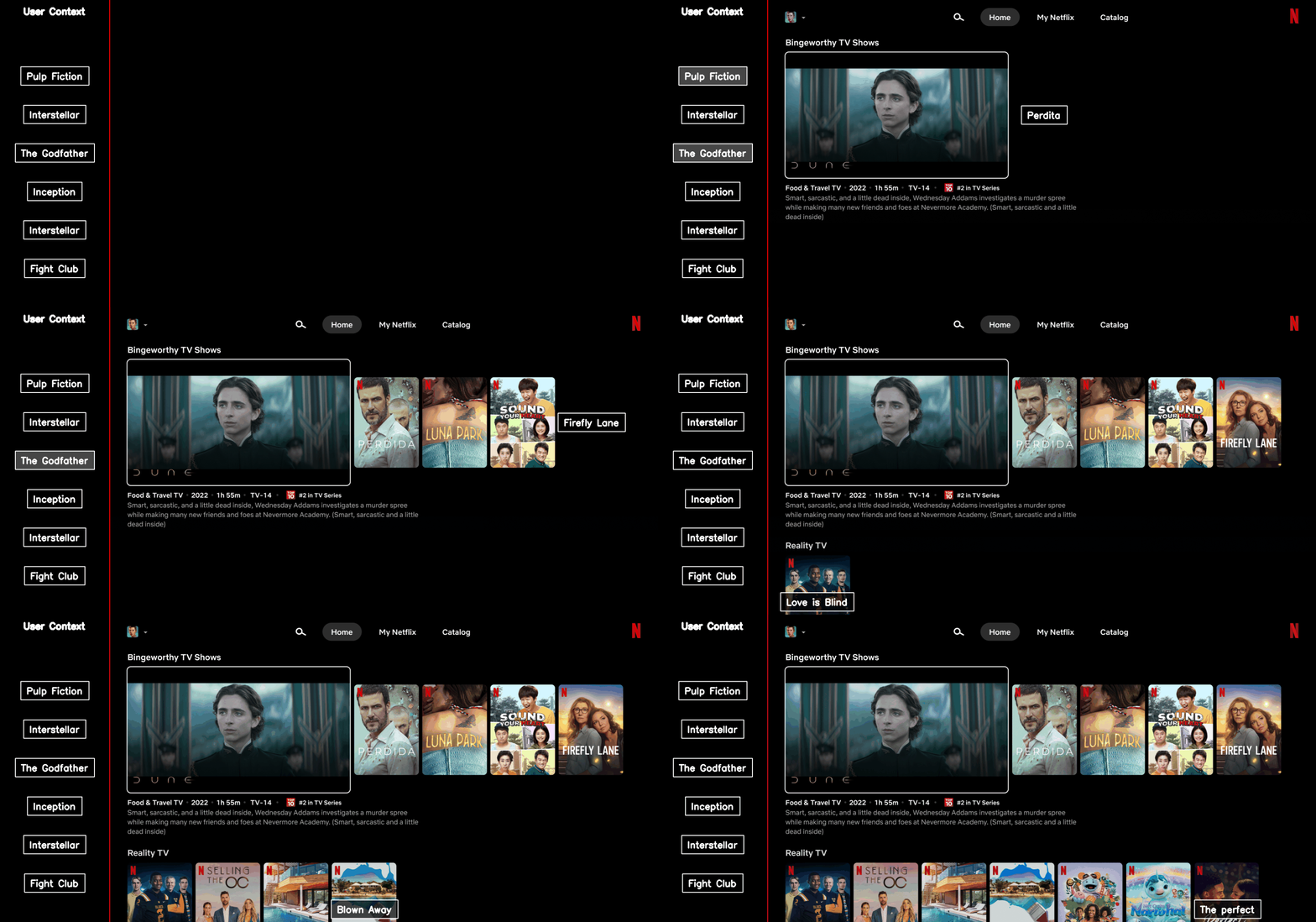
A Netflix homepage is not a simple ranked list. It is a two-dimensional structured layout:
Row 1: [Show A] [Show B] [Show C] [Show D] ...
Row 2: [Movie X] [Movie Y] [Movie Z] ...
Row 3: [Game 1] [Game 2] [Game 3] ...
Every decision is interconnected:
- Which rows appear
- What order the rows are in
- Which entities appear within each row
- How everything is arranged together
Key insight: Choosing Show A for Row 1 affects what makes sense for Row 2. These decisions are not independent.
The Traditional Approach and Its Limitations
The old approach used a multi-stage pipeline:
Stage 1: Candidate Generation (rows)
    ↓
Stage 2: Row Ranking
    ↓
Stage 3: Candidate Generation (entities per row)
    ↓
Stage 4: Entity Ranking
    ↓
Final Homepage
Problems with this approach:
| Problem | Explanation |
|---|---|
| Isolated optimization | Each stage optimizes locally, not for the whole page |
| Complex engineering | Many separate components to build and maintain |
| No holistic view | No single component sees the full picture |
| High latency | Multiple sequential stages add up |
Step 2: The Core Idea — Reframing as a Generative Problem
The LLM Inspiration
Large language models (LLMs) showed the world that a single model can perform diverse tasks by simply generating a response to a prompt:
Prompt → [Transformer Model] → Response
GenPage borrows this exact paradigm:
User Context (prompt) → [GenPage Transformer] → Full Homepage (response)
The model answers one question:
"Given everything we know about this user and this request, what homepage should we generate to maximize user satisfaction?"
Why This Is Powerful
Instead of many specialized components, you have one model that:
- Sees the full context
- Generates rows and entities together
- Can optimize the page as a whole
- Learns relationships between decisions
Analogy: Think of the difference between a committee of specialists each writing one paragraph of a report versus one expert writing the whole report with full awareness of every section.
Step 3: Tokenization — Teaching the Model a New Language
Why Custom Tokenization?
LLMs use text tokenizers. Netflix homepage data is not text. It includes:
- User watch history
- Timestamps
- Shows, movies, games
- Row categories
- Device types
Using a generic text tokenizer would be inefficient and lose structure. GenPage builds a domain-specific tokenizer.
What Gets Tokenized
Everything is converted into a single sequence of discrete tokens:
[Context Tokens] → [Page Tokens]
     ↑                   ↑
  Input (prompt)    Output (response)
Context Tokens (the prompt)
Three categories of information:
1. User History Tokens
Each action includes:
- Action type (play, thumbs-up, trailer view, add to list)
- Entity ID (which show/movie)
- Timestamp (when)
- Duration (how long)
2. User Profile Tokens
- Language preference
- Profile type (adult, child, etc.)
3. Request Context Tokens
- Time of day
- Day of week
- Device type
Page Tokens (the response)
The homepage is serialized left to right, top to bottom:
[Row1_Token] [EntityA_Token] [EntityB_Token] [EntityC_Token]
[Row2_Token] [EntityX_Token] [EntityY_Token] [EntityZ_Token]
...
Key design choice: Each entity and each row is represented as exactly one token. This simplifies everything downstream, especially business rule enforcement.
Handling Special Cases
| Challenge | Solution |
|---|---|
| Long user history | Summarized/compressed representation |
| Continuous values (timestamps) | Bucketized into discrete ranges |
| New entities (cold start) | Fallback tokens + semantic embedding fusion |
| Distinguishing data sources | Special separator tokens |
Step 4: The Training Pipeline — Pretraining Then Post-Training
GenPage mirrors the LLM training recipe exactly:
Step 1: Pretraining (learn the "language" of Netflix homepages)
    ↓
Step 2: Post-Training (align with user satisfaction)
         ├── Option A: Weighted Binary Classification (WBC)
         └── Option B: Reinforcement Learning (RL)
Stage 1: Pretraining
Objective: Next-token prediction
Given context tokens and a partial page, predict the next token:
[User History] [Row1] [EntityA] [EntityB] → predict [EntityC]
Training data: Homepage impressions that received positive user feedback in production.
What this teaches: The model learns the relationship between user contexts and successful homepages. It learns to imitate the existing production system.
Limitation: It only imitates. It does not directly optimize for how much reward a page generates.
Stage 2A: Post-Training with Weighted Binary Classification (WBC)
The core idea: Turn generation into value prediction at the token level.
For every entity that was shown to a user:
- The reward system assigns a scalar reward based on actual user behavior
- Convert reward to a binary label (positive engagement vs. abandonment)
- Use reward magnitude as a weight (binge-watching = high weight, 10-minute watch = low weight)
- Train the model to predict this label for each token
Reward → Binary Label (sign) + Weight (magnitude)
       → Weighted Binary Cross-Entropy Loss
At inference time: The model scores candidate tokens, greedily picks the highest-value token, and repeats until the full page is generated.
Advantages of WBC:
- Simpler to optimize than RL
- Clear credit assignment (each token has a direct reward)
- Aligns with existing production ranking objectives
Limitation: Optimizes token by token, not the page as a whole.
Stage 2B: Post-Training with Reinforcement Learning (RL)
The core idea: Treat homepage generation as a sequential decision-making problem and optimize the page-level reward.
This is inspired by RLHF (Reinforcement Learning from Human Feedback) used to align LLMs.
Two-step process:
Step 1: Train a Reward Model
        Input: Generated homepage
        Output: Predicted page-level reward
        (This predicts reward without showing the page to real users)

Step 2: Use RL to optimize the policy
        Algorithm: Dr. GRPO (a variant of GRPO)
        Constraint: KL penalty to stay close to pretrained checkpoint
                    (prevents reward hacking)
Why the KL penalty? The reward model is only reliable for pages similar to what the production system generates. Straying too far risks the model finding ways to "trick" the reward model (reward hacking).
Advantages of RL over WBC:
| Capability | WBC | RL |
|---|---|---|
| Page-level optimization | ✗ | ✓ |
| Captures row-entity interactions | Partial | ✓ |
| Test-time reasoning | ✗ | ✓ |
| Multi-token entity representations | ✗ | ✓ |
Step 5: Key Engineering Challenges and Solutions
Challenge 1: Entity Cold Start
Problem: New shows/movies have no interaction data, so their token embeddings are weak.
Two solutions:
- Semantic Embedding Fusion: Use content-based embeddings (from metadata, descriptions) to initialize new entity representations
- Fallback Tokens: Special tokens like
[Entity_Fallback_Token]that the model learns to handle gracefully
During training, known tokens are randomly replaced with fallback tokens, teaching the model to work even when it encounters unknowns.
Challenge 2: Model Freshness
Problem: Daily retraining from scratch is too expensive, but the model must stay current with new content and trends.
Solution: Multi-Cadence Incremental Training
[Full Pretraining + Post-Training]  ← runs periodically (e.g., weekly)
         ↓
[Daily Incremental Update]          ← continues from previous checkpoint
         ↓                            using latest day's data + sampled past data
[Daily Incremental Update]
         ↓
...
[Full Pretraining + Post-Training]  ← next full cycle
This balances:
- Freshness (daily updates capture new trends)
- Stability (mixing past data prevents catastrophic forgetting)
Challenge 3: Business Rule Enforcement
Problem: The homepage must satisfy strict rules:
- Structural rules (organized as rows)
- Deduplication (no repeated entities)
- Row pinning (certain rows must appear at fixed positions)
- Category consistency (Comedy row must contain comedies)
Solution: Constrained Decoding
At each generation step, compute a mask of eligible tokens based on business rules and apply it to the output logits:
Raw Logits: [0.9, 0.7, 0.8, 0.6, ...]
Rule Mask:  [  1,   0,   1,   1, ...]  ← 0 = rule violation
Masked:     [0.9,  -∞, 0.8, 0.6, ...]
Only rule-compliant tokens can be selected.
Why custom tokenization helps here: Because each entity is a single token, business rules map directly to token masks. No complex multi-token bookkeeping needed.
Challenge 4: Serving Latency
Problem: Autoregressive generation (one token at a time) can be slow, especially for long rows.
Solution: Hybrid Row Decoding
For each row:
  Step 1: Autoregressively generate the FIRST FEW entities
          (these matter most — users see them first)

  Step 2: In ONE forward pass, score ALL remaining eligible entities
          and select the top-scoring ones
This preserves quality where it matters (row beginning) while dramatically reducing the number of decoding steps.
Challenge 5: In-Session Personalization
Problem: User preferences change during a browsing session. The model needs to respond to what the user just did.
Solution: Incremental Generation with Real-Time Context
Initial Request:
[Long-term history] → Generate Rows 1-3

User scrolls, watches trailer for Action movie...

Next Request:
[Long-term history] + [Rows 1-3 tokens] + [Latest in-session actions] → Generate Rows 4-6
The model naturally attends to timestamps, so recent actions have more influence and fade back to long-term preferences over time.
Step 6: Results and Key Findings
Online A/B Test Results
GenPage was tested against a mature, highly optimized production system:
| Metric | Result |
|---|---|
| Core user engagement | Statistically significant improvement (p < 0.001) |
| End-to-end serving latency | 20% reduction |
Counterintuitive finding: A generative model was faster than the multi-stage pipeline it replaced, because it eliminated multiple ranking stages and heavy feature computation.
Offline Finding 1: Prompt Enrichment > Model Scaling
This is one of the most important practical takeaways:
Model size: 120M → 900M parameters (~7.5× increase)
WBC loss reduction: ~1.3%

Context enrichment (adding/improving data sources):
WBC loss reduction: ~6.9%
Interpretation: In their current regime, the model is information-bottlenecked, not capacity-bottlenecked. Adding better information to the prompt is more valuable than making the model bigger.
Practical implication: Before scaling your model, ask whether you are giving it the right information.
The expected progression:
Early stage:  Context enrichment dominates
              (model can't use what it doesn't see)

Later stage:  Model capacity dominates
              (context is saturated, need more parameters to extract value)
Offline Finding 2: RL Increases Diversity Without Being Told To
During RL training, homepage diversity increased even though diversity was never part of the reward function.
Why this matters: It suggests RL is genuinely optimizing the page as a whole. A page with diverse content tends to satisfy more users than a page that myopically repeats the same type of content. The model discovered this on its own.
This is evidence that page-level optimization captures interactions between rows and entities that token-level optimization (WBC) misses.
Step 7: Synthesis — The Big Picture
What GenPage Represents
Traditional Approach:          GenPage Approach:
┌─────────────────┐            ┌─────────────────────────────┐
│ Candidate Gen   │            │                             │
├─────────────────┤            │   Single Transformer        │
│ Row Ranking     │    →→→     │                             │
├─────────────────┤            │   Prompt → Homepage         │
│ Entity Ranking  │            │                             │
├─────────────────┤            └─────────────────────────────┘
│ Business Rules  │
└─────────────────┘
The Design Principles That Made It Work
| Principle | Implementation |
|---|---|
| Treat homepage as a sequence | Custom tokenization |
| Learn before aligning | Pretrain then post-train |
| Optimize what matters | WBC for entity-level, RL for page-level |
| Handle the real world | Cold start, freshness, business rules, latency |
| Measure what matters | Reward system tied to long-term satisfaction |
What Is Still Unfinished
The authors are honest about remaining gaps:
- Long context still relies on handcrafted summarization (not fully end-to-end)
- Language, multimodality, and reasoning from LLMs not yet incorporated
- Unintended category distribution shifts need investigation
- Reward system alignment with the new generative paradigm is ongoing
Quick Reference Summary
GenPage in One Paragraph:
─────────────────────────
GenPage treats Netflix homepage construction as a language modeling
problem. User history and context become a tokenized prompt. A
decoder-only transformer autoregressively generates the full homepage
— rows and entities together — as the response. Training follows the
LLM recipe: next-token-prediction pretraining teaches the model the
"language" of successful homepages, then WBC or RL post-training
aligns outputs with user satisfaction. Custom tokenization enables
efficient serving, constrained decoding enforces business rules,
hybrid row decoding reduces latency, and multi-cadence incremental
training keeps the model fresh. In production, GenPage improved
engagement and cut latency by 20%.
Self-Check Questions
Test your understanding:
- Why is homepage construction harder than producing a single ranked list?
- What is the role of pretraining vs. post-training in GenPage?
- Why does custom tokenization make constrained decoding simpler?
- What is the difference between the reward system and the reward model?
- Why does WBC provide easier credit assignment than RL?
- What does the finding "prompt enrichment > model scaling" imply for practitioners?
- Why did RL increase diversity even without diversity in the objective?
- How does hybrid row decoding balance quality and latency?