Learning Outcomes
After studying this material, you should be able to:
- Define what SOPs are and explain why they matter in business operations
- Explain why SOPs are difficult for AI agents to execute
- Identify the limitations of existing AI agent benchmarks
- Describe what SOP-Bench is, how it was built, and what makes it different
- Analyze the key experimental findings and their practical implications
- Apply these insights to real-world decisions about deploying AI agents
Step 1: Understanding SOPs (The Foundation)
What is an SOP?
A Standard Operating Procedure (SOP) is a written set of steps an organization follows to complete routine work consistently and correctly every time.
Think of it as an organization's institutional memory written down.
Where SOPs Are Used
| Industry | Example SOP |
|---|---|
| Healthcare | Registering a new patient |
| Logistics | Classifying hazardous shipments |
| Banking | Verifying new business customers |
| Trust & Safety | Deciding whether to remove content |
Why SOPs Matter
SOPs serve three critical functions:
- ✅ Carry compliance rules — legal and regulatory requirements
- ✅ Encode decision logic — how to handle edge cases
- ✅ Preserve institutional knowledge — what experienced workers know
Key insight: SOPs keep operations consistent across different employees, shifts, and locations.
Step 2: Why SOPs Are Hard for AI Agents
The Hidden Complexity Problem
SOPs look cleaner than they actually are. This is the core challenge.
A real SOP requires three things that are never fully written down:
1. Interpreting instructions that were never fully spelled out
2. Drawing on shared domain knowledge (assumed background)
3. Making judgment calls as conditions change
Concrete Example: Patient Intake Procedure
Consider steps 4 and 6 of a hospital intake SOP — both say "verify the patient's insurance" without explaining how or why it appears twice.
A human expert knows:
- Step 4 = Confirm coverage with the insurer
- Step 6 = Confirm patient data is correctly entered into the hospital's management system
An AI agent faces three simultaneous challenges:
| Challenge | What It Means |
|---|---|
| Ambiguous instruction | "Verify" means two different things |
| Memory requirement | Must remember what it already did |
| Tool selection | Must choose between tools that look nearly identical |
Critical point: This is where "polished demo behavior quietly falls apart" — AI looks capable in simple tests but fails on real procedures.
Step 3: Why Existing Benchmarks Fall Short
What Current Benchmarks Test (In Isolation)
Most benchmarks test one skill at a time with clean, machine-formatted prompts:
- Some test: Can the model pick the right API?
- Some test: Can it follow written constraints?
- Some test: Can it plan a sequence of steps?
The Problem
Real SOP execution requires all of these simultaneously, plus:
- Using multiple tools in a coordinated way
- Managing dependencies between steps
- Tracking what has already happened
- Recovering when something goes wrong
The Gap in Previous Approaches
| Previous Approach | Limitation |
|---|---|
| Translate SOPs into executable workflows | Only short descriptions, narrow domains, datasets not public |
| Publish real business procedures | No tools, no ground-truth answers — can't actually test agents |
The gap: No benchmark combined realistic procedures + working tools + ground-truth answers — until SOP-Bench.
Step 4: What SOP-Bench Is and How It Works
Core Definition
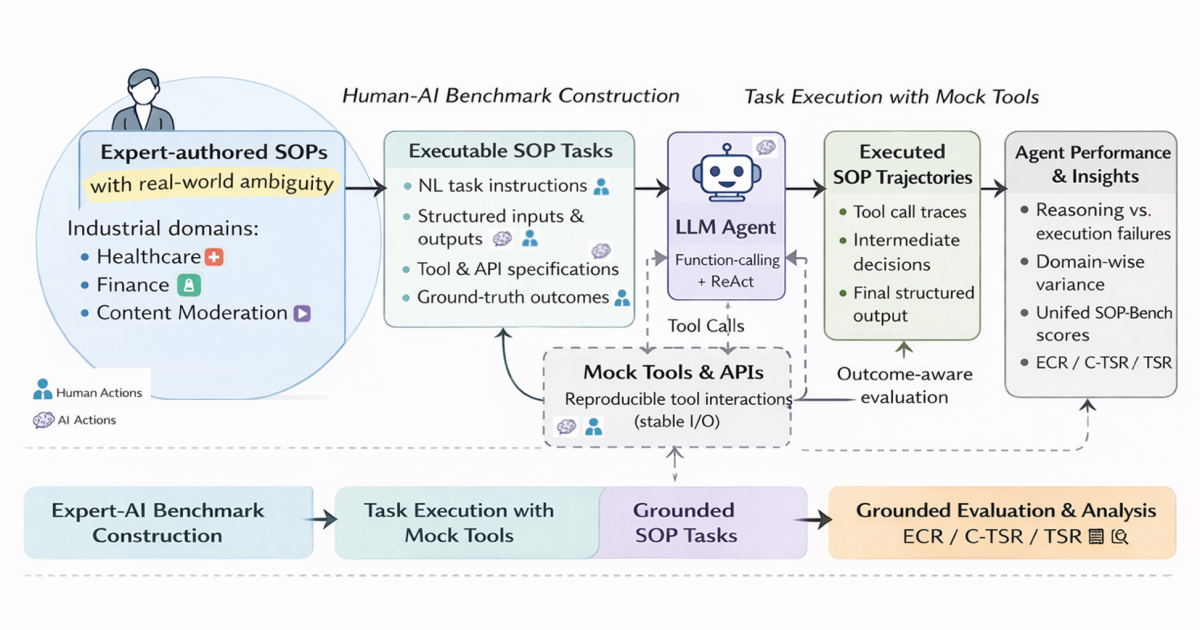
SOP-Bench is an openly available benchmark that measures how well AI agents carry out real SOPs authored by domain experts.
What Makes It Different (Three Key Innovations)
1. REAL procedures — ambiguity left in, not cleaned up
2. WORKING tools — agents actually call APIs, not just describe what they'd do
3. GROUND TRUTH — scored against correct answers, not a model's opinion
Scale and Coverage
- 12 business areas including:
- Healthcare intake
- Dangerous-goods classification
- Customer service
- Content moderation
- Financial compliance
- Warehouse inspection
- 2,000+ tasks in total
The Structure of Each Task
Every procedure in SOP-Bench has exactly four components:
┌─────────────────────────────────────┐
│  1. The SOP text                    │
│  2. The tools an agent can call     │
│  3. Specifications for those tools  │
│  4. Test cases with known answers   │
└─────────────────────────────────────┘
How It Was Built: Human + AI Collaboration
The construction process used a deliberate division of labor:
Domain experts contributed:
- Authored original procedures from real industrial workflows
- Set context for each task
- Verified all generated content
- Confirmed logic, checked data, ran code
AI (Claude 3.5 Sonnet v2) contributed:
- Converted procedures into machine-runnable format
- Generated data schemas
- Created mock APIs and tool specifications
- Generated datasets mixing ordinary cases with edge cases
Important: No proprietary or sensitive data was used at any stage.
Step 5: Key Experimental Findings
The researchers tested two agent designs across 11 frontier models. Here are the four major findings:
Finding 1: Newer Is Not Automatically Better ⚠️
What happened: Upgrading to a newer model version sometimes lowered performance.
- Claude 4.5 family scored lower than Claude 4 family on the reasoning-style agent
- The same reversal appeared in individual model comparisons
Practical implication:
A routine model upgrade can silently lower your success rate. The only reliable way to catch this is to test on your actual procedures before deploying.
Finding 2: More Tools Can Make an Agent Worse 🔧
The experiment:
- Condition A: Agent given exactly 6 tools the task required
- Condition B: Agent given those 6 tools + 20 extra plausible-looking but useless tools
Result: Success rate nearly halved with the larger toolkit.
Practical implication:
Trimming an agent's tools to fit the specific task may be a key component of deployment readiness. Capability is not free.
Finding 3: No Single Setup Wins Everywhere 📊
Performance varied dramatically across procedures:
| Procedure Type | Approximate Success Rate |
|---|---|
| Easiest (e.g., triaging emails by intent) | ~90% |
| Hardest (e.g., annotating objects in driving video) | ~25% |
Gap: More than 3x difference across the benchmark suite.
Practical implication:
A single benchmark score tells you almost nothing about how an agent will perform on your specific use case. Test on your actual procedures.
Finding 4: Agent Architecture Matters As Much As Model Choice 🏗️
Comparison: Function-calling agent vs. Reasoning-style agent
| Factor | Result |
|---|---|
| Overall average | Reasoning-style agent slightly ahead |
| Head-to-head wins | Reasoning won only 8 of 13 procedure runs |
| Speed | Reasoning agent took ~33% longer per task |
Practical implication:
The shape of the procedure — not a single overall average — should drive your agent architecture choice.
Bonus Finding: An Open Question About Complexity
Counterintuitive result: A procedure with long reading sections but few decision points performed worse than one packed with many decisions.
- Natural assumption: More decisions = harder
- Observed reality: Longer, simpler-looking procedure scored far worse
This remains an open research question — one SOP-Bench is designed to help investigate.
Step 6: Putting It All Together — The Big Picture
What These Findings Mean Collectively
These results are not a verdict on any single model. They are:
- A map of where the field still needs to invest
- A reminder that raw capability ≠ reliability on procedural work
- A practical tool for identifying steps where human oversight remains essential
The Core Argument in One Diagram
Static skills test
        ↓
Tests one capability at a time
Tests with clean prompts
No ambiguity, no tools, no memory
        ↓
INSUFFICIENT for real deployment

SOP-Bench
        ↓
Tests all capabilities simultaneously
Tests with real ambiguity
Working tools + memory + ground truth
        ↓
NECESSARY for agents alongside human operators
Quick Reference Summary
| Concept | Key Point |
|---|---|
| What is an SOP? | Written steps for consistent, correct execution of routine work |
| Why are SOPs hard for AI? | Ambiguity, assumed knowledge, judgment calls |
| Why do benchmarks fall short? | They isolate single skills with clean prompts |
| What is SOP-Bench? | First benchmark combining real SOPs + working tools + ground truth |
| Finding 1 | Newer model ≠ better performance |
| Finding 2 | More tools can hurt performance |
| Finding 3 | No single setup wins across all procedures |
| Finding 4 | Agent architecture matters as much as model choice |
| Core lesson | Test on your actual procedures before trusting agents in production |
Self-Check Questions
Test your understanding:
- Why does the same instruction ("verify insurance") mean two different things in the patient intake example?
- What three things does an AI agent need to do simultaneously in that scenario?
- What is the fundamental gap that SOP-Bench fills compared to previous benchmarks?
- Why did adding more tools hurt agent performance?
- What should a team do before upgrading their production AI model, based on Finding 1?
- Why is a single benchmark score insufficient for predicting real-world performance?