Step-by-Step Teaching Guide
Step 1: Understanding the Foundation — What is ROS?
Before diving into Isaac ROS, you need to understand what it builds upon.
ROS (Robot Operating System)
- An open source framework created by Open Robotics
- Provides developers with:
- Common tools
- Shared libraries
- Industry standards
- Used to build and connect robot applications
- Has nearly 1.3 million active users worldwide
Think of it this way:
ROS is like an operating system for robots — just as Windows gives your PC a foundation to run apps, ROS gives robots a foundation to run behaviors.
Step 2: What is NVIDIA Isaac ROS?
Isaac ROS is NVIDIA's layer built on top of ROS that adds:
| What ROS Provides | What Isaac ROS Adds |
|---|---|
| Open source tools | GPU-accelerated computing |
| Basic libraries | Physical AI models |
| Community standards | Production-ready libraries |
| Software framework | High-performance processing |
Key Point:
Isaac ROS makes ROS faster and smarter by leveraging NVIDIA's GPU technology — without forcing developers to abandon familiar tools.
Step 3: What is Isaac ROS 5.0 and Why Does It Matter?
Isaac ROS 5.0 is the latest release, announced at ROSCon in Toronto, Canada.
The Core Problem It Solves:
Robots need to:
- Perceive — understand their environment
- Reason — make decisions
- Act — respond in dynamic, real-world conditions
Building software to do all three is complex and time-consuming. Isaac ROS 5.0 addresses this by introducing agentic workflows.
Step 4: Understanding Agentic Workflows — The Big New Idea
What is an AI Agent?
An AI agent is software that can:
- Automate repetitive tasks
- Navigate complex codebases
- Turn developer ideas into working applications faster
How Isaac ROS 5.0 Uses AI Agents:
Think of it as moving from:
"Humans build robots" → "Humans AND AI agents build robots together"
Specific Agentic Features in 5.0:
1. Isaac Skills
- Reusable workflows for setup and manipulation
- Both developers AND AI agents can use them
- Example: Pick-and-place skill connects detection, depth estimation, and pose output automatically
2. Agent-Ready Documentation
- Documentation written so AI agents can understand it
- Converts developer intent into working code faster
3. FoundationStereo Fine-Tuning Skill
- An AI agent helps adapt a stereo perception model to YOUR specific:
- Cameras
- Environment
- Application
- Result: More accurate perception without manual tuning
Step 5: Key Technical Capabilities
5.1 Platform Support
- Now supports ROS Lyrical and Ubuntu 24.04
- Scales from entry-level to high-performance hardware:
Entry Level ──────────────────► High Performance
Jetson Orin Nano              Jetson Thor
5.2 FoundationPose
- A foundation model for object pose estimation and tracking
- Answers the question: "Where is this object, and which way is it facing?"
- Now 5.5x faster with agent-ready inference library
5.3 CUDA Integration
- NVIDIA contributed a standard data-handling interface to ROS Lyrical
- CUDA provides GPU acceleration as a working example
- Available to the entire ROS community, not just NVIDIA users
Step 6: The Broader Ecosystem — Who Is Using It?
Isaac ROS 5.0 is not just a product — it's a platform others build on.
Key Partners and Their Use Cases:
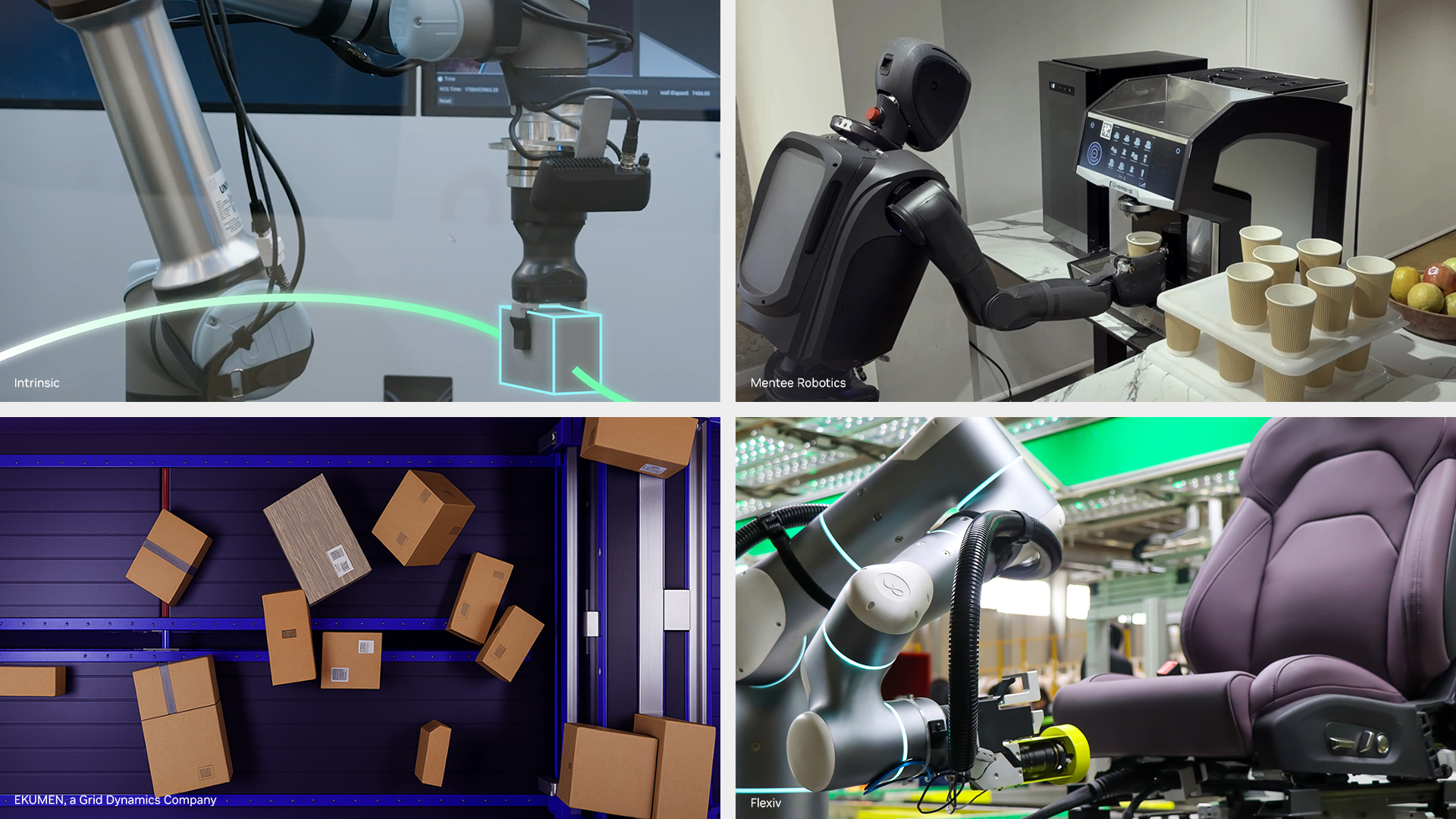
| Company | What They Do With Isaac ROS |
|---|---|
| RealSense (AgenticROS) | Connects Isaac ROS with AI models so agents can interact with ROS robots |
| Intrinsic | Industrial machine tending with automatic object detection and tracking |
| Seeed Studio | Combines perception + motion planning on Jetson Thor for pick-and-place |
| Magna | Manufacturing automation with hardware-in-the-loop testing |
| Universal Robots | Helps robots adapt to imprecisely positioned parts |
| Mentee Robotics | Powers humanoid robot perception and behavior |
| ROBOTIS (TurtleBot3) | Vision-guided manipulation tasks |
| FieldAI | On-robot AI that works without cloud connectivity |
| Ekumen | Maps collision-free paths in 2–5 milliseconds using GPU |
Pattern to Notice:
Every partner uses Isaac ROS to reduce development time and increase robot capability — especially in perception and manipulation tasks.
Step 7: The Physical AI Stack — From Development to Deployment
Isaac ROS 5.0 addresses both sides of the physical AI challenge:
Side 1: Building Capable Applications
- Agentic workflows speed up development
- Pre-built skills reduce repetitive coding
- Foundation models provide ready-to-use AI
Side 2: Running Applications in the Real World
- NVIDIA Jetson platform runs the full stack at the edge
- Real-time performance without cloud dependency
- Scalable from small robots to complex humanoids
The Complete Stack Visualized:
┌─────────────────────────────────┐
│        Robot Application        │
├─────────────────────────────────┤
│     AI Models (FoundationPose,  │
│     FoundationStereo, GR00T)    │
├─────────────────────────────────┤
│   Isaac ROS (Accelerated Libs)  │
├─────────────────────────────────┤
│         ROS Framework           │
├─────────────────────────────────┤
│      NVIDIA Jetson Hardware     │
└─────────────────────────────────┘
Step 8: Summary — Connecting Everything Together
| Concept | Key Takeaway |
|---|---|
| ROS | Open source foundation for robotics |
| Isaac ROS | GPU-accelerated, AI-enhanced layer on top of ROS |
| Isaac ROS 5.0 | Adds agentic workflows to speed up development |
| AI Agents in Robotics | Automate coding tasks, fine-tuning, and setup |
| Foundation Models | Pre-trained AI for perception, pose, and tracking |
| Jetson Platform | Runs the full stack on the physical robot |
| Ecosystem | Dozens of companies extending and validating the platform |
Quick Knowledge Check
Test yourself with these questions:
- What does ROS provide that Isaac ROS builds upon?
- What is an "agentic workflow" and why is it valuable in robotics?
- What does FoundationPose do, and how much faster is it in version 5.0?
- Name two companies using Isaac ROS and explain their specific use case.
- Why is running AI "at the edge" on Jetson important for robots?
Bottom Line: Isaac ROS 5.0 represents a shift where AI agents become co-developers in robotics — reducing complexity, accelerating deployment, and making advanced physical AI accessible to the entire ROS community through free, open source tools.