Step-by-Step Study Material
Step 1: Foundation — What is Inference and Why Does Speed Matter?
What is Inference?
Think of AI model development in two phases:
| Phase | What Happens | Analogy |
|---|---|---|
| Training | Model learns from data | Student studying |
| Inference | Model generates responses | Student taking an exam |
Inference = the moment the AI produces output for the user
Why Speed Matters
When you ask ChatGPT a question, the model generates text token by token (word by word). Faster token generation means:
- ⚡ Quicker responses
- 🔄 More efficient workflows
- 💰 Lower operational costs
Step 2: Understanding the Hardware — NVIDIA Blackwell Architecture
What is Blackwell?
NVIDIA Blackwell is a GPU architecture — essentially the design blueprint of the graphics processing unit chip.
Why GPUs for AI?
CPU (Regular Processor)        GPU (Graphics Processor)
├── Few powerful cores         ├── Thousands of smaller cores
├── Great for sequential tasks ├── Great for parallel tasks
└── Like 1 expert worker       └── Like 1000 workers simultaneously
AI inference requires massive parallel computation → GPUs are ideal
Key Takeaway
NVIDIA Blackwell GPUs are specifically optimized to handle the mathematical operations AI models require, making them significantly faster than general-purpose processors.
Step 3: The Performance Breakthrough — 8x Faster Token Generation
What Does "8x Faster" Actually Mean?
Practical Example:
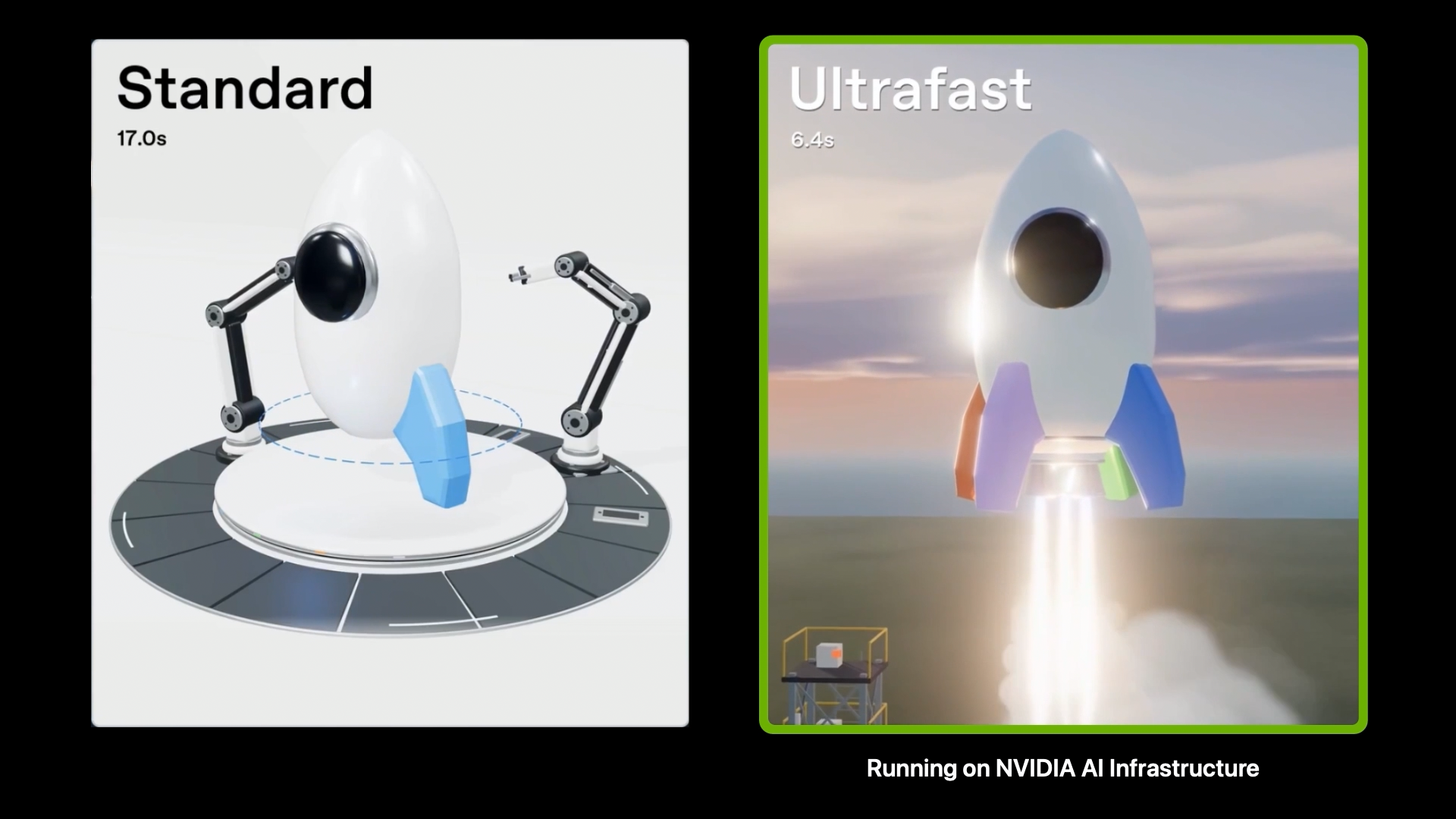
Standard Mode:  ████████████████  → 8 seconds to complete task
Ultrafast Mode: ██               → 1 second to complete same task
How Was This Achieved?
The article mentions inference optimizations — these are technical improvements including:
- Kernel Optimization — Custom low-level code that directly instructs GPU hardware
- Architecture Exploitation — Using Blackwell's specific capabilities to their fullest
- AI-Assisted Improvement — OpenAI used its own models to optimize the inference software
💡 Key Concept: OpenAI's models were used to write better code for running on NVIDIA GPUs — AI improving AI performance
Step 4: Real-World Application — AI Agent Workflows
What is an AI Agent Workflow?
An AI agent doesn't just answer one question — it completes multi-step tasks:
Agent Workflow Loop:
┌─────────────────────────────────────────┐
│  1. Write Code                          │
│       ↓                                 │
│  2. Use a Tool (run code, search web)   │
│       ↓                                 │
│  3. Check Result                        │
│       ↓                                 │
│  4. Decide Next Action                  │
│       ↓                                 │
│  5. Repeat until task complete ←────────┘
└─────────────────────────────────────────┘
Why Speed Multiplies in Loops
This is the critical insight from the article
If each step takes 2 seconds vs 0.25 seconds:
| Steps in Workflow | Standard Mode | Ultrafast Mode | Time Saved |
|---|---|---|---|
| 5 steps | 10 seconds | 1.25 seconds | 8.75 sec |
| 20 steps | 40 seconds | 5 seconds | 35 sec |
| 100 steps | 200 seconds | 25 seconds | 175 sec |
The faster the individual step → the more dramatic the total workflow improvement
Step 5: Programmability — The Long-Term Advantage
What Does "Programmable Platform" Mean?
A programmable GPU platform means developers can:
- ✅ Write custom code (kernels) that directly controls GPU behavior
- ✅ Reuse infrastructure across different tasks
- ✅ Continuously improve performance after deployment
The Continuous Improvement Loop
Deploy Model
     ↓
Use AI models to analyze performance
     ↓
Identify optimization opportunities
     ↓
Write better GPU kernels
     ↓
Deploy improvements → Model gets faster without retraining
     ↑_______________________________________________|
Three Workload Types on One Platform
| Workload | What It Does |
|---|---|
| Training | Teaching the model |
| Inference | Running the model for users |
| Reinforcement Learning | Improving the model through feedback |
Benefit: One flexible infrastructure handles all three → better resource utilization, lower costs
Step 6: Connecting the Concepts — The Big Picture
How Everything Fits Together
NVIDIA Blackwell Architecture
        ↓
Provides programmable, parallel computing power
        ↓
OpenAI writes optimized kernels (using AI to write AI code)
        ↓
Inference becomes 8x faster
        ↓
AI agents complete multi-step workflows dramatically faster
        ↓
Developers build more responsive, capable applications
Summary: Key Concepts to Remember
| Concept | Core Idea |
|---|---|
| GPU Inference | GPUs accelerate AI response generation through parallel processing |
| Blackwell Architecture | NVIDIA's GPU design optimized for AI workloads |
| Token Generation Speed | Faster tokens = faster responses = better user experience |
| Agent Workflows | Speed improvements multiply across repeated steps |
| Programmability | Allows continuous post-deployment performance improvements |
| AI-Assisted Optimization | AI models help optimize the infrastructure running AI models |
Quick Self-Check Questions
- Why are GPUs better than CPUs for AI inference?
- Why does 8x faster token generation have an outsized impact on agent workflows?
- What does it mean that OpenAI used its own models to optimize GPU performance?
- What advantage does a programmable GPU platform provide over a fixed one?
- Name the three workload types that can share a single NVIDIA platform
✅ If you can answer all five questions confidently, you have successfully mastered the learning outcomes for this material.