How AI Makes Bug Triage Faster and More Trustworthy
Step-by-Step Teaching Guide
Step 1: Understanding the Problem First
Before any AI solution makes sense, you must clearly understand what problem existed.
The Manual Bug Triage Problem
Imagine a company receiving thousands of customer bug reports. Each one required an engineer to:
Customer Bug Report
        ↓
Engineer reads investigation
        ↓
Engineer determines root cause
        ↓
Engineer classifies the issue
        ↓
Engineer documents reasoning
        ↓
Work can finally begin
Why This Was Painful
| Problem | Impact |
|---|---|
| Fully manual process | 300+ person-days of effort |
| Relied on individual expertise | Same bug classified differently by different engineers |
| No standardization | Leadership couldn't see clear trends |
| Slow insights | Days of manual analysis for release reports |
Key Insight: The problem wasn't just speed. It was inconsistency and lost institutional knowledge.
Step 2: Understanding Why Simple AI Wasn't Enough
Many teams make this mistake: they assume the newest, largest AI model solves everything.
The LLM Trap
The team initially tried Large Language Models (LLMs). Here's why that failed for this specific task:
What LLMs are GOOD at:          What this task NEEDED:
✓ Reasoning across text         ✓ Deterministic predictions
✓ Generating summaries          ✓ Confidence scores
✓ Flexible responses            ✓ Explainability
✗ Consistent classification     ✓ Consistent classification
✗ Confidence scoring            ✗ Flexible/creative answers
✗ Deterministic behavior
Core Lesson: A deterministic prediction means the system gives the same answer for the same input every time. Bug classification requires this. Creative writing does not.
Quick Knowledge Check
Ask yourself: Why would a customer support system need deterministic behavior rather than creative AI responses?
Answer: Because engineers need to trust and verify predictions. If the AI gives different answers each time, engineers cannot build confidence in the system.
Step 3: The Hybrid AI Architecture Solution
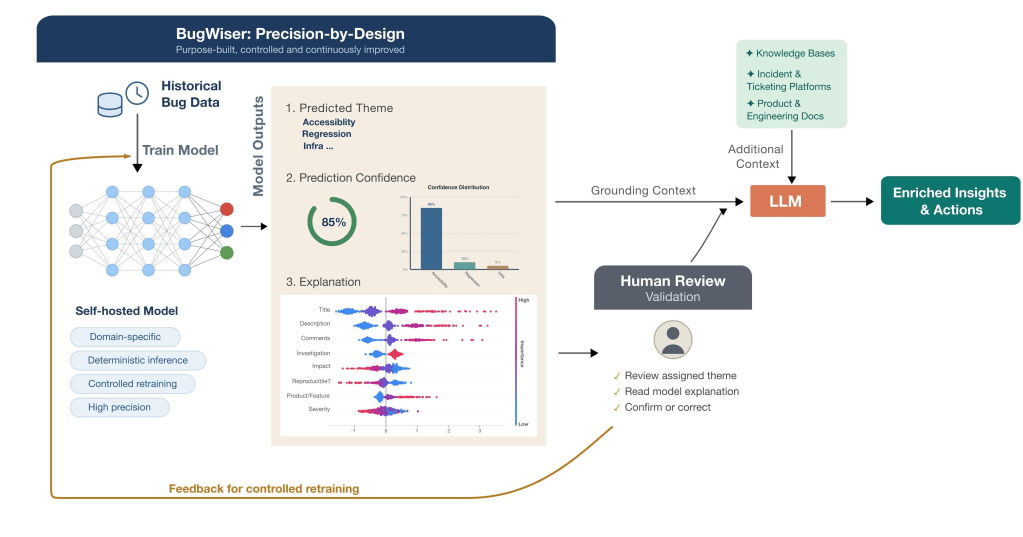
The breakthrough was recognizing that different tasks need different tools.
The Two-Model Architecture
Customer Bug Report
         ↓
┌─────────────────────────────────────────┐
│         CUSTOM ML MODEL                 │
│  • Trained on Salesforce's OWN history  │
│  • Fast, deterministic classification   │
│  • Provides confidence score            │
│  • Explains its reasoning               │
└─────────────────────────────────────────┘
         ↓
┌─────────────────────────────────────────┐
│              LLM (Opus)                 │
│  • Synthesizes engineering context      │
│  • Generates richer summaries           │
│  • Handles unstructured information     │
└─────────────────────────────────────────┘
         ↓
    Engineer receives:
    Classification + Confidence + Summary
Why This Division Makes Sense
Think of it like a hospital:
- The specialist doctor (Custom ML) gives a precise diagnosis based on years of specific medical records
- The medical writer (LLM) translates that diagnosis into a clear report for the patient
Neither replaces the other. Each does what it does best.
Step 4: The "Trust by Design" Principle
This is the most important concept in the article. Building AI that people actually use requires deliberate trust engineering.
The Three Pillars of Trust by Design
Pillar 1: Transparency
Every prediction includes:
├── The classification itself
├── A confidence score (How certain is the AI?)
└── Evidence explanation (Why did it decide this?)
Pillar 2: Human Control
High confidence prediction → Can be auto-accepted
Low confidence prediction  → Requires human review
Engineer disagrees         → Human overrides AI
Pillar 3: Continuous Learning
Engineer correction
        ↓
Becomes new training data
        ↓
Model improves
        ↓
Future predictions get better
        ↓
(Cycle repeats)
Critical Distinction: The goal was NOT to replace engineers. It was to teach the system to think the way engineers already think.
Step 5: How Institutional Knowledge Was Preserved
This step addresses a subtle but powerful concept: encoding human expertise into AI.
The Traditional Knowledge Problem
Expert Engineer retires/leaves
         ↓
Years of judgment disappears
         ↓
New engineers make inconsistent decisions
         ↓
Quality suffers
The BugWiser Solution
Years of historical engineering decisions
         ↓
Used as training data for custom ML model
         ↓
Model learns HOW experts evaluated bugs
         ↓
Expertise is preserved and applied consistently
         ↓
Even when individual experts leave
Analogy to Understand This
Think of it like a master chef's recipe book:
- The chef's judgment is encoded into written recipes
- Any trained cook can now replicate the dish consistently
- The chef's expertise lives beyond any single person
BugWiser did this with engineering judgment at scale.
Step 6: Measuring Real Success
Results matter. Here's how to evaluate whether an AI system actually worked:
The Metrics That Mattered
| Metric | Before | After |
|---|---|---|
| Triage time | 300+ person-days | Less than 1 week |
| Consistency | Varied by engineer | Standardized framework |
| Prediction acceptance | N/A | ~90% accepted without changes |
| Release insights | Days of manual work | Generated automatically |
What 90% Acceptance Rate Really Means
100 bug predictions
├── ~90 accepted as-is (AI was correct)
└── ~10 corrected by engineers
         ↓
Those 10 corrections become training data
         ↓
Next batch: potentially 91-92% acceptance
         ↓
System continuously improves
Step 7: The Universal Lessons to Apply Anywhere
These principles extend far beyond bug triage.
Lesson 1: Match the Model to the Task
Need creativity and synthesis?     → Use LLM
Need consistency and precision?    → Use specialized ML model
Need both?                         → Use both strategically
Lesson 2: Bigger ≠ Better
"The best AI model is not always the largest model. It is the one best suited for the problem you're trying to solve."
Lesson 3: Design for Trust, Not Just Accuracy
An AI system with 95% accuracy that engineers don't trust will not be used. An AI system with 90% accuracy that engineers trust and can verify will transform workflows.
Lesson 4: Human Feedback is a Feature, Not a Fallback
Traditional thinking: Human review = AI failure
BugWiser thinking:    Human review = AI improvement data
Summary: The Complete Mental Model
PROBLEM: Manual, inconsistent, slow bug triage
         ↓
INSIGHT: Need deterministic + explainable AI
         ↓
SOLUTION: Hybrid (Custom ML + LLM)
         ↓
PRINCIPLE: Trust by Design
    ├── Confidence scores
    ├── Explainability
    └── Human-in-the-loop
         ↓
RESULT: 300 days → Less than 1 week
        90% prediction acceptance
        Preserved institutional knowledge
Self-Assessment Questions
Test your understanding:
- Why couldn't a general-purpose LLM alone solve this problem?
- What makes a prediction "trustworthy" in an engineering context?
- How does the feedback loop prevent the model from becoming outdated?
- When would you choose a specialized ML model over an LLM in your own work?
- What is the difference between automating a task and encoding expertise into a system?
If you can answer all five confidently, you have mastered the core concepts of this article.