How AI Scaled Localization with Context and Validation
After studying this material, you should be able to:
- Explain why prompt engineering alone is insufficient for enterprise AI applications
- Describe the architecture of a multi-stage AI orchestration pipeline
- Understand the role of context engineering as a structural component, not just a prompt improvement technique
- Identify how human expertise is transformed (not replaced) in AI-powered workflows
- Apply these principles to designing trustworthy AI pipelines in complex, real-world domains
Step-by-Step Teaching
Step 1: Understand the Problem Space
The Core Challenge
Before learning the solution, you must understand why this problem was hard.
Salesforce needed to translate software into 34 languages per release. The constraints were:
| Factor | Reality |
|---|---|
| Volume growth | +35% between releases |
| Budget | Fixed |
| Release window | Fixed |
| Quality standard | Production-grade software |
🔑 Key insight: The problem was not simply "translate faster." The system had already been optimized for decades. The question became: How do you reinvent an entire production pipeline using AI without breaking quality or schedules?
Why This Was Harder Than It Looks
You might assume: "Just use ChatGPT to translate."
Here is why that fails at enterprise scale:
- Customers rename platform objects (e.g., "Account" → "Patient"), and every surrounding sentence must remain grammatically correct across 34 languages
- Each product (Sales Cloud, Health Cloud, Slack) has different vocabulary, tone, and user expectations
- Salesforce has specific branding, formality standards, and regional conventions
- A single mistranslated UI string ships to millions of users worldwide
🧠 Mental model: Think of translating software like translating a legal contract, not a casual email. Every word carries functional and contextual weight.
Step 2: Understand Why Prompt Engineering Alone Failed
The First Instinct (And Its Limits)
The team's first approach was to improve prompts. This is the most common starting point for AI engineering.
The pattern they discovered:
Fix branding in prompt → Grammar breaks
Fix grammar → Product context is lost
Fix product context → Terminology inconsistent across products
This is called the whack-a-mole problem in prompt engineering. Solving one dimension breaks another.
The Critical Realization
"The breakthrough was combining prompt engineering with context engineering to create an AI orchestration pipeline, not better prompt engineering alone."
This is the central lesson of the entire article. Write it down.
| Approach | What It Does | Why It's Insufficient Alone |
|---|---|---|
| Prompt Engineering | Tells the model how to behave | Cannot carry enough structured information for complex domains |
| Context Engineering | Gives the model what it needs to know | Must be architecturally embedded, not just appended to prompts |
| AI Orchestration | Sequences specialized stages | Combines both into a reliable production system |
Step 3: Learn the Architecture — The Multi-Stage AI Pipeline
How the Pipeline Works
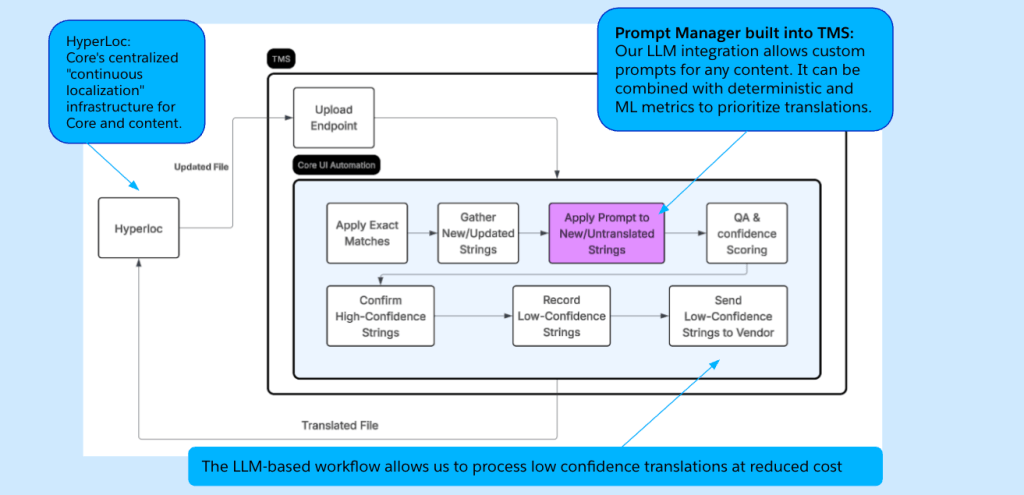
Instead of one translation request, the system runs a sequence of specialized AI stages:
Stage 1: Establish grammatical rules + language conventions
        ↓
Stage 2: Load Salesforce terminology + branding guidelines
        ↓
Stage 3: Inject product context (Which cloud? Which feature?)
        ↓
Stage 4: Generate translation
        ↓
Stage 5: AI Editor reviews output
        ↓
Stage 6: AI Validator checks terminology, quality, consistency
        ↓
Stage 7: Human review + feedback loop
        ↓
        PRODUCTION
📌 Scale fact: A single translation can pass through up to 85 specialized prompt stages before reaching production.
Why Stages Matter
Each stage is specialized, meaning it does one job well rather than one stage doing everything poorly.
Think of it like a manufacturing assembly line:
- A car factory does not have one robot build the entire car
- Each station handles one precise task
- Quality is checked at multiple points, not just at the end
The same logic applies here. AI orchestration is pipeline engineering, not just AI engineering.
Step 4: Understand Context Engineering as Architecture
What Context Engineering Actually Means
This is the most important concept to internalize.
Context engineering is not just writing longer prompts.
It means structuring and delivering the right information to the model at the right stage, so the model understands:
- What it is translating (a button label, an error message, a tooltip)
- Where it lives (Sales Cloud, Health Cloud, Slack)
- Who will read it (enterprise healthcare users vs. sales professionals)
- Why it exists (what customer action it supports)
Context as Infrastructure
The team repurposed existing human-facing assets:
| Original Purpose | New Role in AI Pipeline |
|---|---|
| Style guides for human translators | Structured context fed to LLMs |
| Glossaries and terminology databases | Consistency enforcement across stages |
| Branding guidelines | Injected at generation and validation stages |
| Linguistic conventions | Applied per-language at early pipeline stages |
🔑 Key insight: "Context wasn't simply improving prompt quality. It had become part of the architecture itself."
This means context engineering decisions affect system design, not just individual prompts.
Step 5: Understand the Validation Pipeline
Why Validation Is Its Own System
Generating a translation is only half the work. Trusting that translation enough to ship it is the other half.
The validation pipeline mirrors the generation pipeline in importance:
AI Generation → AI Editing → AI Validation → Human Review
Each layer checks different things:
- AI Editing: Refines tone, grammar, consistency
- AI Validation: Checks against terminology databases, branding rules, quality thresholds
- Human Review: Does not simply approve/reject — humans refine prompts, context data, and validation rules
The Feedback Loop
Human reviewer finds issue
        ↓
Identifies whether it's a prompt problem, context problem, or validation gap
        ↓
Updates the relevant pipeline component
        ↓
Every future release benefits automatically
🧠 Key principle: Human expertise was not removed. It was elevated from doing translation to improving the system that does translation.
Step 6: Recognize the Broader Engineering Challenges
AI Created New Engineering Problems
Faster AI output broke downstream systems:
- Batching strategies had to change because output volume increased dramatically
- Source control needed updating for higher-frequency content delivery
- Testing and deployment pipelines needed redesign
- Database capacity became a constraint
📌 Lesson: When you introduce AI into a production system, you are not just solving the AI problem. You are reengineering the entire surrounding system.
The Pipeline Must Evolve With Models
Foundation models improve constantly. The architecture was designed so that:
- Prompt engineering, context data, and validation rules are modular
- When the underlying model changes, the team does not rebuild everything from scratch
- The system improves as models improve, rather than breaking
Step 7: Synthesize the Core Lessons
Lesson 1: Context Is Architecture
Do not treat context as an afterthought to prompting. Design your system around what information the model needs, when it needs it, and how it is structured.
Lesson 2: Orchestration Over Single Prompts
Complex real-world tasks require sequences of specialized AI stages, not one powerful prompt.
Lesson 3: Validation Is Non-Negotiable
Production AI systems require multi-stage validation pipelines, not just generation pipelines.
Lesson 4: Human Expertise Is Transformed, Not Replaced
"AI did not replace decades of localization expertise. It transformed that expertise into prompts, contextual intelligence, validation pipelines, and engineering workflows."
The domain knowledge still matters. AI makes it scalable and executable at enterprise speed.
Lesson 5: AI Systems Become Trustworthy Through Engineering
"AI systems don't become production-ready because foundation models improve. They become production-ready because engineers build the workflows, validation, and context that make those models trustworthy at scale."
Summary Table
| Concept | Simple Definition | Why It Matters |
|---|---|---|
| Prompt Engineering | Instructions telling AI how to behave | Necessary but insufficient alone |
| Context Engineering | Structured information AI needs to perform correctly | Becomes part of system architecture |
| AI Orchestration | Sequencing specialized AI stages into a pipeline | Enables reliability at enterprise scale |
| Multi-stage Validation | AI + human review at multiple checkpoints | Builds trust in AI output |
| Feedback Loop | Human refinements improve future pipeline runs | Compounds quality over time |
✅ You are now equipped to explain why enterprise AI systems require orchestration pipelines, why context engineering is an architectural decision, and how human expertise is transformed rather than eliminated when AI enters a production workflow.