Step-by-Step Teaching
Step 1: Understanding Why Prototypes Break at Scale
The Prototype Mental Model
When you first build an AI application, the interaction looks like this:
User Request → Build Prompt → Call Model → Return Response
This works perfectly because each request is independent. If it fails, you just try again. Nothing carries over between calls.
What Changes at Production Scale
Now imagine running that same logic across 10,000 records simultaneously:
10,000 rows → 10,000 model calls → some succeed, some fail,
some hit rate limits, some timeout, worker crashes at row 8,432...
Suddenly you face questions your prototype never had to answer:
- What actually completed before the crash?
- Did row 8,432 fail, or did it succeed but fail to record success?
- Can you safely retry it without duplicating work?
Key Insight: You have stopped debugging AI behavior and started debugging distributed execution.
Quick Check ✓
Before moving on, ask yourself: Why does the single-request model break down at scale? (Answer: because it assumes independence, but large executions have shared state, partial progress, and interdependencies.)
Step 2: Identifying the Real Problem — Execution Has No Memory
The Row 8,432 Problem
Consider this scenario:
Background job processes rows 1 → 8,431 ✓
Worker crashes during row 8,432 ✗
System restarts...
Your instinct says: "Row 8,432 failed. Retry row 8,432."
But look deeper:
| Question | Why It Matters |
|---|---|
| Did the model generate a response? | Maybe it succeeded but crashed before saving |
| Did the output reach the database? | Partial writes create inconsistent state |
| Was the status updated? | System may not know what "done" means |
| Is retry safe? | Could duplicate already-completed work |
The failed row is not the real problem. It is simply where uncertainty becomes visible.
The Root Cause
The application has no explicit representation of the execution itself. It only has:
- Logs (incomplete)
- Database state (possibly inconsistent)
- Partial outputs (unreliable)
This is like trying to reconstruct a conversation from scattered sticky notes after someone threw them in the air.
Step 3: Defining the Unit of Work — Recovery Boundaries
The Two Wrong Extremes
Before you can fix failures, you must answer: What should the system actually recover?
❌ Too Broad:  Retry the entire 10,000-row job
               → Repeats thousands of successful calls
               → Wastes model quota
               → Risks overwriting correct outputs

❌ Too Granular: Retry every tiny instruction independently
                → Massive orchestration overhead
                → Hard to manage and reason about
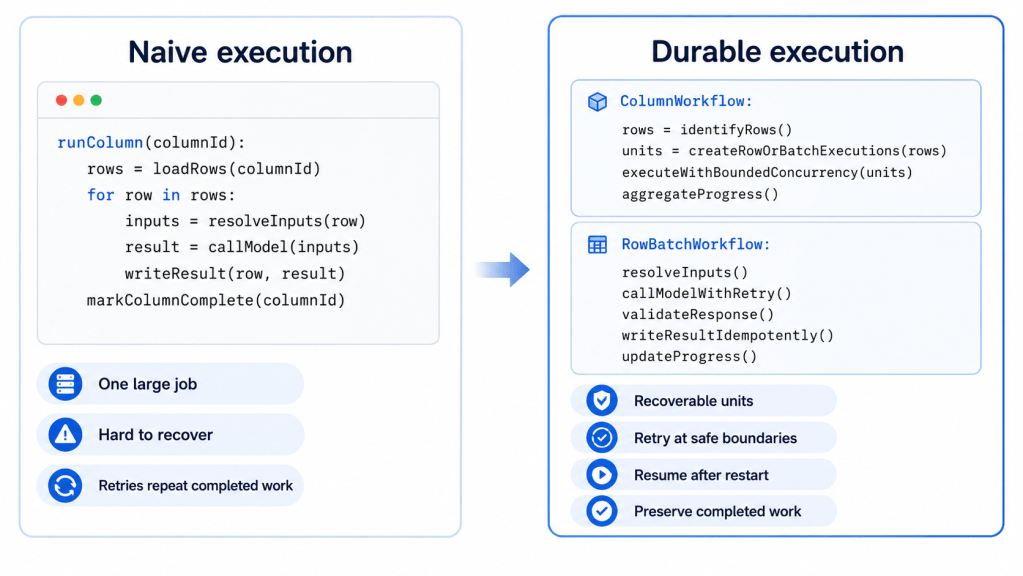
The Right Approach: Hierarchical Execution Units
Model your execution as a hierarchy that mirrors how users think about the work:
Column Run (user's overall request)
    └── Batch / Row (meaningful execution unit)
            └── Activities (atomic operations)
                    ├── Resolve inputs
                    ├── Build prompt
                    ├── Call model
                    ├── Validate response
                    ├── Write output
                    └── Update progress
Why this works:
- A failure in Row 47 only restarts Row 47
- Rows 1–46 are untouched
- The user sees progress at a level they understand
Core Principle: The right retry boundary is the smallest meaningful unit of recoverable work.
Practical Exercise 🔧
Map this to something familiar: If you were processing 1,000 customer invoices, what would be your hierarchy? (Hint: Batch run → Individual invoice → Line item operations)
Step 4: Making Execution Durable — State That Survives Failures
The Fundamental Question
Once you have smaller recoverable units, a new problem emerges:
If a worker restarts, where does the next worker find out what already completed?
The Fragile Approach (What Most Systems Do)
Worker A processes rows 1-8,431
Worker A crashes
Worker B starts
Worker B reads logs + database + timestamps
Worker B tries to reconstruct what happened
Worker B makes assumptions...
Worker B gets it wrong in edge cases
This works when failures are rare. It becomes increasingly fragile as executions grow longer.
The Durable Approach (Reframing the Problem)
Instead of asking "How does a worker remember where it left off?", ask:
"What if the execution remembered its own history, independent of any worker?"
Traditional Model:          Durable Model:
┌─────────────┐            ┌─────────────────────────┐
│   Worker    │            │   Execution History      │
│  (holds     │            │   (persisted externally) │
│   state)    │            │                          │
│  crashes ✗  │            │   Worker A reads it ✓    │
└─────────────┘            │   Worker A crashes       │
                           │   Worker B reads it ✓    │
                           │   Execution continues ✓  │
                           └─────────────────────────┘
The worker becomes replaceable. The execution does not.
How This Works in Practice (Temporal Example)
Column Execution = Parent Workflow (durable, persisted)
    └── Row/Batch = Child Workflow (own retry behavior)
            └── Model Call = Activity (retry policy defined here)

If worker disappears:
→ Another worker picks up from persisted execution history
→ No reconstruction needed
→ No guessing about what completed
The Results This Produces
| Metric | Before Durable Workflows | After Durable Workflows |
|---|---|---|
| Failure rate (10 users, 200 rows) | ~90% | 0% |
| Recovery method | Manual reconstruction | Automatic from history |
| P95 completion time | Baseline | ~60% improvement |
Step 5: Designing Smart Retry Strategies
Retries Must Match Execution Boundaries
Now that execution is durable and boundaries are defined, retries become precise:
Transient model timeout on Row 47:
→ Retry ONLY the activity that timed out
→ Row 47 resumes from last checkpoint
→ Rows 1-46 untouched ✓
→ Model quota not spent twice ✓

Validation failure on Row 23:
→ Isolated to Row 23
→ Other rows continue unaffected ✓
The Checkpoint Mechanism
Process Batch:
  ├── Row 1 → Success → Checkpoint ✓
  ├── Row 2 → Success → Checkpoint ✓
  ├── Row 3 → Failure → Retry (up to 10x, exponential backoff)
  │     ├── Attempt 2 → Success → Checkpoint ✓
  └── Row 4 → Success → Checkpoint ✓

If worker crashes after Row 2's checkpoint:
→ Resume from Row 3 (not Row 1)
→ Row 3 retries remaining attempts
→ Rows 1-2 never re-executed
Retry Policy Components
Every activity should define:
| Component | Purpose | Example |
|---|---|---|
| Max attempts | Prevent infinite loops | 10 retries |
| Backoff strategy | Avoid thundering herd | Exponential |
| Non-retryable errors | Skip hopeless retries | Invalid API key |
| Idempotency | Safe to repeat | Write only if not exists |
Rule Before Implementing Retries: Decide what your system is allowed to repeat before deciding how to repeat it.
Step 6: Observability — Making Progress Visible
The Problem with "Running..."
A single status indicator tells users and engineers nothing useful:
❌ "Running..."
   → Is it progressing? Stalled? Retrying?
   → Nobody knows.
Layered Progress Mirrors Layered Execution
Your observability model should match your execution hierarchy:
Worksheet Level:  "3 of 5 columns complete"
    └── Column Level:   "8,200 of 10,000 rows complete"
            └── Row Level:      "Row 47: Retrying (attempt 2/10)"
                    └── Cell Level:     "Value generated ✓ / Failed ✗ / Pending..."
Why this matters:
- Users can distinguish completed vs failed vs retrying
- Engineers can debug without reconstructing execution manually
- Progress is understandable, not mysterious
Principle: Progress visibility should mirror the same execution boundaries that define recovery. When they stay aligned, failures become understandable instead of mysterious.
Step 7: The Architectural Mindset Shift
Old Questions vs. New Questions
Most teams start AI architecture discussions here:
❌ Old Questions:
   "Which model should we use?"
   "How should we write the prompt?"
   "What temperature setting works best?"
Production AI demands these questions instead:
✓ New Questions:
   "What is the smallest meaningful unit of recoverable work?"
   "What state must survive a worker restart?"
   "Which operations are safe to retry?"
   "How will users know what completed vs. what needs attention?"
The Diagnostic Test
Imagine execution reaches row 8,432 before something unexpected happens.
| Your First Instinct | What It Means |
|---|---|
| "Rerun everything from the start" | You are still designing around model execution |
| "What state survived the failure?" | You have started designing for production |
Summary: The Complete Mental Model
PROTOTYPE AI                    PRODUCTION AI
─────────────────               ──────────────────────────────
Single request                  Long-running workflow
Independent calls               Coordinated execution
Stateless                       Durable state
Retry = start over              Retry = resume from boundary
"Did model respond?"            "What state survived?"
One status                      Layered observability
Worker = execution              Execution > any single worker
The Four Pillars of Reliable Production AI
1. EXECUTION HIERARCHY
   Define meaningful units at every level

2. DURABLE STATE
   Execution history lives outside any single process

3. ALIGNED RETRIES
   Retry boundaries match execution boundaries

4. LAYERED OBSERVABILITY
   Progress visibility matches execution structure
Final Takeaway
The model generates intelligence. Your execution model determines whether that intelligence can be trusted.
Choosing a better model improves the quality of your outputs. Designing durable workflows determines whether those outputs survive to reach your users reliably at scale.