AWS EC2 launches verified Nitro Isolation Engine for enhanced virtual-machine security.
Concept 1: What is a Virtual Machine (VM) and Why Does Isolation Matter?
The Basic Idea
A virtual machine is a software-based simulation of a physical computer. Think of it like an apartment in a building:
- The building = physical server
- Each apartment = a virtual machine
- Multiple tenants (customers) share the same building
Why Isolation is Critical
Just like apartment tenants shouldn't be able to walk into each other's units, VMs must be completely separated from each other. Without isolation:
- One customer could read another customer's private data
- A malicious VM could interfere with or crash other VMs
- Security and privacy guarantees collapse
Key Takeaway
Isolation = the guarantee that what happens in one VM cannot affect or be seen by another VM
Concept 2: What is a Hypervisor?
Definition
A hypervisor is the software layer that sits between physical hardware and virtual machines. It:
- Creates and manages VMs
- Allocates resources (CPU, memory, storage)
- Enforces the "walls" between VMs
The Problem with Traditional Hypervisors
Traditional hypervisors like the Nitro Hypervisor do many things:
- Handle business logic
- Manage device drivers
- Schedule which VM runs when
- Enforce isolation
This complexity makes them hard to verify for correctness — there are too many moving parts to mathematically prove they work perfectly.
Analogy
A hypervisor is like a building manager who handles rent, repairs, security, and scheduling — doing everything makes it hard to guarantee any one thing is done perfectly.
Concept 3: What is a Separation Kernel?
The Core Idea (coined by John Rushby, 1981)
A separation kernel is a minimal software component with one job only: enforcing isolation between compartments.
The Key Principle: Separate Policy from Mechanism
| Policy (decisions) | Mechanism (enforcement) |
|---|---|
| Which VMs to create | Actually isolating them |
| How to allocate resources | Checking every request |
| When to schedule a VM | Blocking unauthorized access |
The separation kernel only does mechanism — it doesn't decide what to isolate, just enforces the isolation once told to.
Why This Matters
By stripping away everything except isolation enforcement, the separation kernel becomes:
- Smaller → easier to understand
- Simpler → easier to verify mathematically
- Auditable → customers can inspect exactly how isolation works
The Nitro Isolation Engine
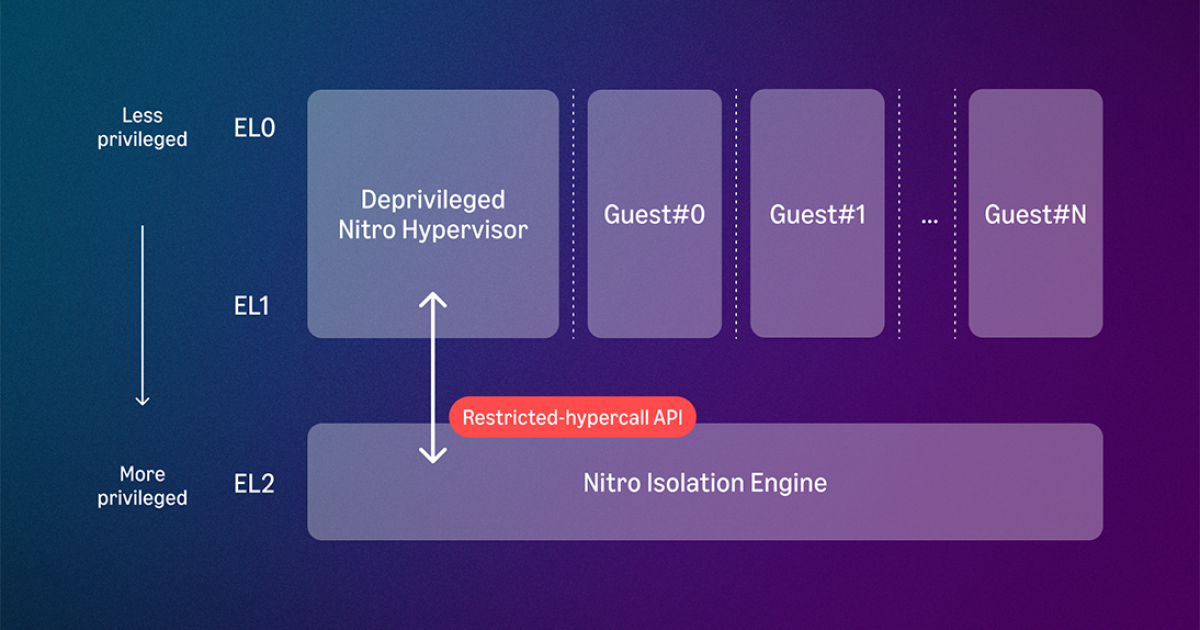
AWS extracted the isolation logic from the full Nitro Hypervisor into a dedicated Nitro Isolation Engine — their separation kernel. The full hypervisor still handles policy but must ask permission from the Isolation Engine before touching any VM state.
Concept 4: What is Formal Verification?
The Problem with Regular Testing
Normal software testing checks: "Did it work in these specific cases?"
But testing cannot prove software works in all cases. There are always edge cases you didn't think to test.
What Formal Verification Does
Formal verification uses mathematical proofs to show that software behaves correctly in every possible situation — not just the ones you tested.
The Tool: Isabelle/HOL
Isabelle/HOL (Higher-Order Logic) is a proof assistant — software that:
- Lets you write mathematical proofs about your code
- Mechanically checks every reasoning step
- Rejects any step that violates the laws of logic
Think of it as a very strict math teacher that checks every line of your proof and won't accept hand-waving.
Scale of This Work
AWS's proof comprises 330,000 lines of machine-checked mathematics — comparable to seL4, the landmark OS verification project that inspired this work.
Concept 5: Specifications — Defining "Correct Behavior"
What is a Specification?
Before you can prove software is correct, you need to precisely define what "correct" means. A formal specification is an exact mathematical description of how the system should behave.
Pre- and Postconditions
Specifications are written as contracts:
PRECONDITION:  What must be true BEFORE the program runs
POSTCONDITION: What must be true AFTER the program runs
Example from the article: When a virtual CPU that is already running tries to turn itself on:
- Precondition: The CPU is already in the "on" state
- Postcondition: The system returns error code
AlreadyOn, and nothing else changes
Total Correctness
Their specifications guarantee total correctness, meaning:
- The program always terminates (doesn't hang forever)
- The result always satisfies the postcondition
- The program is memory safe and free of runtime errors
Concept 6: The Four Properties Being Proved
The article describes four types of guarantees the proofs establish:
1. Confidentiality and Integrity
- Confidentiality: VM A cannot read VM B's data
- Integrity: VM A cannot modify VM B's data
- Only authorized information flows can occur
- Example: Memory is always wiped clean before being given to a new VM
2. Functional Correctness
- The implementation behaves exactly as specified
- Every function does precisely what its contract says
3. Absence of Runtime Errors
- No crashes from things like:
- Unwrapping a
Nonevalue in Rust (like accessing a null pointer) - Division by zero
- Index out of bounds
- Unwrapping a
4. Memory Safety
- No buffer overflows (writing past the end of allocated memory)
- No NULL pointer dereferences (accessing memory at address zero)
- These are common sources of security vulnerabilities
Concept 7: μRust — A Verifiable Subset of Rust
Why Not Just Use Regular Rust?
Full Rust has many advanced features (traits, dynamic dispatch, complex lifetimes) that make formal reasoning very difficult.
The Solution: μRust ("Micro Rust")
AWS created μRust, a restricted subset of Rust that:
- Is expressive enough to write the Nitro Isolation Engine
- Is simple enough to reason about mathematically
- Deliberately excludes hard-to-verify features
Shallow Embedding in Isabelle/HOL
The meaning of μRust programs is defined directly in terms of higher-order logic — the language Isabelle/HOL understands. This means:
- Every μRust program has a precise mathematical meaning
- Proofs about μRust programs are proofs in pure mathematics
Analogy
μRust is like a simplified version of English designed for legal contracts — it loses some expressiveness but gains precision and unambiguity.
Concept 8: Separation Logic — Reasoning About Memory
The Challenge
Low-level programs manipulate memory directly using pointers. Reasoning about this is tricky because:
- Two pointers might point to the same memory location (aliasing)
- Modifying one variable might unexpectedly change another
What Separation Logic Does
Separation Logic is a specialized mathematical logic designed to reason about programs that manipulate memory. Its key feature:
It lets you say: "This piece of code only touches this region of memory, and that piece of code only touches that region — and those regions are separate."
This makes it much easier to reason about what a function does and doesn't affect.
Why It Matters Here
The Nitro Isolation Engine must guarantee that operations on one VM's memory never touch another VM's memory. Separation Logic is the perfect tool for expressing and proving this.
Concept 9: Weakest Precondition Calculus
The Core Question
Given a program and a desired outcome (postcondition), what is the least restrictive starting condition that guarantees the outcome?
Simple Example
- Program:
result = x + y - Desired postcondition:
resultis a valid integer (no overflow) - Weakest precondition:
x + ymust not exceed the maximum integer value
The "weakest" precondition is the most permissive one — it doesn't over-constrain the inputs.
How It's Used in Proofs
- Start from the postcondition (desired outcome)
- Work backwards through the program
- Compute the weakest precondition automatically
- Show that the contract's stated precondition implies the computed weakest precondition
This gives a systematic, mechanical way to verify programs — which is why it can be automated.
Concept 10: Refinement — Connecting Levels of Abstraction
The Problem
The formal verification works at two levels:
- High-level specification: Abstract description of system behavior (e.g., "a hypercall is one atomic step")
- Low-level implementation: Actual μRust code with all its details
How do you connect these two levels?
The Solution: Refinement
Refinement is a proof technique that shows:
"Every behavior possible in the concrete implementation is also a valid behavior in the abstract specification."
In other words, the implementation is a faithful realization of the high-level spec — it doesn't do anything the spec doesn't allow.
Analogy
Think of a blueprint (high-level spec) and the actual building (implementation). Refinement proves the building matches the blueprint — every room, every wall, every door is where the blueprint says it should be.
Concept 11: Noninterference — Making Confidentiality Mathematical
The Challenge
"Confidentiality" is an intuitive concept, but to prove it mathematically, you need a precise definition.
The Key Idea: Indistinguishability Preservation
Noninterference says:
If two system states are indistinguishable to an observer before a step, they must remain indistinguishable after the step.
The Article's Example
Consider two machines, A and B, each with:
- One public register (visible to observer)
- One private register (hidden from observer)
Before: A and B have the same public register value → they look identical to the observer.
Bad program: "If private register = 1, set public register = 1"
After running this program:
- Machine A (private=0): public register stays 0
- Machine B (private=1): public register becomes 1
Now A and B look different — the observer can deduce the private values! This is an information leak.
Why This Captures Confidentiality
If indistinguishability is always preserved:
- The observer can never learn anything about private data by watching public outputs
- No matter what operations run, private information cannot leak to unauthorized observers
Visualized
BEFORE:          AFTER (BAD program):
A: pub=5, priv=0    A': pub=0, priv=0  ← different!
B: pub=5, priv=1    B': pub=1, priv=1  ← observer can now distinguish!
   ↑ indistinguishable                    ↑ distinguishable = information leaked
Putting It All Together
Here's how all the concepts connect in the Nitro Isolation Engine verification:
GOAL: Prove VMs are truly isolated from each other

STEP 1: Extract isolation logic into a SEPARATION KERNEL
        (Nitro Isolation Engine — small, focused, auditable)

STEP 2: Write the engine in μRUST
        (verifiable subset of Rust)

STEP 3: Write FORMAL SPECIFICATIONS
        (pre/postconditions using SEPARATION LOGIC)

STEP 4: Prove FUNCTIONAL CORRECTNESS
        (using WEAKEST PRECONDITION CALCULUS in Isabelle/HOL)

STEP 5: Connect implementation to high-level spec
        (using REFINEMENT)

STEP 6: Prove CONFIDENTIALITY and INTEGRITY
        (using NONINTERFERENCE / indistinguishability preservation)

RESULT: Mathematical guarantee that no VM can read or modify
        another VM's data — ever, in any circumstance
Summary Table
| Concept | What It Is | Why It Matters |
|---|---|---|
| Virtual Machine | Software-simulated computer | Multiple customers share hardware |
| Hypervisor | Manages VMs on hardware | Creates and enforces VM boundaries |
| Separation Kernel | Minimal isolation-only component | Small enough to formally verify |
| Formal Verification | Mathematical proof of correctness | Guarantees beyond testing |
| Isabelle/HOL | Proof-checking software | Mechanically validates every proof step |
| Specification | Precise definition of correct behavior | Defines what we're proving |
| μRust | Verifiable subset of Rust | Expressive yet formally tractable |
| Separation Logic | Logic for memory reasoning | Proves memory regions don't overlap |
| Weakest Precondition | Systematic proof technique | Automates correctness proofs |
| Refinement | Connects abstraction levels | Links spec to implementation |
| Noninterference | Indistinguishability preservation | Makes confidentiality mathematically precise |