Why A Frontier Data Agent Outperforms General Coding Agents in Quality and Cost
Concept 1: The "More Exploration = Better Results" Assumption (And Why It's Wrong)
The conventional wisdom:
The longer an AI agent explores, retries, and verifies → the more accurate it becomes
What the evaluation actually found:
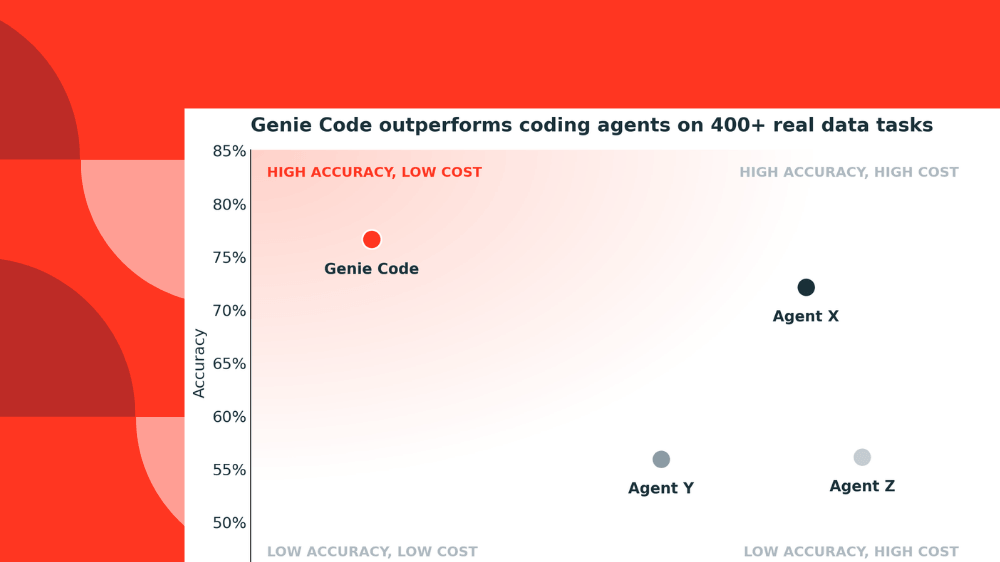
- Genie Code was both more accurate AND cheaper than general coding agents
- This directly contradicts the assumption
Think of it like this:
A specialist doctor doesn't need to run every possible test to diagnose you. They already know which tests matter. A general practitioner might order more tests, spend more time, cost more — and still miss the diagnosis.
Concept 2: Why Data Environments Are Uniquely Difficult
Data agents face three specific challenges that general coding agents aren't built for:
| Challenge | What It Means |
|---|---|
| Dynamic workspaces | Hundreds of thousands of tables, notebooks, dashboards constantly changing |
| Contradictory information | Metadata and documents can be outdated or conflict with each other |
| No verifiable tests | Unlike coding tasks, you can't just "run the code and see if it passes" |
Key insight: General coding agents rely on running tests to verify correctness. In data environments, that safety net doesn't exist.
Concept 3: The "Random Walk" Problem
When general agents don't know where to look, they explore randomly — scanning broadly, querying large tables inefficiently, retrying repeatedly.
The consequences:
- ❌ Higher token usage → higher cost
- ❌ Longer run times → timeouts = automatic failures
- ❌ More wrong turns → lower accuracy
Evidence from the data:
- Agents Y and Z timed out frequently on large table scans
- Agent X's most expensive run cost $9.49 (vs. Genie Code's max of $3.87)
- General agents put 33–40% of tasks over $1 vs. only 16% for Genie Code
Concept 4: How Genie Code Skips the Random Walk
Genie Code was given three specialized capabilities to avoid inefficient exploration:
1. 🔍 Semantic Search Over the Catalog
- Instead of scanning everything, it understands meaning to find the right asset directly
- Like using a smart librarian vs. reading every book on the shelf
2. 🧠 Persistent Memory
- Remembers which tables and business logic users rely on
- Doesn't rediscover the same context repeatedly across tasks
3. 🏢 Deep Enterprise Context Understanding
- Knows the business meaning behind data, not just its technical structure
The result in numbers:
Genie Code averaged 8.3 tool calls per task — fewer than any agent tested One example task: Genie Code answered correctly in 5 tool calls; general agents never recovered
Concept 5: Accuracy vs. Cost — The Benchmark Results
| Agent | Accuracy | Cost Per Task |
|---|---|---|
| Agent X | 72.1% | $1.09 |
| Agent Y | 55.9% | $0.91 |
| Agent Z | 56.1% | $1.16 |
| Genie Code | ~80%+ | ~$0.52 |
(Genie Code's exact accuracy isn't stated but is described as highest, at roughly half Agent X's cost)
The core insight:
Since all agents used the same tier of frontier LLMs, cost differences come entirely from efficiency — how many turns and tokens it takes to reach an answer.
Concept 6: The Compounding Advantage of Specialization
This is the central lesson of the article:
Specialized Knowledge
        ↓
Skip unnecessary exploration
        ↓
Fewer tool calls → Less time → Lower cost
        ↓
Fewer timeouts → Higher accuracy
        ↓
Better results at lower cost (NO trade-off)
The expertise compounds — it doesn't just help in one dimension, it improves accuracy, speed, and cost simultaneously.
Concept 7: Generic Benchmarks Don't Capture Real-World Performance
The broader lesson:
- AI leaderboards test general capabilities
- Real users work in specific, messy, domain-specific environments
- A model that ranks highly on a generic benchmark may perform poorly on your actual tasks
Implication:
Evaluations should be built from real user tasks in the actual environment the agent will operate in — not synthetic or general benchmarks.
Summary: The Big Picture
| Principle | Takeaway |
|---|---|
| More exploration ≠ better results | Efficiency beats brute force |
| Data environments are uniquely hard | They need purpose-built agents |
| Specialization compounds | Better accuracy + lower cost simultaneously |
| Generic benchmarks mislead | Real-world tasks tell the true story |
The article's core argument is simple but powerful: a specialist who already knows where to look will always outperform a generalist who has to search everywhere — and that advantage shows up in every measurable dimension.