ToyBlocks: A Testbed for Robot Learning and Reasoning
Learning Outcomes
After studying this material, you should be able to:
- Explain what FoundationWorlds are and why controlled simulation environments matter for robotics research
- Describe how ToyBlocks is structured and what problems it solves
- Distinguish between high-level and low-level models in robot learning
- Understand how training data generation, evaluation, and sim-to-real transfer work
- Analyze how agentic AI systems reason and act within robotic environments
Step 1: The Core Problem — Why Robotics Needs Controlled Environments
The Analogy First
Think of how biologists study complex systems:
Complex System → Controlled Environment → Vary conditions → Observe effects
Living organism → Petri dish          → Change variables → Draw conclusions
Robotics has the same need. Robots can fold laundry or sort parts, but:
- Demonstrations are narrow (work in one specific setting)
- It is unclear what the robot actually learned
- It is hard to trace why failures happen
What Researchers Actually Need
| Need | Why It Matters |
|---|---|
| Repeat the same test | Confirm results are reliable |
| Change training data | See what data actually helps |
| Change model design | Compare approaches fairly |
| Trace failure causes | Fix problems systematically |
Key Insight: Without a controlled environment, robotics research is like doing chemistry without a lab — you can observe things, but you cannot isolate causes.
Step 2: Introducing FoundationWorlds
Definition
A FoundationWorld is a framework pairing:
Controlled Simulated World
        +
Automatic Task & Demo Generation Tools
        +
Metrics for Measuring Robot Behavior Over Time
What Questions FoundationWorlds Help Answer
- How do models improve as more training data becomes available?
- How do you best combine high-level reasoning with precise physical control?
- Does a model generalize to tasks it has never seen before?
Step 3: ToyBlocks — The First FoundationWorld
What It Is
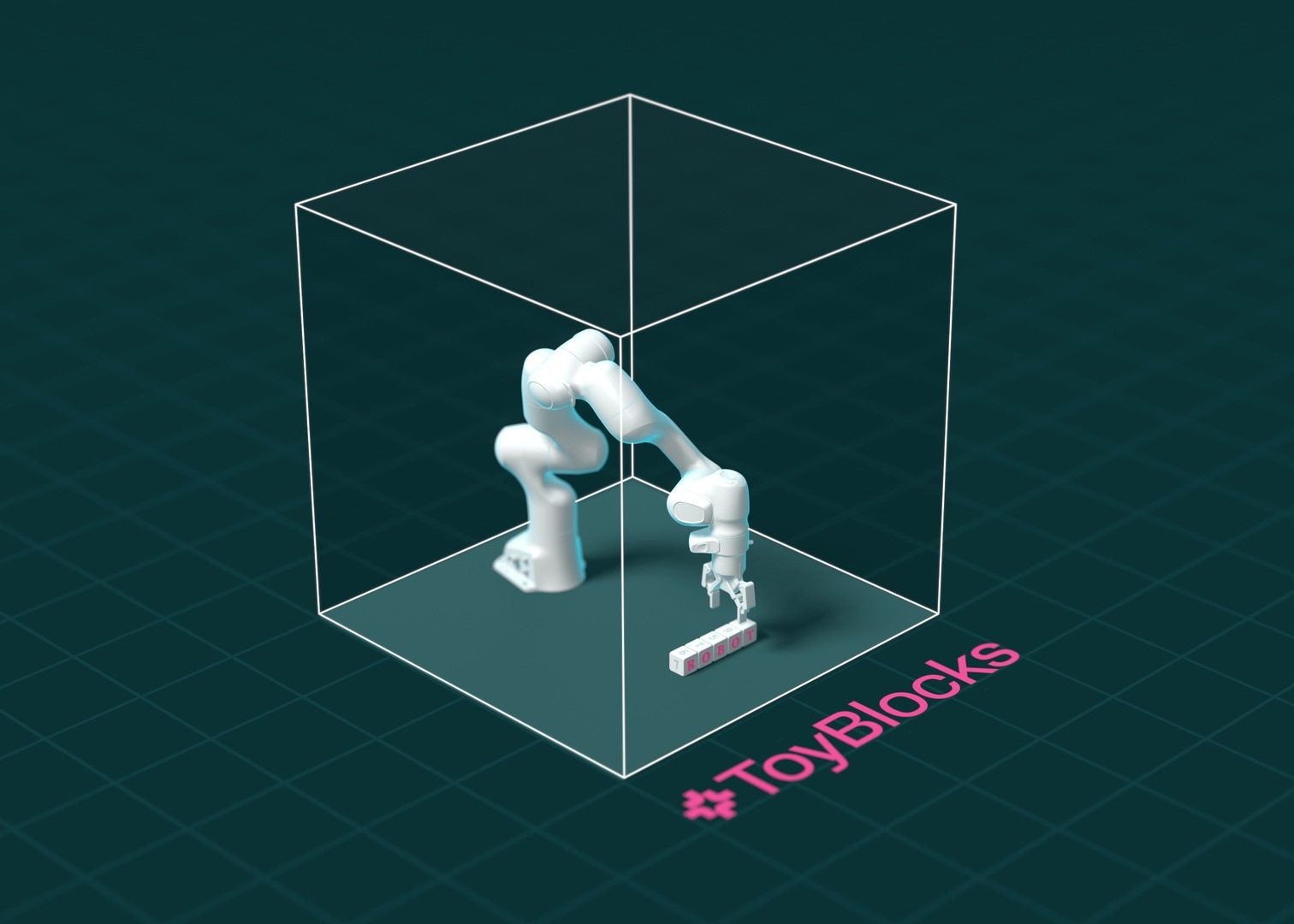
ToyBlocks is a simulation built around:
- A robot arm
- Blocks on a tabletop
- Letters and pictures on block faces
The setting is deliberately simple, but it still requires the robot to:
- Reason about how blocks interact
- Push, flip, and stack blocks
- Search for hidden information (letters on unseen faces)
The Four Design Requirements
| Requirement | What It Means |
|---|---|
| Realistic physics and appearance | Simulated arm and blocks behave like real ones |
| Automatic task and demo generation at scale | No need for humans to manually control the robot |
| Reasoning combined with dexterity | Not just physical skill — the robot must think |
| Broad task coverage within the domain | Covers all reasonable tasks in the block world |
Why narrow scope? Open-ended domains make it impossible to fulfill all four requirements. ToyBlocks' narrow focus makes it possible to fulfill all of them completely.
Step 4: How ToyBlocks Generates Training Data
This is one of the most important technical concepts. Follow this chain:
Step-by-Step Data Generation Pipeline
Step 1: Skill Training (Reinforcement Learning)
        ↓
Step 2: Task-and-Motion Planning (TAMP)
        ↓
Step 3: Parallel Simulation Execution
        ↓
Step 4: Labeled Demonstration Dataset
Breaking Down Each Step
Step 1 — Skill Training
- Uses Reinforcement Learning (RL) inside Isaac Lab (Nvidia's simulation framework)
- Robot learns through trial and error
- Learns non-prehensile skills — actions that do not involve picking up objects:
- Pushing a block across the table
- Flipping a block onto another face
- Uses privileged information — exact position and orientation values the simulator provides directly, which a real robot cannot access
- This allows automatic skill generation that would otherwise require a human operator
Step 2 — Task-and-Motion Planning (TAMP)
- Automatically selects and sequences the skills needed to solve a task
- Plans the robot's movements between skills
- No human involvement required
Step 3 — Parallel Execution
- Runs hundreds of plans simultaneously on a single GPU
- Achieves up to 24× real-time speed
- Makes large-scale data generation practical
Step 4 — Labeled Dataset
- Each recorded demonstration includes labels describing:
- Which task the robot is performing
- Which skill is being executed at each moment
Why This Matters
Traditional data collection requires teleoperation — a human remotely controlling the robot for every demonstration. ToyBlocks eliminates this bottleneck entirely.
Step 5: The Two Levels of Robot Intelligence
This is a critical conceptual distinction running throughout the entire article.
High-Level vs. Low-Level Models
HIGH-LEVEL MODEL (Planner)
"What should I do next?"
→ Selects which skill to use
→ Identifies which block to act on
→ Sequences actions across many steps
        ↓ gives instructions to ↓
LOW-LEVEL MODEL (Executor)
"How exactly do I move?"
→ Maps sensor observations to physical actions
→ Controls the robot arm precisely
→ Executes the commanded skill
Concrete Example from ToyBlocks
| Role | Model Used | What It Does |
|---|---|---|
| High-level planner | Molmo 2 (Vision-Language Model) | Chooses skill (rotate, flip) and points to the relevant block |
| Low-level executor | ManiFlow | Controls the simulated arm to carry out the instruction |
Why This Separation Is Useful for Research
When a robot fails at a long task, you can now ask:
- Did the planner choose the wrong action? → High-level failure
- Did the executor move incorrectly? → Low-level failure
ToyBlocks provides oracles — reference components with correct plans or actions — at both levels, so you can isolate exactly where failure occurred.
Step 6: Studying Generalization
What Generalization Means in Robotics
A robot generalizes when it successfully performs tasks or handles situations it was not explicitly trained on.
Types of Generalization ToyBlocks Tests
Interpolation — New configurations within the training range
Example: Trained on positions in the left half of the table
         Tested on new positions still in the left half
Extrapolation — Configurations beyond the training range
Example: Trained on positions in the left half of the table
         Tested on positions in the right half
Compositional Generalization — Combining familiar skills in new sequences
Example: Trained on stacks of 2 and 5 blocks
         Tested on stacks of 3 and 4 blocks
         (Can the robot combine what it knows?)
Appearance Generalization — New letters, colors, or block appearances not seen during training
Key Finding
Studies on VLA (Vision-Language-Action) generalization have produced conflicting results — some show brittleness, others show strong generalization. ToyBlocks argues this conflict exists because real-world datasets have limited flexibility in spatial variation. ToyBlocks provides the controlled conditions needed to resolve this question properly.
Step 7: Agentic AI Systems in ToyBlocks
What an Agentic System Is
An agentic system is an AI that:
- Perceives its environment
- Plans a sequence of actions
- Calls tools to execute those actions
- Adapts based on results
How ToyBlocks Enables Agentic Research
ToyBlocks exposes robot skills through the Model Context Protocol (MCP) — a standard for connecting AI applications to tools.
The agent can:
- See the scene through camera images
- Call skills (pick, flip, rotate) by pointing at a pixel
- Decide when to search, build, or declare a task impossible
Three Experimental Settings
Setting 1 — Classical Planning
- Agent uses text descriptions of the scene
- Solves 30/30 block-stacking tasks
- Also solves 30/30 using camera images in a closed loop
Setting 2 — Search and Spell
- Agent must find blocks with specific letters among up to 8 blocks
- 50% of scenes are infeasible (missing required letters)
- Agent must recognize infeasibility and say so
- Results: 63% success rate
- Main errors:
- Confusing look-alike letters: 13%
- Incorrect letter orientation: 15%
Setting 3 — Self-Directed Experimentation
- Agent behaves like a scientist
- When a skill behaves unexpectedly, it:
- Forms a hypothesis
- Designs a small test
- Revises its understanding
Result comparison:
Default skill descriptions:        24% success
Human expert descriptions:         36% success
Agent's own learned descriptions:  63% success
Key Insight: An agent that writes its own skill descriptions through experimentation outperforms both default descriptions and human-written ones.
Step 8: World Models as Simulators
What Action-Conditioned World Models Are
These are models trained to predict how a scene changes in response to a robot's actions — essentially learning to simulate physics from data rather than using a hand-coded physics engine.
The Research Question
Can these learned world models replace traditional simulators for training and evaluating robots?
Why ToyBlocks Is Uniquely Useful Here
To test a world model, you need ground truth — the actual state of the scene to compare against predictions. ToyBlocks provides this directly from the simulator.
What Was Tested
- 4 skills: pick-and-place, flip, rotate, mixed task
- 900 trajectories per skill (50% successful, 50% unsuccessful)
- Models must predict whether a skill execution will succeed
Three Model Types Tested
| Model | Type | What It Predicts |
|---|---|---|
| Wan 2.2 | Video prediction (5B parameters) | Future images |
| Astra | Agentic — builds its own physics simulator | Simulator states |
| LeWM | Latent world model | Learned internal representations |
Two Evaluation Modes
- Full trajectories: Errors accumulate over long sequences
- Short interaction segments: Isolates a single interaction (e.g., gripper touching a block)
Step 9: Sim-to-Real Transfer
The Core Challenge
A robot trained entirely in simulation must work on a physical robot without any real-world training examples. This is called zero-shot sim-to-real transfer.
The Three-Stage Transfer Process
Stage 1: BEFORE Data Generation
→ System Identification
→ Tune simulated joint friction and motor inertia
   to match real robot trajectories

Stage 2: DURING Data Generation
→ Domain Randomization
→ Vary: object size, friction, table height (physical)
→ Vary: lighting, backgrounds, materials, camera parameters (visual)

Stage 3: AT INFERENCE TIME
→ Use real cameras (ZED front-facing + ZED Mini wrist-mounted)
→ Generate clean depth maps from RGB images using FastFoundationStereo
   (avoids noisy depth sensor measurements)
Results
| Evaluation | Simulation | Real World |
|---|---|---|
| ManiFlow atomic skills | 80.0% | 81.1% |
| Molmo 2 + ManiFlow (long tasks) | 55.5% (111/200) | 50.0% (15/30) |
Notable finding: Simulation performance closely predicted real-world performance, validating ToyBlocks as a meaningful proxy for physical deployment.
Step 10: Putting It All Together — The Full Picture
TOYBLOCKS FRAMEWORK OVERVIEW

[Controlled Simulation]
    ↓
[Automatic Skill Training via RL]
    ↓
[Task-and-Motion Planning → Demonstrations]
    ↓
[Parallel Data Generation at Scale]
    ↓
[Training: High-Level (Molmo 2) + Low-Level (ManiFlow)]
    ↓
[Evaluation: Generalization, Planning, Agentic Behavior, World Models]
    ↓
[Sim-to-Real Transfer → Physical Robot]
    ↓
[Metrics: Success rates, execution speed, forces, task progress]
Summary Table: Key Concepts
| Concept | Definition | Why It Matters |
|---|---|---|
| FoundationWorld | Controlled simulation + auto data generation + metrics | Enables reproducible robotics research |
| ToyBlocks | First FoundationWorld using blocks and a robot arm | Proves the framework works |
| Non-prehensile skills | Actions without grasping (push, flip) | Expands robot capability beyond picking |
| Privileged information | Exact simulator values unavailable to real robots | Enables automatic skill generation |
| TAMP | Automatic task and motion planning | Sequences skills without human input |
| High-level model | Plans what to do (Molmo 2) | Handles reasoning and sequencing |
| Low-level model | Executes how to move (ManiFlow) | Handles precise physical control |
| Interpolation/Extrapolation | Generalization within vs. beyond training range | Tests true learning vs. memorization |
| Domain randomization | Varying physical and visual properties during training | Improves real-world robustness |
| Sim-to-real transfer | Deploying simulation-trained models on physical robots | Validates simulation usefulness |
| Agentic system | AI that plans, acts, and adapts through tool use | Tests frontier model capabilities |
| World model | Learned predictor of scene changes from actions | Alternative to physics simulators |
Self-Check Questions
- Why is a narrow, controlled environment more useful than a broad one for studying robot learning?
- What is the difference between interpolation and extrapolation generalization, and why does the distinction matter?
- Explain why separating high-level and low-level models helps researchers diagnose failures.
- Why did the agent's self-written skill descriptions outperform human-written ones?
- What three stages does ToyBlocks use to bridge the gap between simulation and the real world?
- If a world model always predicts success, what accuracy would it achieve on ToyBlocks' test set, and why is that the baseline?