How Agentic AI Is Transforming the Search for Alien Signals
Step-by-Step Study Material
Step 1: Understanding the Core Problem
Why is searching for extraterrestrial signals difficult?
Before AI, scientists faced three major challenges:
| Challenge | Description |
|---|---|
| Data Volume | Radio telescopes generate terabits of data per second |
| Speed | Signals must be analyzed as they arrive, not stored first |
| Human Limitation | Manual analysis could take weeks or years |
💡 Key Insight: The sheer scale of data makes human-only analysis practically impossible.
Step 2: What is Agentic AI?
Definition
An AI agent is a system that can:
- Perceive its environment (incoming data)
- Make decisions autonomously
- Take actions without constant human instruction
- Adapt based on results
Simple Analogy
Think of a traditional telescope operator vs. an AI agent:
Traditional: Human reads data → Human decides → Human adjusts telescope
Agentic AI:  Agent reads data → Agent decides → Agent adjusts telescope
             (all from a single natural language request)
Step 3: The SETI + Agentic AI System Explained
Who is involved?
- Breakthrough Listen — Major SETI research program
- SETI Institute — Scientific organization dedicated to finding extraterrestrial intelligence
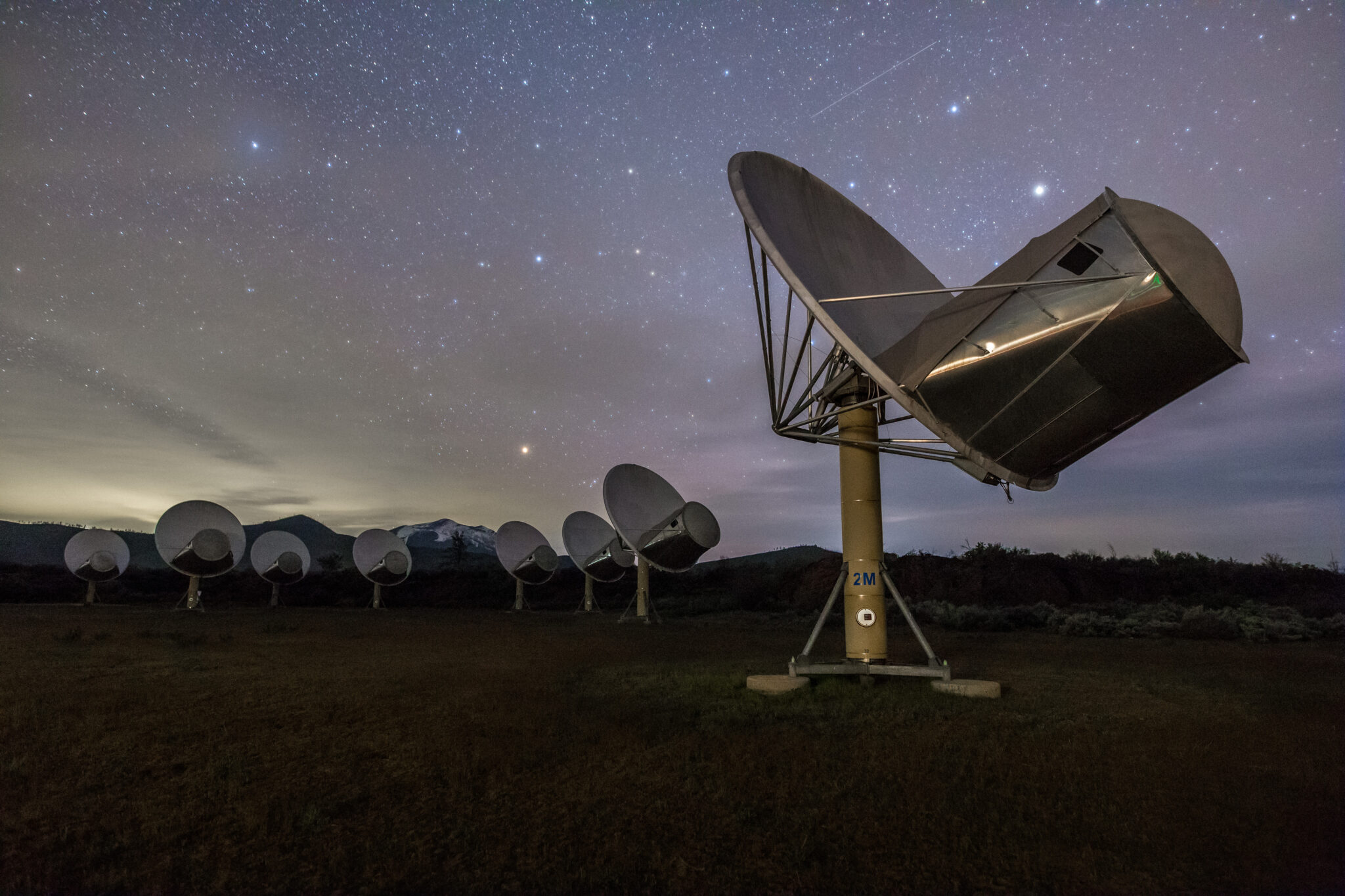
- Location — Allen Telescope Array, Northern California
The System Architecture (Layer by Layer)
🔵 Layer 1: Data Ingestion — DAQIRI
- Built on NVIDIA Holoscan platform
- Pulls terabits per second directly into GPU memory
- Processes data in flight (no waiting, no filling hard drives)
🟢 Layer 2: Signal Processing — CyberEther
- Developed by the SETI Institute
- Uses NVIDIA CUDA-X libraries:
- cuFFT → Fast Fourier Transform (converts signals into analyzable frequency data)
- cuBLAS → Linear algebra operations for mathematical analysis
- Handles the complex math of interpreting radio signals
🟡 Layer 3: Agent Control — Nexus
- Web-based observatory orchestrator
- Acts as the agent's control panel
- Provides agents with:
- Instrument status
- Compute resources
- Processing pipelines
- Researchers interact using natural language prompts
Step 4: What Can the Agent Actually Do?
A single agent, from one natural language request, can:
1. STEER    → Point telescope antennae toward a target
2. CALIBRATE → Focus the instrument for a clean signal
3. CORRECT  → Catch and fix incoming data errors
4. ANALYZE  → Apply AI models to the live data stream
5. REPORT   → Plot and present results
⏱️ Impact: Tasks that took humans weeks or years now take hours
Step 5: Real-World Proof — The Crab Nebula Achievement
Why does this matter?
The system already demonstrated real-world success:
First-ever real-time AI detection of a pulsar in the Crab Nebula
What is a pulsar?
- A rapidly spinning stellar remnant (collapsed star)
- Emits regular pulses of radio waves like a cosmic lighthouse
- Extremely precise and fast signals — ideal for testing detection systems
Why is this significant?
- Proves the pipeline works in real conditions
- Validates that AI agents can detect known complex signals
- Builds confidence for detecting unknown extraterrestrial signals
Step 6: The Bigger Philosophical Idea
AI searching for AI
Scientists suggest that if extraterrestrial civilizations exist, they could be billions of years older than humanity — meaning their technology, including AI, could be vastly more advanced.
Human-built AI agents → Searching for → Alien-built AI agents
"What they find may have much more in common with themselves than with the humans who created them." — Andrew Siemion, SETI Institute
Why this reframes SETI
- Traditional SETI: Humans listening for alien humans
- Modern SETI: AI systems listening for alien technology/AI
Step 7: What's Next?
| Development | Purpose |
|---|---|
| NVIDIA Nemotron open models | Faster local processing where internet/cloud isn't available |
| Far side of the Moon observatories | No Earth radio interference; agents running fully offline |
Summary: The Big Picture
PROBLEM:  Too much data, too fast, for humans alone
SOLUTION: Agentic AI that steers, processes, and analyzes in real time
RESULT:   Faster, smarter, scalable search for extraterrestrial signals
PROOF:    First real-time AI pulsar detection in the Crab Nebula
FUTURE:   Offline AI agents on the Moon, searching the universe autonomously
Quick Self-Check Questions
- What three challenges made traditional SETI data analysis difficult?
- What makes an AI system "agentic" rather than just automated?
- What role does each component play: DAQIRI, CyberEther, and Nexus?
- Why is the Crab Nebula pulsar detection considered a milestone?
- Why might future extraterrestrial signals look more like AI than biological life?