After studying this material, students should be able to:
- Explain what NVIDIA Omniverse is and how AI agents integrate with it
- Identify the core Omniverse libraries and their specific functions
- Describe the developer workflow for building simulations using frontier AI agents
- Recognize real-world use cases where AI-assisted simulation applies
- Understand how natural language instructions direct AI agents to assemble simulation components
Step-by-Step Teaching
Step 1: Understanding the Core Problem Being Solved
Before diving into tools, understand why this matters.
Building a simulation traditionally requires:
- Writing complex code manually
- Deep expertise in physics engines, rendering, and 3D assets
- Significant time connecting multiple systems together
The challenge looks like this:
Idea → Assets → Physics → Rendering → Sensors → Testing → Working App
         ↑          ↑          ↑           ↑          ↑
    (each step requires specialized knowledge and code)
The solution introduced here:
Developers use natural language instructions to direct frontier AI agents (like GPT-6 Astra or Claude Fable 5), which then generate the code and connections needed — while the developer reviews and guides the results.
Step 2: Understanding the Key Players
2A: What is NVIDIA Omniverse?
Think of Omniverse as a platform of building blocks for simulation. It provides:
| Component | What It Does | Real-World Analogy |
|---|---|---|
| GPU-accelerated physics | Simulates how objects move, collide, fall | Like a physics engine in a video game, but industrial-grade |
| Rendering | Creates realistic visual output | Like a camera capturing a scene |
| Sensor simulation | Mimics cameras, LiDAR, etc. | Like giving a robot virtual eyes |
| Scene management | Organizes 3D environments | Like a stage manager for a theater |
2B: What are Frontier AI Agents?
These are advanced AI models capable of:
- Understanding natural language instructions
- Writing and executing code
- Connecting multiple software libraries
- Iterating based on feedback
Examples mentioned:
- GPT-6 Astra — used across most projects
- Claude Fable 5 — used alongside Astra for sensor validation
2C: What is OpenUSD?
Universal Scene Description (USD) is a file format and framework for describing 3D scenes. Think of it as the common language all tools speak when sharing 3D data.
Step 3: Learning the Core Omniverse Libraries
These libraries are the building blocks AI agents connect together:
┌─────────────────────────────────────────────────────┐
│              OMNIVERSE LIBRARY STACK                │
├──────────────┬──────────────────────────────────────┤
│  ovphysx     │  Physics simulation                  │
│  ovstage     │  Scene updates and management        │
│  ovrtx       │  Rendering (visual output)           │
│  ovui        │  User interface                      │
│  ovstream    │  Streaming to browser/other apps     │
│  simready    │  Pre-built simulation-ready assets   │
└──────────────┴──────────────────────────────────────┘
Key insight: The AI agent's job is largely to connect these libraries correctly based on what the developer needs.
Step 4: Understanding the Developer Workflow
This is the core process used across all projects:
Step 1: Developer has an idea
           ↓
Step 2: Developer gives natural language instruction to AI agent
           ↓
Step 3: AI agent maps out the workflow / selects libraries
           ↓
Step 4: AI agent generates code connecting the components
           ↓
Step 5: Developer reviews results
           ↓
Step 6: Developer guides corrections or refinements
           ↓
Step 7: Working simulation application
Important: The developer does not disappear. They remain in control — directing, reviewing, and correcting at each stage.
Step 5: Learning Through Real Use Cases
Now apply the framework above to each project. Notice the pattern repeating in every case.
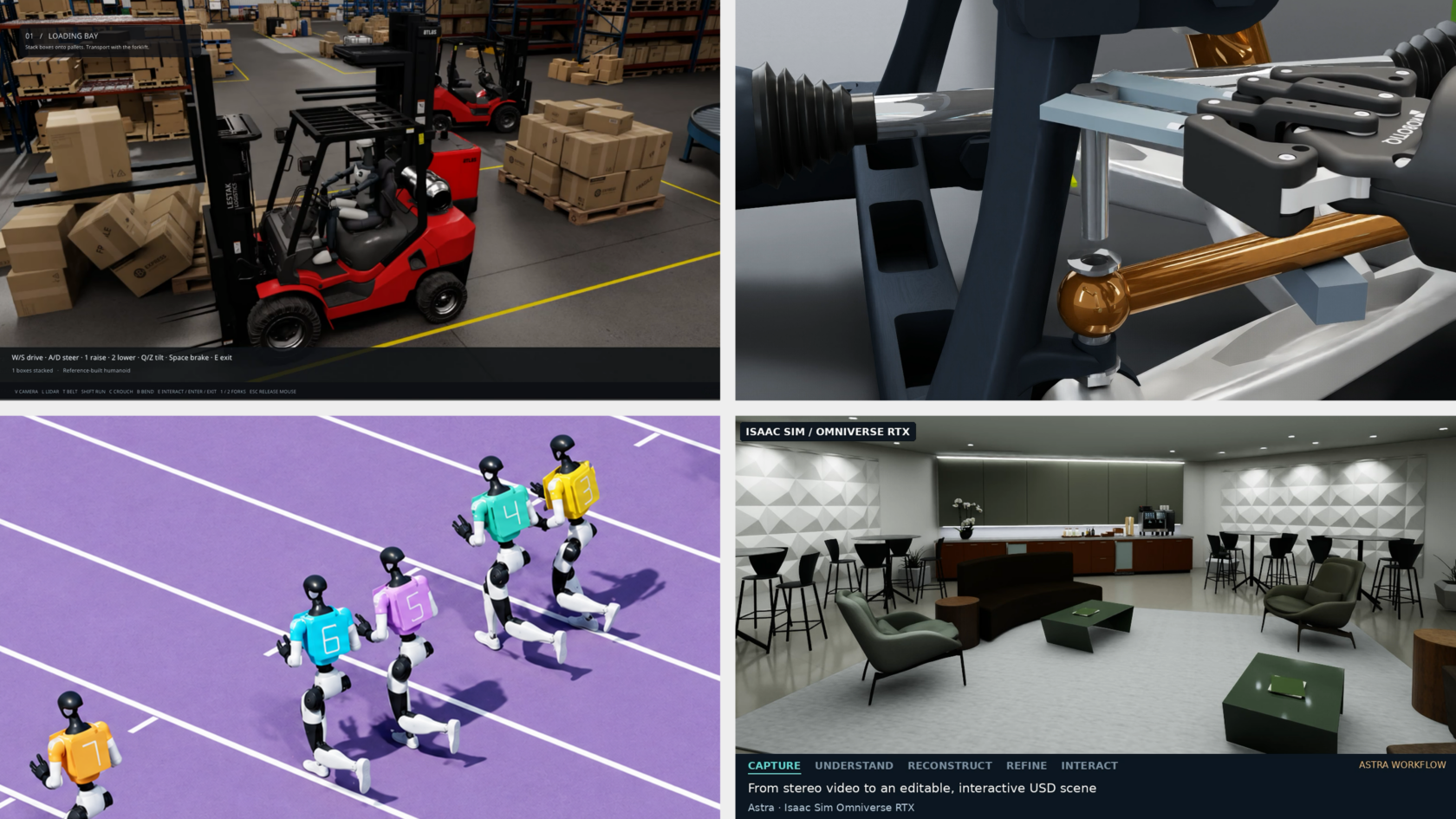
Use Case 1: Humanoid Warehouse Simulator
Problem: Need an interactive simulation to test warehouse robot behavior before real deployment
What the developer did:
- Directed Astra to connect:
ovphysx+ovstage+ovrtx+ovui+simready - Astra generated animation and application code
Result: Interactive simulator with first- and third-person views
Concept learned:
Multiple Omniverse libraries can be combined by an AI agent to create a complete interactive environment from a natural language request
Use Case 2: Autonomous Driving Testing
Problem: Scene, sensor, or model changes can unpredictably affect self-driving simulations
What the developer did:
- Asked Astra to build a reusable simulation of San Francisco's Market Street
- Connected: asset creation → traffic → RTX sensor simulation → driving model in stages
- Used Cosmos3-Nano to vary weather/lighting in recorded videos
Result: A testing ground to compare how changes affect driving behavior
Concept learned:
AI agents can build staged, modular workflows — connecting components one at a time and checking each integration before moving forward
Use Case 3: Digital Twin Sensor Validation
Problem: Simulated sensors must closely match real sensors for reliable robot/vehicle testing
What the developer did:
- Directed two AI agents (Astra + Claude Fable 5) to compare:
ovrtxcamera output vs. recorded camera data- Raw LiDAR output vs. recorded LiDAR data
- Agents measured differences, modified OpenUSD scenes, checked results
- Process ran iteratively over ~3 days
Result: Created 2 digital twins from scratch, improved 2 existing ones
Concept learned:
AI agents can run iterative improvement loops — measure → modify → check → repeat — guided by quantitative metrics (KPIs)
New term — Digital Twin:
A digital twin is a virtual replica of a real physical object or environment, accurate enough to test behavior and predict outcomes
Use Case 4: Robo Olympics
Problem: Need to verify that robot movements work under real physical constraints
What the developer did:
- Used sports videos + natural language to guide Astra
- Astra built controllers and refined them through physics trials
- Tools used: Newton Physics Engine + NVIDIA Warp (open source) +
ovrtx
Result: Robot cleared a hurdle in 64 of 100 simulation trials — giving data to improve timing and control
Concept learned:
Simulation trials generate quantitative feedback (e.g., 64/100 success rate) that developers use to improve robot behavior iteratively
Use Case 5: Robotic Disassembly Testing
Problem: Before deploying a robot to disassemble products, verify its tools can physically reach and remove parts
What the developer did:
- Directed Astra to model a car suspension in PTC Onshape (CAD tool)
- Configured it in NVIDIA Isaac Sim
- Astra measured available space and designed a custom wrench for the robot
Result: Successful removal of a suspension component in simulation
Concept learned:
AI agents can bridge design tools (CAD) and simulation tools, connecting design decisions directly to physical testing outcomes
Use Case 6: International Space Station Browser App
Problem: Turning 3D models + live data into a browser-accessible application
What the developer did:
- Used a single prompt to assemble NASA assets into an OpenUSD ISS model with telemetry
- Used a follow-up prompt to adjust the scene (shift to Earth's daytime side)
- Tools: Blender (asset prep) +
ovrtx+ovstage+ovstream
Result: 3D ISS model with operational data, viewable in a browser
Concept learned:
Complex multi-component applications can be initiated with a single natural language prompt, with refinements made through follow-up prompts
Use Case 7: Room Capture to Testing Environment
Problem: A scanned room needs editable objects and accurate physics before interaction testing
What the developer did:
- Used stereo camera captures processed through: PyCuSFM + FoundationStereo + nvblox
- Astra assembled assets and used USD Content Agents to configure object behavior
- Isaac Sim tests guided collision and contact revisions
Result: Editable studio environment where doors and drawers behave physically correctly
Concept learned:
Real-world captured data (camera scans) can be transformed into editable, physics-accurate simulations through an AI-guided pipeline
Step 6: Synthesizing the Big Picture
Now connect everything into one unified understanding:
┌─────────────────────────────────────────────────────────────┐
│                    THE OMNIVERSE AI WORKFLOW                │
│                                                             │
│  DEVELOPER (idea + direction + review)                      │
│       ↕  natural language                                   │
│  AI AGENT (Astra / Claude Fable 5)                          │
│       ↕  generates & connects code                         │
│  OMNIVERSE LIBRARIES (physics, rendering, sensors, scene)   │
│       ↕  outputs                                            │
│  SIMULATION (interactive, testable, improvable)             │
└─────────────────────────────────────────────────────────────┘
Three Roles Always Present:
| Role | Who/What | Responsibility |
|---|---|---|
| Director | Human developer | Sets goals, reviews, corrects |
| Builder | AI agent | Generates code, connects libraries |
| Infrastructure | Omniverse libraries | Executes physics, rendering, sensors |
Step 7: Key Concepts Summary
| Concept | Definition |
|---|---|
| Frontier AI Agent | Advanced AI model that can understand instructions and generate/execute code |
| NVIDIA Omniverse | Platform of GPU-accelerated simulation libraries |
| OpenUSD | Universal 3D scene description format used across tools |
| Digital Twin | Virtual replica of a real object/environment |
| SimReady Assets | Pre-built 3D assets ready for simulation use |
| Iterative Workflow | Repeated cycle of measure → modify → check |
| Isaac Sim | NVIDIA's robotics simulation platform |
| LiDAR | Sensor that measures distances using laser pulses |
| KPI-based feedback | Using measurable metrics to guide improvement |
Quick Self-Check Questions
- What is the developer's role when using AI agents for simulation — are they passive or active?
- Name three Omniverse libraries and what each one does
- What does "iterative workflow" mean in the context of digital twin improvement?
- How did the autonomous driving project use staged integration?
- What is the difference between a digital twin and a regular 3D model?
- Why would a developer simulate robotic disassembly before doing it physically?
Core takeaway: Frontier AI agents lower the barrier to building complex simulations by translating natural language into working code that connects specialized libraries — but the developer remains essential as the director who defines goals, reviews outputs, and guides improvements.