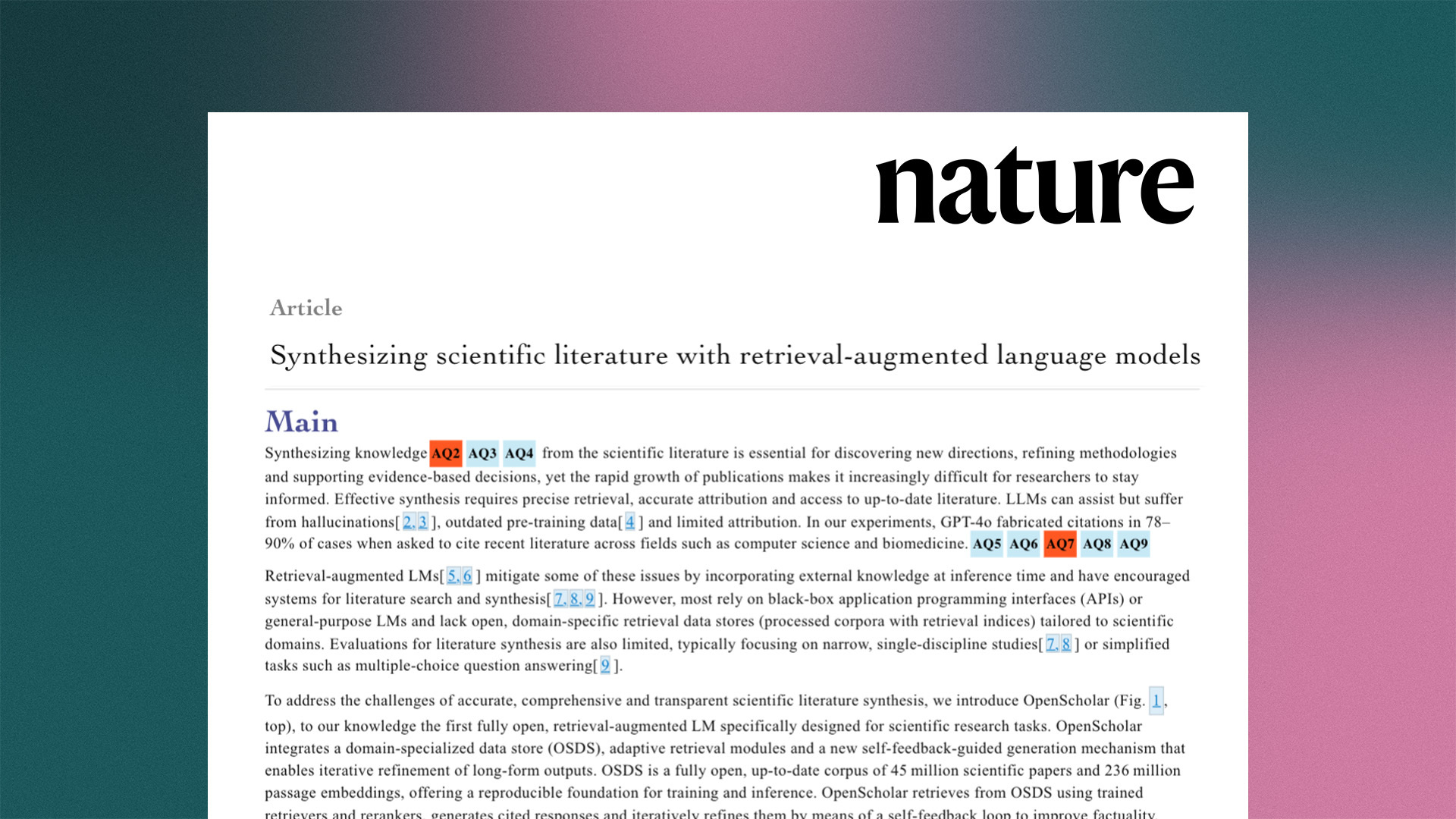
Ai2 develops an AI model to synthesize scientific literature with verifiable citations.
Concept 1: The Core Problem — Information Overload in Science
What is it?
Scientists must read and stay updated on thousands of new research papers published every single day. This is humanly impossible to do alone.
The Challenge
- The pace of scientific publishing is relentless
- No single researcher can read everything relevant to their field
- Missing important papers can slow down or misdirect research
Simple Analogy
Imagine trying to drink from a firehose. That's what keeping up with scientific literature feels like for researchers today.
Concept 2: The Problem with General-Purpose AI (Like ChatGPT)
What is it?
Current general AI systems can write, but they have a critical flaw for scientific use: they are not reliably grounded in real sources.
Two Specific Failures:
| Problem | What it means |
|---|---|
| Citing irrelevant work | The AI mentions real papers, but they don't actually support the claim |
| Hallucinating sources | The AI invents paper titles, authors, or journals that don't exist |
Why This Matters
In science, trust and verifiability are everything. A convincing-sounding answer with fake citations is worse than no answer — it can mislead researchers.
Concept 3: Retrieval-Augmented Generation (RAG)
What is it?
RAG is a technique that gives an AI the ability to search and retrieve real documents before generating an answer, rather than relying only on what it memorized during training.
How it Works (Step by Step):
User asks a question
        ↓
AI searches a large database of real documents
        ↓
AI retrieves the most relevant passages
        ↓
AI generates an answer BASED ON those retrieved passages
        ↓
AI cites the actual sources it used
Simple Analogy
Think of the difference between a student who answers from memory vs. one who looks things up in a library before answering. RAG is the library-using student.
Why RAG Solves the Hallucination Problem
Because the model is anchored to real retrieved text, it is much harder for it to invent sources — the sources are right there in front of it.
Concept 4: The Scientific Corpus — 45 Million Papers
What is it?
A corpus is simply a large, organized collection of text. In this case, the researchers built a corpus of 45 million open-access scientific papers.
Key Details:
- Open-access means the papers are freely available (not behind paywalls)
- This corpus is what the AI searches through when answering questions
- It includes newer papers, solving another weakness of standard AI (which only knows what it was trained on up to a certain date)
Why Size Matters
The larger and more current the corpus, the more likely the AI can find genuinely relevant evidence for any scientific question.
Concept 5: Full-Text Snippet Indexing
What is it?
An index is like the index at the back of a book — it helps you find information quickly. A full-text snippet index means the system can search through the actual content of papers (not just titles or abstracts) and retrieve small, relevant snippets (passages).
Why Snippets?
- Full papers can be very long
- The AI only needs the most relevant portion of a paper to answer a question
- Snippets make retrieval faster and more precise
Simple Analogy
Instead of handing someone an entire encyclopedia, you hand them the exact paragraph that answers their question.
Concept 6: Ranking — Finding the Best Results
What is it?
After retrieving many potentially relevant snippets, the system must rank them — deciding which ones are most useful to include in the answer.
Why Ranking Matters
- A search might return hundreds of snippets
- Not all are equally relevant or high quality
- Poor ranking = poor answers, even if the right information exists somewhere in the corpus
The Article's Point
The researchers show that careful ranking significantly improves answer quality. It's not just about finding information — it's about finding the right information and prioritizing it correctly.
Concept 7: Citation Handling
What is it?
Citation handling refers to how the system links specific claims in its answer to specific sources that support those claims.
Good Citation Handling Means:
- Every factual claim has a traceable source
- The cited source actually supports the claim made
- Scientists can click through and verify the evidence themselves
Why This is Hard
The AI must:
- Know which part of its answer needs a citation
- Match that part to the correct retrieved snippet
- Format the citation accurately
The Result
Scientists can inspect and validate every claim — they don't have to just trust the AI.
Concept 8: ScholarQABench — Measuring Performance
What is it?
A benchmark is a standardized test used to measure how well a system performs. ScholarQABench is the first large, multi-domain benchmark specifically designed to evaluate:
- Scientific synthesis quality
- Citation accuracy
Why a New Benchmark Was Needed
Existing benchmarks tested general knowledge or simple Q&A. No benchmark existed for the specific challenge of synthesizing scientific literature with proper citations.
Multi-Domain
The benchmark covers multiple scientific fields, not just one, making it a more robust and generalizable test.
Evolution
ScholarQABench
      ↓
ScholarQA-CS (Computer Science portion)
      ↓
ScholarQA-CS2 (included in AstaBench)
Concept 9: Open Science and Reproducibility
What is it?
The researchers made everything publicly available:
- Model checkpoints (the trained AI model itself)
- The retrieval index
- The data
- A live demo
Why This Matters
- Other scientists can verify the results
- Others can build on the work
- It prevents the system from being a "black box"
The Principle
Science advances when work can be inspected, validated, and extended by others — not just trusted on faith.
Concept 10: The Bigger Vision — Automated Research Assistants That "Show Their Work"
What is it?
The ultimate goal is an AI research assistant that doesn't just sound convincing but actually demonstrates its reasoning with verifiable evidence.
The Evolution of This Work:
This Paper (RAG + Scientific Synthesis)
        ↓
ScholarQA (question answering system)
        ↓
Asta (report generation capability)
        ↓
Deep Research Tulu / DR Tulu
(multi-step search + long-form research reports)
What "Multi-Step Search" Means (DR Tulu)
Instead of one search → one answer, the system can:
- Search for initial information
- Identify gaps in what it found
- Search again to fill those gaps
- Synthesize everything into a comprehensive report
Summary: How All Concepts Connect
PROBLEM: Too many papers + AI hallucinations
              ↓
SOLUTION: RAG (search real papers before answering)
              ↓
FOUNDATION: 45M paper corpus + snippet index
              ↓
QUALITY CONTROL: Careful ranking + citation handling
              ↓
EVALUATION: ScholarQABench (new benchmark)
              ↓
TRUST: Open-source, reproducible, verifiable
              ↓
VISION: AI assistants that show their work
The key insight of the entire article is this:
It's not enough for AI to sound right. In science, it must be verifiably right — and show exactly where its answers come from.