MolmoAct 2 shows what open models can unlock for robotics | Ai2
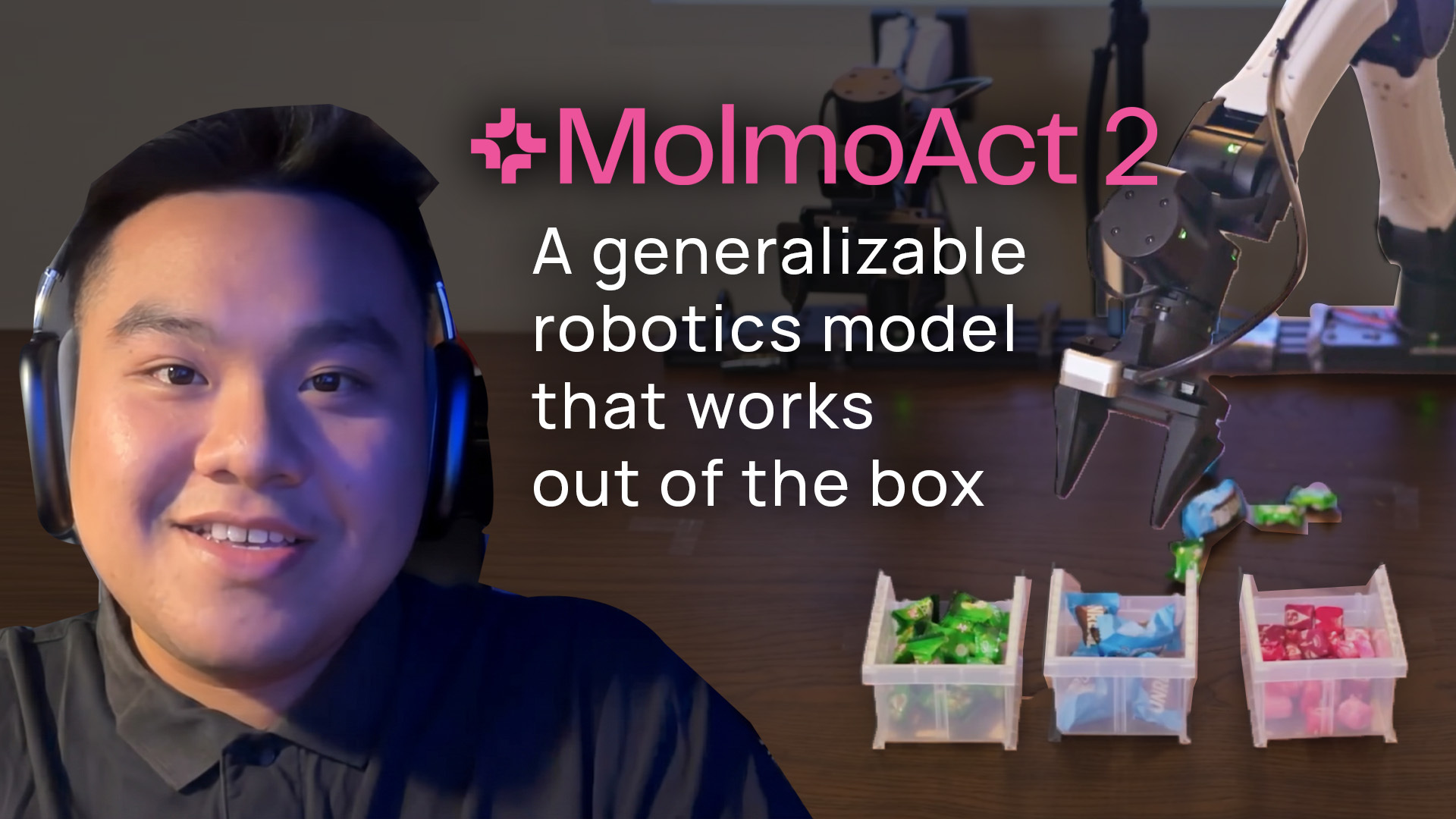
Concept 1: What is a "Foundation Model" in Robotics?
Traditional robots are trained to do specific tasks — pick up a red block, open a door, etc. If you give them a new task, they fail.
A foundation model is a large AI model trained on broad data that can generalize — meaning it can handle tasks it was never specifically trained on.
Key insight from the article: Pham gave MolmoAct 2 tasks it hadn't been trained on, and it still performed them. That's generalization in action.
Concept 2: Spatial Awareness in Robotics
One of the hardest problems in robot learning is:
Instruction → Understanding the scene → Taking the right action
This requires the robot to:
- See objects
- Understand WHERE they are in 3D space
- Connect that understanding to physical movement
MolmoAct 2 demonstrated strong spatial awareness, meaning it could identify objects AND reason about their positions to guide actions.
Concept 3: The "GPT-2 Moment" Analogy
Pham called this "the GPT-2 moment of robotics." Here's what that means:
| GPT-2 (2019) | MolmoAct 2 (2026) |
|---|---|
| Early but capable language model | Early but capable robot model |
| Showed language AI could generalize | Shows robot AI can generalize |
| Opened doors for future development | Opens doors for robotics community |
The point: GPT-2 wasn't perfect, but it signaled a turning point. MolmoAct 2 may represent that same turning point for robotics.
Concept 4: Open vs. Closed Models
This is a critical distinction in AI:
Closed models give you:
- ✅ Access to use the model
- ❌ No weights (the learned parameters)
- ❌ No training data
- ❌ No ability to customize
Open models like MolmoAct 2 give you:
- ✅ Model weights
- ✅ Training data
- ✅ Training code
- ✅ Fine-tuning scripts
Why does this matter for robotics specifically?
Robot learning systems are notoriously hard to reproduce. If you can't see the weights or training process, you can't build on someone else's work. Open models solve this.
Concept 5: Fine-Tuning and Customization
Because MolmoAct 2 is open, builders can fine-tune it — meaning they take the general model and adapt it to their specific robot or task.
Think of it like this:
General MolmoAct 2 model
        ↓
Fine-tune on YOUR robot's data
        ↓
Specialized model for YOUR use case
This is far more efficient than training a robot model from scratch, which requires enormous resources.
Concept 6: The "Out of the Box" Value
Pham noted that people were simply deploying MolmoAct 2 on their robots and it worked — without customization.
This is significant because it means:
- Low barrier to entry — you don't need massive compute or data
- Rapid prototyping — Pham built a working voice-controlled robot in a weekend hackathon
- Community acceleration — more people can experiment, leading to faster progress
Summary: The Big Picture
Open Model (weights + data + code)
        +
Strong Generalization (works on unseen tasks)
        +
Spatial Awareness (understands scenes)
        =
A foundation the entire robotics community can build on
The article's core message is that openness + capability together create a multiplier effect — not just one team benefits, but the entire field moves forward.
🔑 The GPT-2 analogy is the key takeaway: We may look back at MolmoAct 2 as the moment general-purpose robot learning became accessible to everyone.