🎯 Learning Outcomes
After studying this material, you should be able to:
- Explain the core problem KnowledgeForge solves (trapped ITSM knowledge + decaying knowledge bases)
- Describe the two-subsystem architecture (Generation + Curation) and how they form a closed loop
- Identify the AWS services used and justify why each was chosen
- Understand key engineering patterns: RAG grounding, vector-based duplicate detection, distributed orchestration, quality scoring, and multi-tenant isolation
- Apply these architectural patterns to design similar document-processing pipelines
📚 Step-by-Step Teaching Guide
STEP 1: Understand the Problem Before the Solution
Before touching any technology, you must clearly understand what problem exists.
The Two-Sided Problem
SIDE 1: The Ticket Graveyard          SIDE 2: The Messy Knowledge Base
─────────────────────────────         ────────────────────────────────
Thousands of resolved tickets    VS   Knowledge base exists but is:
each month, each containing:          • Full of duplicate articles
  • A symptom                         • Stale/outdated content
  • A root cause                      • Inconsistent quality
  • A working fix                     • Hard to search effectively

Result: Knowledge is TRAPPED          Result: Knowledge is UNUSABLE
Why This Matters
Think of it like a library where new books are locked in the basement (tickets), while the public shelves (knowledge base) are filled with outdated, duplicate copies of the same book.
Key insight: The resolutions already exist. The problem is access and organization, not missing information.
STEP 2: Understand the High-Level Architecture
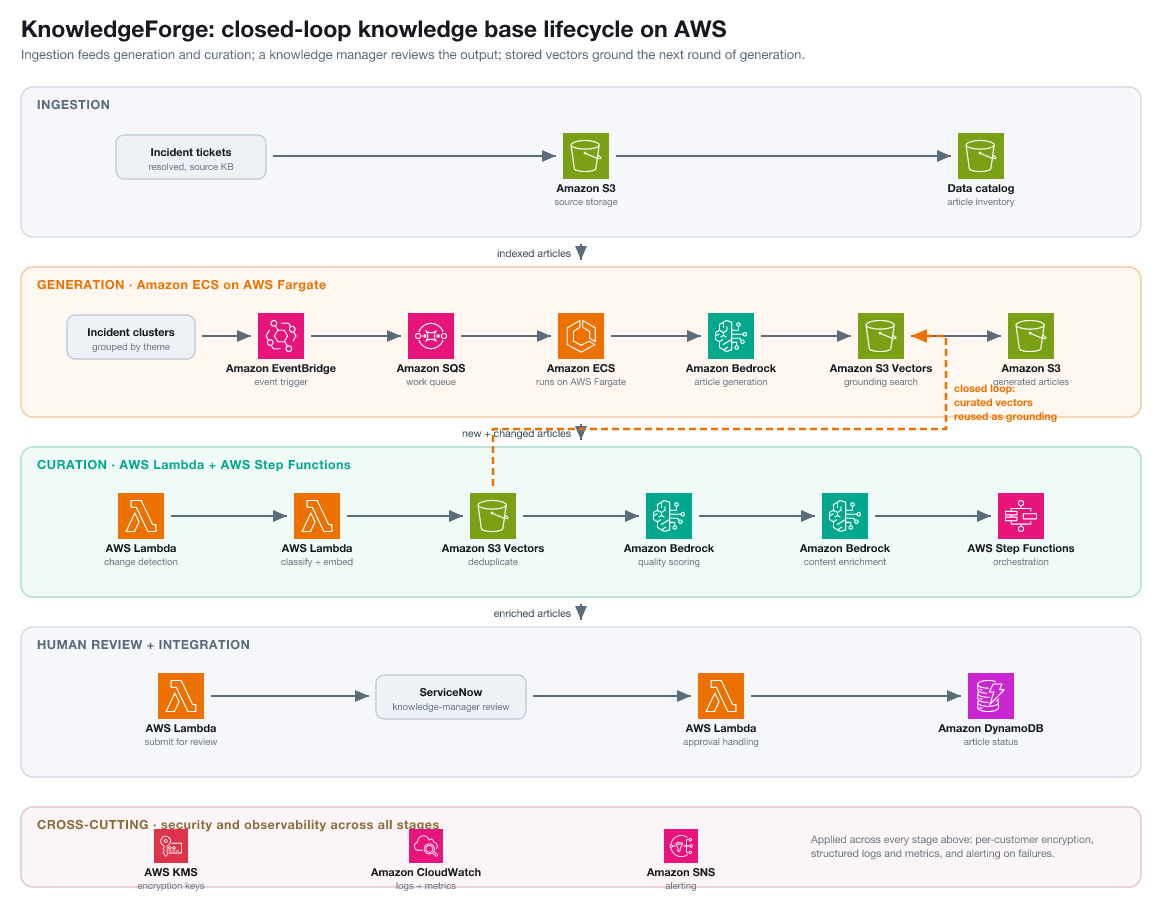
KnowledgeForge has two subsystems that feed each other in a closed loop.
┌─────────────────────────────────────────────────────────┐
│                    CLOSED LOOP                          │
│                                                         │
│  Incident Tickets                                       │
│       │                                                 │
│       ▼                                                 │
│  ┌──────────────┐    vectors    ┌──────────────────┐   │
│  │  GENERATION  │◄──────────────│    CURATION      │   │
│  │              │               │                  │   │
│  │ Tickets →    │──new articles─►│ Classify         │   │
│  │ Articles     │               │ Deduplicate      │   │
│  └──────────────┘               │ Score Quality    │   │
│                                 │ Improve Content  │   │
│                                 └────────┬─────────┘   │
│                                          │              │
│                                          ▼              │
│                                  Knowledge Manager      │
│                                  Reviews & Approves     │
└─────────────────────────────────────────────────────────┘
The Five Stages an Article Travels Through
| Stage | What Happens |
|---|---|
| 1. Ingestion | Ticket clusters arrive as JSON in S3 |
| 2. Generation | AI writes draft articles from ticket clusters |
| 3. Classification | Articles are sorted by type |
| 4. Curation | Deduplication → Quality Scoring → Improvement |
| 5. Review | Knowledge manager approves before publishing |
STEP 3: Learn the Generation Subsystem
How Generation Works — Step by Step
Step 3.1: Input arrives
Resolved Tickets (grouped by theme)
         │
         ▼
    JSON file in S3
    (per customer, per theme)
    Contains:
    • Keywords
    • Article scope
    • Sample ticket descriptions
    • Work notes from engineers
Step 3.2: The queue and compute layer
New S3 file
    │
    ▼
Amazon SQS Queue  ←── event notification
    │
    ▼
Amazon ECS + AWS Fargate container
(polls queue, processes up to 5 themes at once)
Why ECS + Fargate here?
| Requirement | Why Fargate Fits |
|---|---|
| Work takes several minutes per theme | Long-running containers (not short Lambda functions) |
| Workload arrives in bursts | Scales task count up/down based on queue depth |
| Team wants to focus on logic, not servers | Serverless containers — no EC2 management |
Step 3.3: RAG Grounding (Critical Concept)
Before writing anything, the system asks: "What already exists on this topic?"
Theme arrives
    │
    ▼
Query S3 Vectors index
"Find 5 most similar existing articles"
    │
    ▼
Pass those articles as CONTEXT to the AI model
    │
    ▼
AI generates new article GROUNDED in existing content
Why this matters: Without grounding, the AI might invent procedures or use inconsistent terminology. With grounding, new articles match the style and accuracy of proven content.
Step 3.4: What gets generated
For each ticket cluster/theme, the model produces two documents:
- A Knowledge Base Article (the fix, step-by-step)
- A Root Cause Analysis document (why it happened)
The system uses response streaming — it assembles the document as tokens arrive rather than waiting for the complete response. This reduces perceived latency on long documents.
STEP 4: Learn the Curation Subsystem
Curation handles all articles — both newly generated ones and existing knowledge base articles.
The Four Curation Steps
Article enters curation
        │
        ▼
┌───────────────────┐
│  1. CLASSIFY      │  What type of article is this?
└────────┬──────────┘
         │
         ▼
┌───────────────────┐
│  2. DEDUPLICATE   │  Does this already exist?
└────────┬──────────┘
         │
         ▼
┌───────────────────┐
│  3. SCORE QUALITY │  How good is this article?
└────────┬──────────┘
         │
         ▼
┌───────────────────┐
│  4. IMPROVE       │  If score is low, rewrite it
└────────┬──────────┘
         │
         ▼
    Published to ServiceNow
    for knowledge manager review
STEP 5: Deep Dive — Duplicate Detection with S3 Vectors
This is one of the most elegant patterns in the system.
Why Keyword Matching Fails
Article A: "Restart the network adapter to fix connectivity"
Article B: "To resolve connection issues, reboot the NIC"
Article C: "Network problems? Cycling the adapter usually works"

Keyword match: These look DIFFERENT
Meaning match: These are the SAME article
How Vector-Based Deduplication Works
Step 5.1: Every article gets converted to a vector
Article text
    │
    ▼
Amazon Titan Text Embeddings V2
    │
    ▼
1,024-dimension vector
(a list of 1,024 numbers representing the article's MEANING)
    │
    ▼
Stored in Amazon S3 Vectors index (per customer)
Step 5.2: New article is compared against existing vectors
New article → embed → query S3 Vectors index
                              │
                              ▼
                    Find top-5 nearest vectors
                              │
                              ▼
                    Cosine distance < 0.05?
                    (similarity > 95%?)
                         │         │
                        YES        NO
                         │         │
                    DUPLICATE    UNIQUE
                         │
                         ▼
                  Keep NEWER article,
                  retire OLDER one
Understanding Cosine Distance Threshold
Distance 0.0 = Identical articles
Distance 0.05 = 95%+ similar = DUPLICATE (flagged)
Distance 0.10 = Related but different = NOT duplicate
Distance 1.0 = Completely unrelated
Tuning insight: Too loose (0.10) → false duplicates flagged. Too tight (0.01) → reworded copies missed. The team sampled flagged pairs and adjusted until behavior was correct.
Why S3 Vectors Instead of a Dedicated Vector Database?
| Factor | S3 Vectors | Standalone Vector DB |
|---|---|---|
| Infrastructure | None (uses existing S3) | New service to manage |
| Cost model | Per query + per GB | Per running node (always-on cost) |
| Integration | Already in S3 ecosystem | Requires new connections |
| Scale | Grows with your content | May need resizing |
Bonus: The same index serves double duty — it's used for RAG grounding in Generation AND for duplicate detection in Curation.
STEP 6: Understand the Orchestration with Step Functions
Why Orchestration Is Needed
Curation processes tens of thousands of articles across many customers. You need:
- Work distributed across multiple workers
- Automatic retry on failures
- State tracking across long-running processes
- Protection against one bad article breaking everything
The Two-Phase Distributed Map
EventBridge (daily schedule)
        │
        ▼
Lambda: Find customers with new/changed articles
        │
        ▼
Group into batches → SQS FIFO Queue
        │
        ▼
Dispatcher: Pull one batch → Start Step Functions execution
        │
        ▼
┌───────────────────────────────────────┐
│         STEP FUNCTIONS STATE MACHINE  │
│                                       │
│  PHASE 1: Distributed Map             │
│  ┌─────────────────────────────────┐  │
│  │ For each article (concurrent):  │  │
│  │  • Classify type                │  │
│  │  • Deduplicate (sequential)     │  │
│  └─────────────────────────────────┘  │
│                                       │
│  PHASE 2: Distributed Map             │
│  ┌─────────────────────────────────┐  │
│  │ For each article (concurrent):  │  │
│  │  • Score quality                │  │
│  │  • Improve if below threshold   │  │
│  └─────────────────────────────────┘  │
└───────────────────────────────────────┘
Key Configuration Decisions Explained
Decision 1: STANDARD vs EXPRESS mode
| Mode | Max Duration | Execution History | Use When |
|---|---|---|---|
| EXPRESS | 5 minutes | Limited | Short, high-volume tasks |
| STANDARD | 1 year | Full history | Long AI calls + debugging |
KnowledgeForge uses STANDARD because Bedrock calls can exceed 5 minutes.
Decision 2: S3 pointer instead of inline state
❌ WRONG approach:
State machine carries full article HTML in its state
→ Hits 256 KB limit immediately with large articles

✅ CORRECT approach:
State machine carries only: { "s3_location": "bucket/article123.json" }
→ Workers read directly from S3
→ State payload stays tiny regardless of article size
Decision 3: FIFO Queue for ordering
Customer A articles: [A1, A2, A3, A4, A5] → processed in order
Customer B articles: [B1, B2, B3, B4, B5] → processed in order
                                              (parallel to Customer A)
Using customer ID as the message group key ensures:
- Each customer's batches process in order (prevents dedup race conditions)
- Different customers still run in parallel (no bottleneck)
STEP 7: Quality Scoring and Content Improvement
The Quality Score
Each article is scored across 10 weighted dimensions (highest to lowest weight):
Dimension                    Weight
─────────────────────────────────────
Technical accuracy           ████████ (highest)
Completeness                 ███████
Clarity                      ██████
Structure/formatting         █████
Step-by-step instructions    ████
Troubleshooting coverage     ███
Prerequisites listed         ██
Examples included            ██
Links/references             █
Metadata quality             █ (lowest)
─────────────────────────────────────
Weighted total = Quality Score (0-100)
The Improvement Decision
Article scored
      │
      ▼
Score ≥ threshold?
   │          │
  YES         NO
   │          │
Keep as-is   Send for AI improvement
              │
              ▼
         Score AGAIN after improvement
              │
              ▼
         New score > Original score?
              │          │
             YES         NO
              │          │
         Keep new    Keep original
         version     (don't make it worse!)
Critical safety check: The before-and-after scoring ensures the pipeline never silently degrades content quality.
The Media Placeholder Pattern
This solves a subtle but important problem: AI models tend to corrupt image URLs and hyperlinks when rewriting prose.
BEFORE improvement:
"See <img src='https://cdn.example.com/diagram.png'> for reference.
Visit <a href='https://docs.example.com/fix'>this guide</a>."

STEP 1 - Replace with tokens:
"See [IMG_1] for reference. Visit [LINK_1]."
(Store: IMG_1 = original img tag, LINK_1 = original link)

STEP 2 - AI improves prose:
"Refer to [IMG_1] for a visual overview.
Consult [LINK_1] for detailed instructions."

STEP 3 - Restore originals:
"Refer to <img src='https://cdn.example.com/diagram.png'> for a visual overview.
Consult <a href='https://docs.example.com/fix'>this guide</a> for detailed instructions."
The AI never sees raw URLs, so it cannot break them.
STEP 8: Resilience Patterns Under Load
Running tens of thousands of AI model calls concurrently requires careful engineering.
Three Controls for Predictable Generation
Control 1: Rate Limiting
─────────────────────────
Limit concurrent Bedrock calls per batch
→ Prevents hitting API quotas
→ Keeps costs predictable

Control 2: Guardrail Fallback
──────────────────────────────
If guardrail API throttles:
  → Process article WITHOUT guardrail
  → Log a WARNING
  → Continue (don't fail the whole batch)
Why: Keeps pipeline healthy during load spikes

Control 3: Token Budget Retry
──────────────────────────────
If response is cut off (hit token limit):
  → Detect "stopped at token limit" signal
  → Retry with DOUBLE the token budget
  → Up to model's maximum ceiling
Why: Long articles need more tokens; short articles pay nothing extra
Two Fault-Tolerance Mechanisms
Mechanism 1: Tolerated Failure Percentage
──────────────────────────────────────────
A few bad articles in a batch?
→ Continue processing the rest
→ Don't abort the entire batch

Mechanism 2: Dead-Letter Queue (DLQ)
──────────────────────────────────────
Repeatedly failing articles?
→ Move to DLQ for investigation
→ Don't block other articles
→ Don't stall the entire run
STEP 9: Multi-Tenant Isolation
The system serves multiple customers on shared infrastructure. Isolation is non-negotiable.
Per-Customer Resources
Customer A                    Customer B
──────────────────────────    ──────────────────────────
S3 Vectors index (A only)     S3 Vectors index (B only)
Custom prompts for A          Custom prompts for B
Encryption key (A only)       Encryption key (B only)
SQS FIFO message group A      SQS FIFO message group B
Why This Design Is Smart
❌ Shared pool approach:
One index for all customers
→ Customer A's articles could appear in Customer B's results
→ Data leakage risk
→ One customer's bad data affects others

✅ Per-customer approach:
Duplicate check runs against THIS customer's index only
Content improvement uses THIS customer's prompts only
Data encrypted under THIS customer's key only
→ Complete isolation by design
Onboarding new customers: No code changes needed. The system discovers customers from a data catalog at runtime. Adding a customer = provisioning their resources only.
STEP 10: Synthesize — The Four Key Lessons
These are the transferable patterns you can apply to your own pipelines:
| Lesson | Pattern | Benefit |
|---|---|---|
| 1. Reuse your vector index | Same index for RAG grounding AND duplicate detection | Solves two problems with one infrastructure component |
| 2. Pass pointers, not payloads | S3 location through Step Functions, not article content | Eliminates state-size failures at scale |
| 3. Score before AND after improvement | Quality check brackets the AI call | Safe to run automatically without degrading content |
| 4. Degrade gracefully under throttling | Guardrail throttle = warning, not failure | Pipeline stays healthy through load spikes |
🧠 Knowledge Check
Test your understanding with these questions:
-
Why does KnowledgeForge use ECS+Fargate for generation but Step Functions for curation?
-
Explain why cosine distance of 0.05 was chosen for duplicate detection. What happens if you set it to 0.20?
-
Trace the path of a single article from ticket cluster to published knowledge base article through all five stages.
-
Why is the media placeholder pattern necessary during content improvement?
-
What would happen if the system used a shared S3 Vectors index for all customers instead of per-customer indexes?
📋 Summary Diagram
ITSM Tickets (resolved, clustered by theme)
              │
              ▼
    ┌─────────────────────────────────────────────────────┐
    │              GENERATION (ECS + Fargate)             │
    │  RAG grounding → Claude Sonnet → KB Article + RCA  │
    └──────────────────────┬──────────────────────────────┘
                           │ new articles
                           ▼
    ┌─────────────────────────────────────────────────────┐
    │           CURATION (Step Functions)                 │
    │                                                     │
    │  Classify → Deduplicate    → Score → Improve        │
    │             (S3 Vectors)     (10     (Claude +      │
    │             cosine dist)     dims)   placeholders)  │
    └──────────────────────┬──────────────────────────────┘
                           │ vectors stored back
                           ▼
              S3 Vectors Index (per customer)
                           │
                           ▼ (also feeds back to Generation)
              Knowledge Manager Review (ServiceNow)
                           │
                           ▼
              ✅ Published Knowledge Base Article