Concept 1: What is Physical AI?
The Core Idea
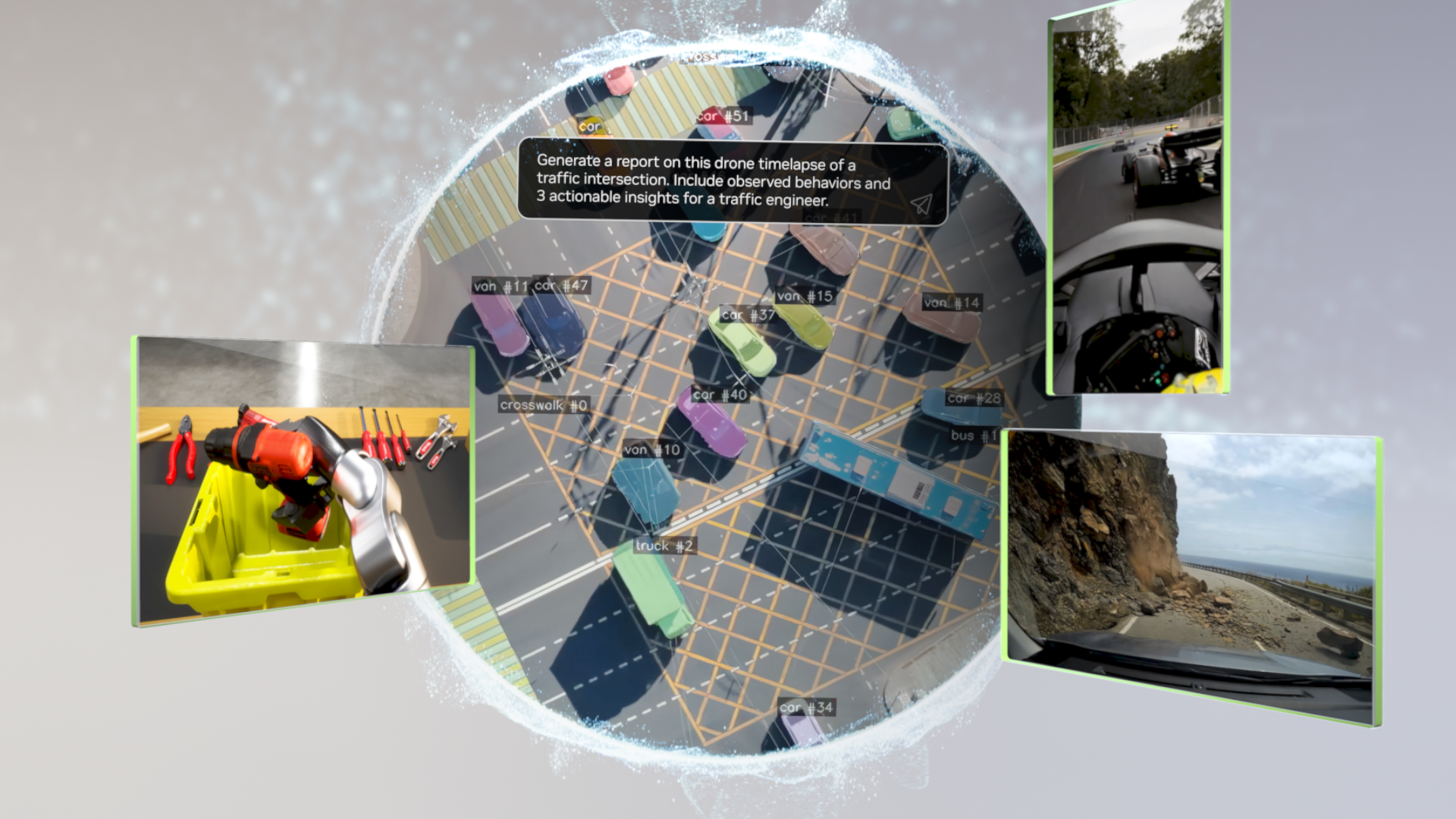
Physical AI refers to AI systems that must understand and interact with the real physical world — not just recognize images or generate text.
Key Examples:
- 🤖 Robots navigating warehouses
- 🚗 Autonomous vehicles driving on roads
- 👁️ Vision AI systems monitoring industrial spaces
What Makes It Different:
| Regular AI | Physical AI |
|---|---|
| Understands appearances | Understands consequences |
| Predicts words/images | Predicts what happens next |
| Works in digital space | Works in physical environments |
Simple analogy: Regular AI can describe a ball rolling. Physical AI understands that if the ball hits the edge of a table, it will fall off.
Concept 2: What Are World Models?
The Core Idea
World models are AI systems that learn how physical environments behave — essentially building an internal simulation of reality.
What They Can Do:
Real World Data → World Model →
    ├── Predict future states
    ├── Generate synthetic training data
    ├── Simulate rare/dangerous scenarios
    └── Provide a foundation for specialization
Why They Matter — The Data Problem:
Physical AI needs massive amounts of data, but:
- ❌ Real-world data is expensive to collect
- ❌ Rare events (crashes, failures) are hard to reproduce safely
- ❌ Every environment is different
World Models Solve This By Enabling:
- More useful data — learning physical relationships from large-scale multimodal scenarios
- More diverse environments — varying weather, lighting, objects, trajectories
- A better foundation — adaptable to specific robots, vehicles, or sensors
Concept 3: Open vs. Closed Models — Why Openness Matters
The Core Idea
Open models allow anyone to download, inspect, modify, and run them on their own infrastructure.
Why This Is Critical for Physical AI:
"Every deployment is a specialization problem."
A general model has never seen:
- Your specific robot design
- Your sensor configuration
- Your operating environment
The Specialization Gap:
General World Model
        ↓
   [GAP to close]
        ↓
Your Specific Robot/Vehicle/System
What You Need to Close That Gap:
| Requirement | What It Means |
|---|---|
| Access to model weights | Ability to modify the model internally |
| Permissive license | Legal right to adapt and deploy |
| Post-training tools | Technical capability to fine-tune |
NVIDIA's Approach:
Cosmos models use the Linux Foundation's OpenMDW 1.1 license, allowing teams to post-train on their own data and hardware.
Concept 4: NVIDIA Cosmos 3 — The Frontier World Model
The Core Idea
Cosmos 3 is an open physical AI foundation model that combines three capabilities in one:
         COSMOS 3
        /    |    \
       /     |     \
Vision    World    Action
Reasoning  Generation  Prediction
Why "One Model Family" Matters:
Previously, teams needed separate models for each task:
- ❌ One model to understand scenes
- ❌ Another to generate synthetic data
- ❌ Another to simulate future states
- ❌ Another for action prediction
Cosmos 3 replaces all of these with a single unified family.
The Model Family — Sized for Different Needs:
| Model | Size | Best For |
|---|---|---|
| Cosmos 3 Super | 64B parameters | High-fidelity world modeling |
| Cosmos 3 Nano | 16B parameters | Efficient reasoning & post-training |
| Cosmos 3 Edge | 4B parameters | On-device deployment (robots, edge GPUs) |
Architecture:
Built on a mixture-of-transformers architecture — a design that efficiently routes different types of tasks to specialized components within the model.
Concept 5: The Simulation Environment — Omniverse & OpenUSD
The Core Idea
Having a world model is only half the workflow. You also need environments to:
- Generate training data
- Run simulations
- Test behavior before real-world deployment
Two Key Tools:
🔧 NVIDIA Omniverse Libraries
- Prebuilt capabilities for building simulation-ready worlds
- Part of NVIDIA Agent Toolkit
- Lets teams train, test, and validate before real deployment
📐 OpenUSD (Universal Scene Description)
- Open framework for composing and exchanging complex 3D data
- Works across digital twins, simulations, and synthetic data generation
- Reduces duplicated work when assets or conditions change
The Workflow Together:
OpenUSD (3D Data Framework)
        +
Omniverse (Simulation Environment)
        +
Cosmos 3 (World Model)
        ↓
Complete Physical AI Development Pipeline
Simple analogy: If Cosmos 3 is the brain that understands physics, Omniverse is the virtual testing ground, and OpenUSD is the universal language everything speaks.
Concept 6: The Ecosystem — From Model to Real-World Deployment
The Core Idea
A model alone isn't enough. Physical AI requires an entire ecosystem of tools, partners, and standards.
NVIDIA's Full Physical AI Stack:
| Domain | Tool |
|---|---|
| World Foundation | Cosmos 3 |
| Robotics | Isaac GR00T |
| Autonomous Vehicles | Alpamayo |
| Vision AI | Metropolis |
Real-World Adoption Examples:
| Sector | Companies |
|---|---|
| 🤖 Robotics | Doosan Robotics, LG Electronics, Samsung, Skild AI |
| 🚗 Autonomous Vehicles | Li Auto, Xiaomi, Afari |
| 👁️ Vision AI | Centific, Milestone Systems, Fogsphere |
The NVIDIA Cosmos Coalition:
A collaborative network bringing together:
- World model builders
- AI developers
- Physical AI leaders
Contributing models, research, and evaluation methods — recently expanding to Japan for factories, logistics, agriculture, healthcare, and transportation.
🗺️ Full Concept Map Summary
PHYSICAL AI
    └── Needs to understand consequences, not just appearances
            └── WORLD MODELS solve this
                    ├── Generate training data
                    ├── Simulate rare scenarios
                    └── Provide adaptable foundation
                            └── Must be OPEN for specialization
                                    └── COSMOS 3 delivers this
                                            ├── Vision Reasoning
                                            ├── World Generation
                                            └── Action Prediction
                                                    └── Deployed via
                                                            ├── Omniverse (simulation)
                                                            └── OpenUSD (3D data)
Key Takeaway
Physical AI is fundamentally a specialization problem. Open world models like Cosmos 3 provide the foundation, but the real power comes from combining open weights + permissive licensing + simulation tools + a collaborative ecosystem — allowing every team to adapt general intelligence to their specific physical world.