After studying this material, you should be able to:
- Explain why standard A/B testing fails in two-sided advertising marketplaces
- Define SUTVA and describe how it gets violated through budget cannibalization
- Describe how Budget Split creates isolated experimental conditions
- Explain how Orthogonal Concurrency enables multiple simultaneous experiments
- Identify residual sources of interference that persist even with these solutions
Step-by-Step Study Material
Step 1: Understanding the Foundation — What is a Two-Sided Marketplace?
Before anything else, you need to understand what makes this environment special.
A standard app has one side:
Company → Users
A retail media marketplace has two sides:
Advertisers (pay money) → Platform → Customers (see ads)
Key constraint: Advertisers have finite budgets. This finite resource is what creates all the problems we will discuss.
Think of it like this: Imagine two restaurants sharing one kitchen. If Restaurant A uses all the stove burners, Restaurant B cannot cook. They are not independent.
Step 2: Why Standard A/B Testing Breaks Here
The Core Assumption: SUTVA
Every standard A/B test relies on SUTVA — Stable Unit Treatment Value Assumption.
SUTVA has one critical requirement:
What happens to User A must NOT affect what happens to User B
In a normal app, this holds reasonably well:
- User A sees a blue button → does not affect User B seeing a red button
- They are independent
How SUTVA Gets Violated in AdTech
Now introduce a shared budget and watch independence collapse:
Scenario:
- Variant A = New, more efficient bidding algorithm
- Variant B = Old baseline algorithm
- Both draw from the SAME campaign budget pool
The chain reaction:
Variant A wins more auctions
        ↓
Budget depletes faster
        ↓
Variant B has less money to spend
        ↓
Variant B performs worse artificially
        ↓
You conclude Variant A is better...
        ↓
...but was it really better, or did it just starve Variant B?
This is called Cannibalization Bias — one variant actively degrades the other's performance through shared resource consumption.
Analogy: You test two athletes on a treadmill, but they share one oxygen tank. The stronger athlete breathes more, leaving the weaker one gasping. You cannot fairly compare their natural abilities.
Step 3: The Solution — Budget Split
The Core Idea
Instead of one shared budget pool, create separate, isolated budget pools per variant.
BEFORE Budget Split:
Campaign Budget ($1000)
    ├── Variant A draws from here
    └── Variant B draws from here (competing!)

AFTER Budget Split:
Campaign Budget ($1000)
    ├── Sub-budget A ($500) → Only Variant A draws from this
    └── Sub-budget B ($500) → Only Variant B draws from this
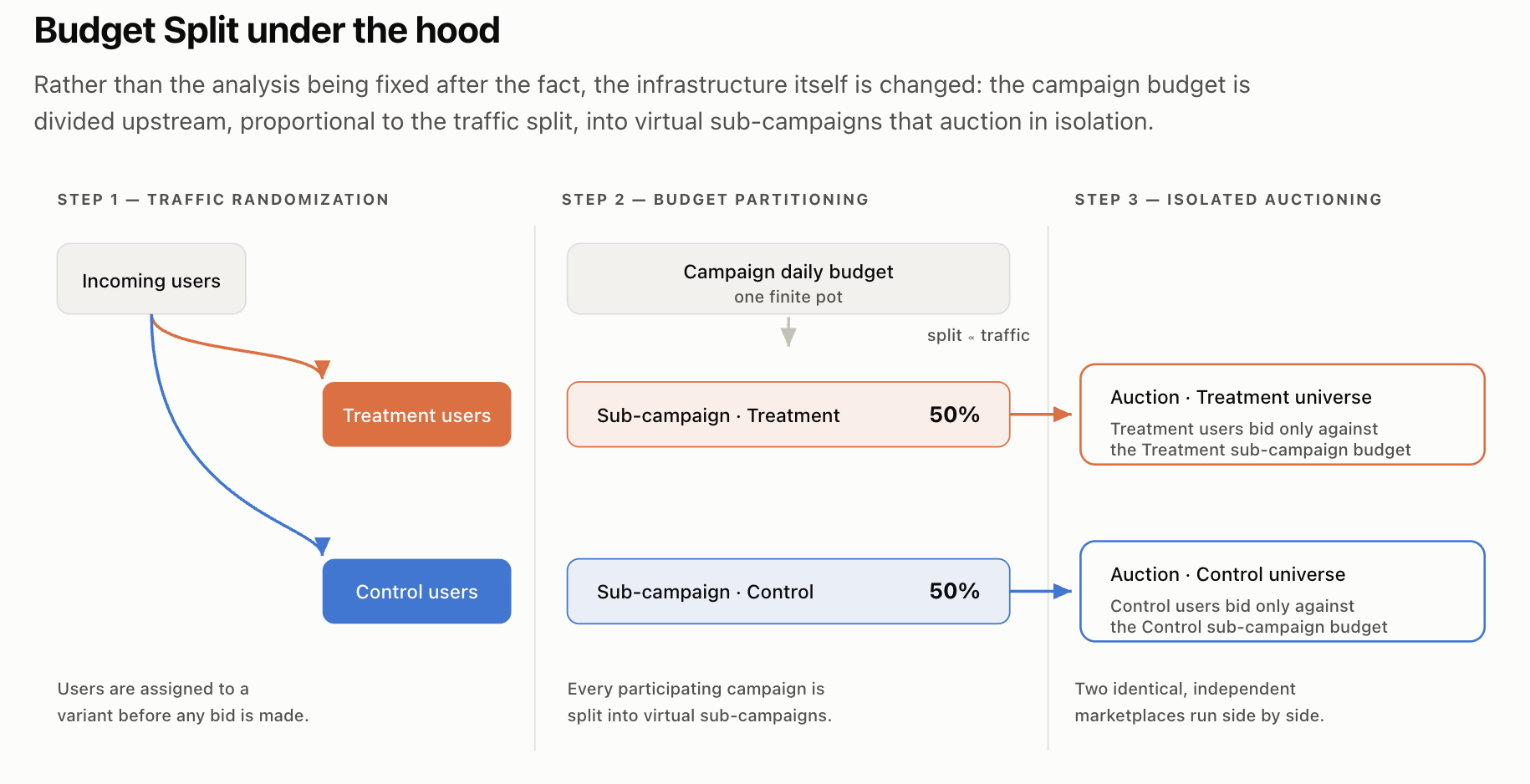
How It Works — Three Mechanical Steps
Step 1: Traffic Randomization
- Users are assigned to either Treatment or Control group
- This is standard A/B test randomization
Step 2: Budget Partitioning
- Every participating ad campaign is split into virtual sub-campaigns
- Split is proportional to traffic split
- 50/50 traffic split → 50/50 budget split
- 70/30 traffic split → 70/30 budget split
Step 3: Isolated Auctioning
Treatment user visits site
        ↓
Only Treatment sub-campaign budget participates in auction

Control user visits site
        ↓
Only Control sub-campaign budget participates in auction
Why This Works
By isolating budgets, you create two independent mini-marketplaces:
Universe A (Treatment):    Universe B (Control):
- Treatment users          - Control users
- Treatment budget         - Control budget
- Treatment algorithm      - Control algorithm
        ↑                          ↑
   No interference between these two universes
Now if Treatment outperforms Control, you can confidently attribute it to the feature, not to budget cannibalization.
Step 4: Scaling Up — Orthogonal Concurrency
The New Problem
Budget Split solves one experiment. But what happens when you want to run two experiments simultaneously?
Experiment 1: Testing new bidding algorithm (variants: 1A, 1B)
Experiment 2: Testing new ad format (variants: 2A, 2B)

Running at the same time = budgets interfere across experiments
The Solution: Orthogonal Concurrency
Orthogonal means the experiments are mathematically independent — knowing a user's assignment in Experiment 1 tells you nothing about their assignment in Experiment 2.
For two concurrent experiments, each campaign budget is split into four buckets:
Experiment 1 →    1A          1A          1B          1B
Experiment 2 →    2A          2B          2A          2B
                ------      ------      ------      ------
Budget Bucket:   1A2A        1A2B        1B2A        1B2B
Visual representation:
                 Experiment 2
                  2A    2B
              ┌──────┬──────┐
Experiment  1A│ 1A2A │ 1A2B │
    1         ├──────┼──────┤
            1B│ 1B2A │ 1B2B │
              └──────┴──────┘
Each cell is an isolated budget bucket. Users land in exactly one cell.
Why "Orthogonal"?
When you analyze Experiment 1:
- Compare all 1A users (1A2A + 1A2B) vs all 1B users (1B2A + 1B2B)
- Experiment 2's variants are equally represented in both groups
- Therefore Experiment 2 cannot bias Experiment 1's results
The experiments are orthogonal — they do not distort each other.
Step 5: Residual Problems — What Still Goes Wrong
Even with Budget Split and Orthogonal Concurrency, perfect isolation is impossible. Here are the remaining interference sources you must understand:
Problem 1: Algorithmic Campaign Steering
Automated systems adjust bids/budgets based on COMBINED performance
        ↓
Treatment's performance affects Control's budget allocation
        ↓
Indirect interference remains
Problem 2: Pre-Experiment ML Contamination
ML models (pCTR, pCVR) train on historical data
        ↓
Historical data reflects pre-experiment distributions (mostly Control)
        ↓
Treatment group's model is trained on Control-influenced data
        ↓
Treatment starts with a biased model
Timeline of contamination:
Past 7-28 days          Experiment starts
[Control data] ────────→ [Treatment uses contaminated model]
Problem 3: Human Interventions
Ad operations staff manually adjust budgets based on aggregate metrics
        ↓
They cannot see the experiment split
        ↓
Their adjustments introduce uncontrolled interference
Problem 4: Right-Censoring
Campaign runs beyond experiment window
        ↓
Revenue from those campaigns is cut off mid-measurement
        ↓
Revenue metrics are artificially depressed or skewed
Fallback Strategy
When isolation cannot be guaranteed, the team pivots to:
- Causal inference methods (non-experimental counterfactual analysis)
- These estimate what would have happened without the treatment
Step 6: The Real-World Impact
Understanding the business value completes the picture:
| Metric | Before (2023) | After (2025) |
|---|---|---|
| Experiments per year | ~8 | 60+ |
| Experiment reliability | Low (flaky) | High |
| Concurrency | Sequential only | Multiple simultaneous |
Why This Matters Beyond Statistics
Reliable experiments
        ↓
Trustworthy results
        ↓
Faster decisions (fail fast on bad ideas)
        ↓
More innovation cycles per year
        ↓
Competitive advantage
Summary: The Complete Mental Model
PROBLEM:
Two-sided marketplace → shared budgets → SUTVA violation → Cannibalization Bias

SOLUTION LAYER 1 — Budget Split:
Split campaign budgets proportionally → isolated sub-campaigns per variant
→ Eliminates direct budget cannibalization

SOLUTION LAYER 2 — Orthogonal Concurrency:
Split into N×M budget buckets for N concurrent experiments
→ Experiments cannot interfere with each other

REMAINING CHALLENGES:
- Algorithmic steering
- ML training contamination
- Human interventions
- Right-censoring

FALLBACK:
Causal inference when isolation fails
Quick Self-Check Questions
- What does SUTVA stand for and what is its core requirement?
- Explain in your own words how Cannibalization Bias occurs
- If a campaign has a $900 budget and traffic is split 60/40, what are the two sub-budget amounts after Budget Split?
- For three concurrent experiments (each with A/B variants), how many orthogonal budget buckets would you need?
- Why does pre-experiment ML training data create interference even after Budget Split is implemented?
Answer to Q4: 2³ = 8 buckets (1A2A3A, 1A2A3B, 1A2B3A, 1A2B3B, 1B2A3A, 1B2A3B, 1B2B3A, 1B2B3B)