After studying this material, you should be able to:
- Explain why AI governance is necessary at scale
- Describe the five pillars of Uber's Responsible AI program
- Understand how visibility, explainability, and governance are implemented technically
- Identify key tools and methods used (Model Catalog, SHAP, PFI, Integrated Gradients)
- Apply the concept of "shift-left governance" to AI development workflows
Step-by-Step Teaching Guide
Step 1: Why Does Responsible AI Matter?
The Core Problem
Imagine a company where hundreds of AI models make decisions every second:
- Calculating your ride price
- Predicting your driver's arrival time
- Detecting fraud on your account
Key Question: How do you ensure all these models are fair, reliable, and accountable?
The Stakes
| Without Governance | With Governance |
|---|---|
| Models behave unpredictably | Predictable, auditable behavior |
| Hard to debug failures | Clear insight into decisions |
| Compliance risks | Built-in regulatory alignment |
| Siloed knowledge | Shared understanding across teams |
Core Insight: As AI scales, governance cannot be an afterthought. It must be built into the system.
Step 2: Understanding the Five Pillars Framework
Uber's solution rests on five interconnected pillars. Think of them as building blocks stacked on each other:
        [ADOPTION]          ← Scaling it company-wide
           ↑
       [EDUCATION]          ← Teaching people to use it
           ↑
       [GOVERNANCE]         ← Enforcing the rules
           ↑
     [EXPLAINABILITY]       ← Understanding how models work
           ↑
        [VISIBILITY]        ← Knowing what models exist
Each pillar depends on the one below it. You cannot govern what you cannot see. You cannot explain what you do not understand.
Step 3: Pillar 1 — Visibility (Knowing What Exists)
The Tool: Model Catalog
Think of the Model Catalog like a library catalog for AI models.
Just as a library catalog tells you:
- What books exist
- What they are about
- Where to find them
The Model Catalog tells you:
- What AI models are deployed
- What they do
- How they perform
The Model Card
Each model gets a Model Card — a standardized document containing:
| Field | Example Content |
|---|---|
| Model description | "Predicts ETA for ride requests" |
| Performance metrics | Accuracy, error rates |
| Deployment details | When deployed, which platform |
| Feature importance | What inputs drive the output |
Why This Matters
Without a centralized inventory, teams duplicate work, governance teams cannot audit models, and no one has a complete picture of AI risk.
Key Design Principle: Many fields are automatically populated from system signals, reducing manual burden on engineers.
Step 4: Pillar 2 — Explainability (Understanding How Models Work)
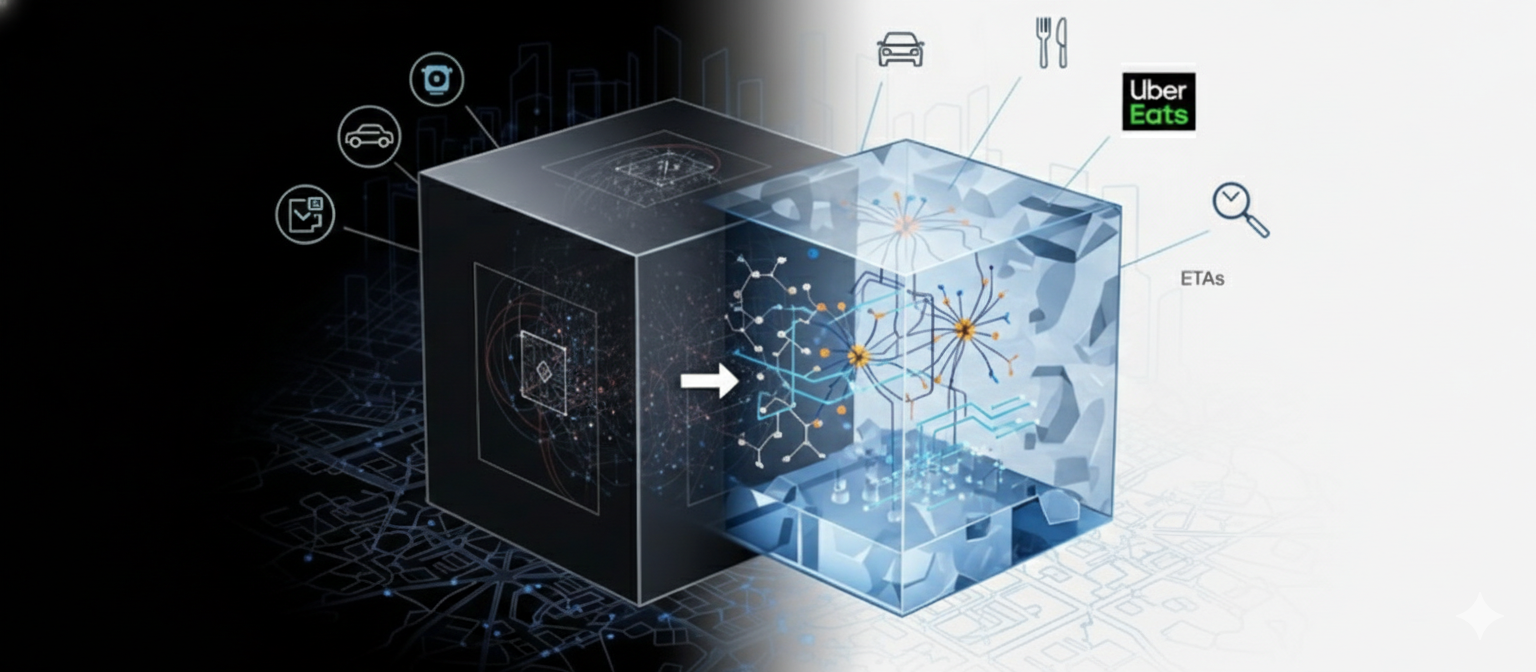
The Black Box Problem
Most AI models are like a black box:
INPUT → [????BLACK BOX????] → OUTPUT
You put data in, you get a prediction out, but you don't know why.
Explainability turns this into a glass box:
INPUT → [TRANSPARENT MODEL] → OUTPUT
         ↓
    "Feature X contributed 40%
     Feature Y contributed 35%
     Feature Z contributed 25%"
Three Levels of Explanation
Uber implements three complementary methods:
Level 1: Global Attributions — The Big Picture
Method: Permutation Feature Importance (PFI)
How it works:
- Train your model normally
- Take one feature (e.g., "distance")
- Randomly shuffle its values across all data points
- Measure how much model performance degrades
- Large degradation = that feature is very important
Example:
Normal accuracy: 92%
After shuffling "distance": 71%  → Distance is VERY important (−21%)
After shuffling "weather": 91%   → Weather is less important (−1%)
Use case: Understanding overall model behavior and risk
Level 2: Local Attributions — The Individual Prediction
Method: SHAP (SHapley Additive exPlanations)
How it works:
- Borrowed from game theory
- Asks: "How much did each feature contribute to THIS specific prediction?"
Example — Why was this ETA 12 minutes?

Base prediction:     8 min
+ Traffic feature:  +3 min
+ Distance feature: +2 min
+ Time of day:      −1 min
= Final ETA:        12 min
For tree-based models (like decision trees, random forests), Uber uses TreeSHAP, which is computationally efficient.
Use case: Debugging individual predictions, explaining decisions to users
Level 3: Integrated Gradients — Deep Learning Models
Method: Integrated Gradients
How it works:
- Used for neural networks
- Starts from a baseline input (e.g., all zeros)
- Gradually moves toward the actual input
- Accumulates gradients along this path to measure each feature's contribution
Baseline Input → → → → → Actual Input
(all zeros)    gradients   (real data)
               accumulated
               = attribution
Use case: Explaining neural network predictions where other methods don't apply
Summary Comparison
| Method | Model Type | Scope | Best For |
|---|---|---|---|
| PFI | Any (model-agnostic) | Global | Overall feature importance |
| TreeSHAP | Tree-based models | Local | Individual predictions |
| Integrated Gradients | Neural networks | Local | Deep learning models |
Step 5: Pillar 3 — Governance (Enforcing Responsible Practices)
The Shift-Left Approach
Traditional governance catches problems late:
Design → Build → Test → Deploy → [GOVERNANCE CHECK] ← Too late!
Shift-left moves governance checks earlier:
[GOVERNANCE CHECK] → Design → Build → Test → Deploy
         ↑
    Catch problems here, when they're cheap to fix
How Uber Implements This
-
Document Review Entry Point
- Engineers write PRDs (Product Review Documents) and ERDs (Engineering Review Documents)
- Governance checks are embedded at this stage
- Problems are caught before any code is written
-
In-Product Enforcement
- Engineers are prompted to complete Model Cards before deployment
- Acts as a gating mechanism — you cannot deploy without completing governance steps
Analogy: Like a seatbelt warning in a car. The car won't let you ignore safety. Governance is built into the workflow, not bolted on afterward.
Step 6: Pillar 4 — Education (Building AI Literacy)
Why Education Is a Pillar
Tools and processes only work if people understand them.
Uber's education strategy includes:
| Resource | Purpose |
|---|---|
| Training Courses | Teach responsible AI principles before model deployment |
| AI Resource Hub | Central documentation, guides, and learning materials |
The Goal: Responsible-First Mindset
Every engineer, product manager, and business owner should ask: "Is this AI being built responsibly?" — not just "Does this AI work?"
Step 7: Pillar 5 — Adoption (Scaling Across the Company)
The Challenge
Building a governance system is one thing. Getting every team to use it is another.
Uber faced two populations:
- New models → Catch them early with shift-left governance
- Existing models → Bring them into compliance retroactively
Key Concepts for Scaling
1. Life-Cycle-Aware Governance
Governance adapts to where a model is in its life cycle:
Experimentation → Development → Staging → Production
     ↓                ↓             ↓           ↓
Light touch      More checks    Full review  Ongoing monitoring
2. Adaptive, Technology-Agnostic Controls
- Rules are dynamic, not static
- New AI techniques (e.g., new GenAI frameworks) are automatically accommodated
- No need to rewrite governance rules every time technology changes
3. Precision with Context
- Not every model carries the same risk
- Governance uses contextual signals to distinguish:
- High-impact production models (need full review)
- Experimental notebooks (lighter touch)
4. System-Level Visibility
- AI at Uber spans multiple platforms and codebases
- Governance operates at the system level, not just individual files
Step 8: Putting It All Together — The Complete Picture
Here is how all five pillars work as an integrated system:
ENGINEER BUILDS A MODEL
         ↓
[VISIBILITY] — Model Card created in Model Catalog
         ↓
[EXPLAINABILITY] — Feature importance automatically computed
         ↓
[GOVERNANCE] — Shift-left checks at PRD/ERD stage
               Gating mechanism before deployment
         ↓
[EDUCATION] — Engineer trained on responsible AI principles
         ↓
[ADOPTION] — Model brought into company-wide governance framework
         ↓
MODEL DEPLOYED RESPONSIBLY
Step 9: Key Takeaways
| Concept | What to Remember |
|---|---|
| Model Catalog | Single source of truth for all AI models |
| Model Card | Standardized document for each model's attributes |
| PFI | Measures global feature importance by shuffling values |
| SHAP/TreeSHAP | Explains individual predictions using game theory |
| Integrated Gradients | Explains neural network predictions |
| Shift-Left | Move governance checks to the earliest possible stage |
| Glass Box | The goal — transparent, interpretable AI systems |
Quick Knowledge Check
Test yourself with these questions:
-
What problem does the Model Catalog solve? (Answer: Provides a centralized, searchable inventory of all AI models — visibility)
-
What is the difference between PFI and SHAP? (Answer: PFI gives global/overall feature importance; SHAP explains individual predictions)
-
What does "shift-left" mean in governance? (Answer: Moving compliance checks to the earliest stages of development, not at deployment)
-
Why is education considered a pillar of responsible AI? (Answer: Tools only work if people understand and adopt a responsible-first mindset)
-
What is the "glass box" approach? (Answer: Making AI systems transparent and interpretable, as opposed to opaque black boxes)
Final Thought: Responsible AI is not a one-time project. It is an ongoing commitment — embedding accountability into platforms, workflows, and culture so that innovation and trust can grow together.