After studying this material, students should be able to:
- Define what an AI agent skill is and how it functions
- Explain why skills grow faster than traditional software ecosystems
- Analyze the gap between skill supply (listings) and skill demand (installs)
- Identify which categories of skills perform best and why
- Understand the concentration patterns in skill adoption
- Predict where the agent skills market is heading next
Step-by-Step Teaching
Step 1: What Is an Agent Skill?
Think of an AI agent like a highly capable but generic new employee.
- They are intelligent and can do many tasks
- But they do not know your specific way of doing things
A skill fills that gap.
A skill gives an agent reusable instructions for a particular job — the steps to follow, what good looks like, and how to evaluate the result.
Simple Analogy
| Without a Skill | With a Skill |
|---|---|
| Agent knows how to write emails generally | Agent knows YOUR company's tone, format, and approval rules |
| Agent can review documents | Agent knows YOUR refund policy criteria |
Key insight: A skill can be as simple as a plain language text file. You do not need to be a programmer to write one.
Step 2: Why Skills Grow Faster Than Traditional Software
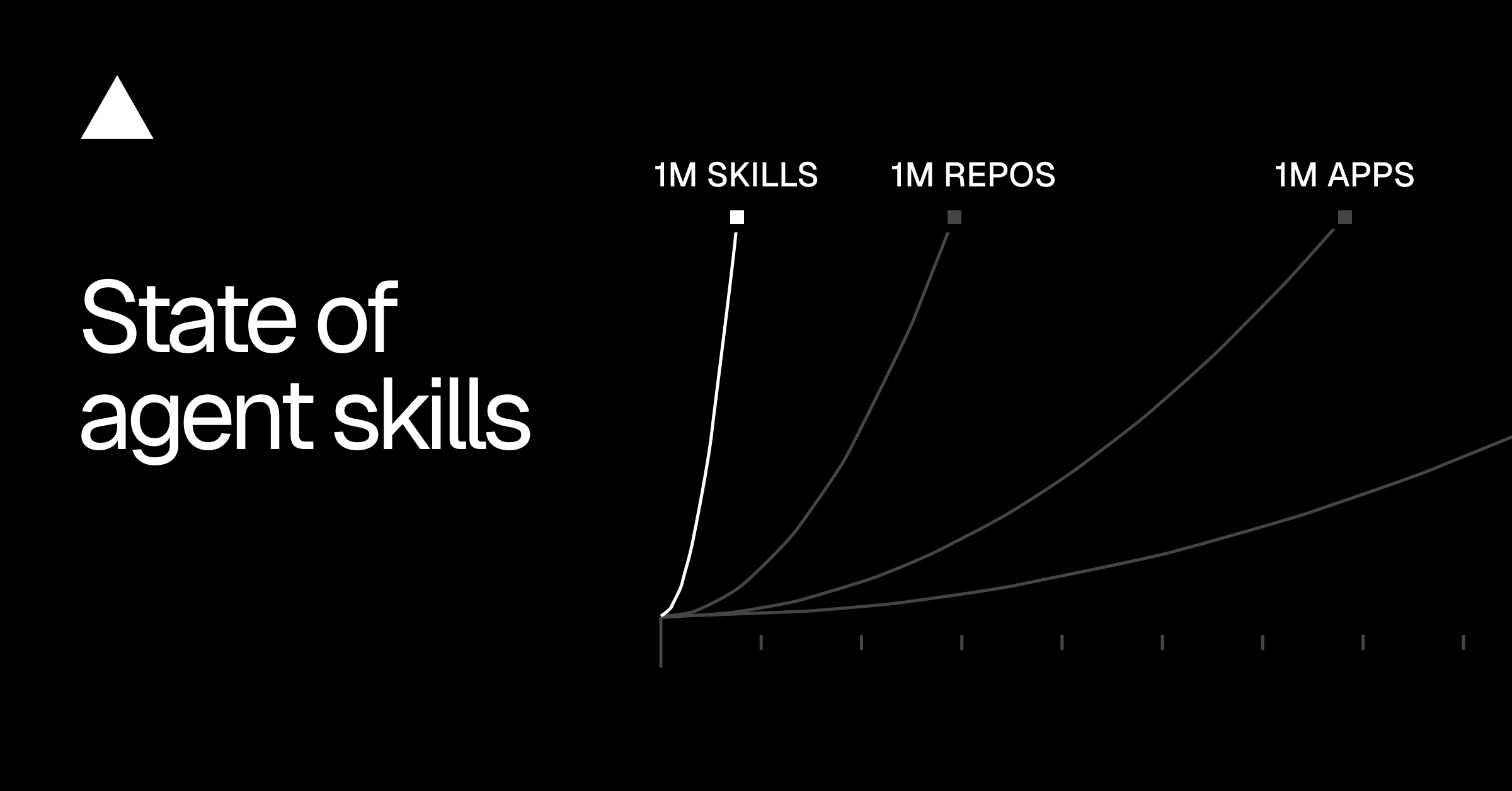
This is a critical concept. Compare time to reach one million items:
| Platform | Time to 1 Million |
|---|---|
| skills.sh | 7 months |
| GitHub repositories | 27 months |
| Apple App Store | ~63 months (5+ years) |
| npm packages | ~117 months (9+ years) |
Why such a dramatic difference?
There are two reasons:
Reason 1 — Lower barrier to create
- Writing code requires programming knowledge
- Writing a skill requires only the ability to describe how a job is done
- This opens creation to a vastly larger pool of people
Reason 2 — Reusability without rewriting
- Once a skill is written, it can be installed by anyone
- It does not need to be adapted or rewritten for each new agent
Think of it this way: millions of people know how to do expense reports, but only thousands can code an expense report application. Skills let the millions contribute.
Step 3: Understanding Supply vs. Demand
This is where the data becomes analytically interesting.
Definitions first:
- Listings = Supply → what skill authors have made available
- Installs = Demand → what people actually want agents to learn
The Gap
| Category | Share of Listings (Supply) | Share of Installs (Demand) |
|---|---|---|
| Software Engineering | ~25% | 18% |
| Agent Workflows | moderate | 15% |
| Business Operations | low | ~11% |
| Writing & Documents | low | ~11% |
Pattern to notice:
- Supply is heavily technical (developers built the ecosystem first)
- Demand is broadly distributed (agents are useful everywhere in a company)
Why does this gap exist?
To write a skill, you need to understand a job deeply enough to explain it. To install a skill, you only need to want the job done.
Early adopters were developers, so they wrote developer skills. But the people installing skills come from every department.
Step 4: Which Skills Perform Best Per Listing?
To measure this fairly, analysts used an efficiency index:
Index = (Category's share of installs) ÷ (Category's share of listings)
- A score above 1.0× means the category gets more installs than its size would predict → underserved demand
- A score below 1.0× means the category gets fewer installs than its size → oversupplied
Winners (High installs per listing):
| Category | Performance vs. Average |
|---|---|
| Business Operations | +74% more installs than average |
| Writing & Documents | +50% more installs than average |
| Cloud & Infrastructure | +42% more installs than average |
Underperformers (Low installs per listing):
| Category | Performance vs. Average |
|---|---|
| Software Engineering | -30% fewer installs than average |
| Education & Productivity | -39% fewer installs than average |
| Research | -55% fewer installs than average |
What does this tell us?
Business operations and writing skills are undersupplied relative to demand. There is a market opportunity here. Research and education skills are oversupplied — many listings compete for relatively fewer installs.
Step 5: The Special Case of Agent Workflow Skills
This deserves its own step because it reveals something important about how agents evolve.
Agent workflow skills teach agents how to be better agents — how to plan, route tasks, use tools, and automate processes.
Why are these so powerful?
Consider the difference:
| Narrow Skill | Broad Skill |
|---|---|
| Contract review skill → applies only to contracts | Planning skill → applies to contracts, research, emails, and everything else |
Agent workflow skills have multiplicative value — they improve performance across every other skill installed.
People are using agents to improve agents. And because agents also help write skills, the catalog grows by improving the very machinery used to build it.
This is a self-reinforcing loop: better agents → better skills → better agents.
Step 6: How Installs Are Concentrated
The distribution of installs follows a power law — a pattern common in software ecosystems.
The numbers:
- Nearly 50% of all skills were installed exactly once
- The top 375 skills (0.04% of registry) account for 62% of all installs
- The top 1.2% of skills account for 94% of all installs
But here is the important nuance:
Despite this concentration, no single skill dominates everything. The most-installed skill accounts for less than 1% of total installs.
Why?
Skills compete within jobs but accumulate across jobs.
Example:
A team picks ONE expense-report skill → winner takes that job
But that same team also installs skills for:
  → spreadsheets
  → research
  → presentations
  → writing
Each job category has its own winner. The total install count is spread across many job-specific winners rather than one universal champion.
Step 7: Cross-Industry vs. Industry-Specific Skills
The data:
| Type | Share of Listings | Share of Installs | Installs per Listing |
|---|---|---|---|
| Cross-industry skills | 66% | 87.5% | 3.6× higher |
| Industry-specific skills | 34% | 12.5% | lower |
Why do cross-industry skills dominate?
A skill for cleaning up a spreadsheet can be used by:
- A bank
- A hospital
- A law firm
- A restaurant
A skill for processing insurance claims can only be used by insurance companies.
Portability = reach = installs.
The most valuable skills are the ones the most people can use.
Step 8: Where the Market Is Heading
The article identifies a clear directional shift in two areas:
Shift 1: From General to Specific Knowledge
| First Generation | Next Generation |
|---|---|
| Public skills teaching what everyone knows | Private skills teaching what only your organization knows |
| General expertise as an advantage | General expertise becomes the baseline |
| Value in broad reach | Value in company-specific judgment |
Example of company-specific knowledge:
- Under what conditions does a customer get a refund?
- What can ship without an additional review?
These answers differ by company. No public skill can encode them.
Shift 2: From Popularity to Effectiveness as the Quality Signal
| Today | Future |
|---|---|
| Best signal = install count | Best signal = measured performance improvement |
| Popularity indicates quality | Skills will have tests and benchmarks |
| Passive adoption | Active evaluation: does the agent do the job better with this skill than without it? |
Summary: The Complete Mental Model
AI Agent = Capable but Generic
     +
Skill = Specific Job Knowledge
     =
Agent that can do YOUR work YOUR way
The ecosystem works because:
- Skills are easy to create (plain language)
- Skills are reusable without rewriting
- Demand spans every industry and function
- Cross-industry and workflow skills multiply in value
The market signal:
- Oversupplied: technical/developer skills
- Undersupplied: business operations, writing, research
- Highest leverage: agent workflow skills (improve everything else)
The future direction:
- Public catalog → baseline capability
- Private organizational skills → competitive advantage
- Install count → effectiveness benchmarks as the quality measure