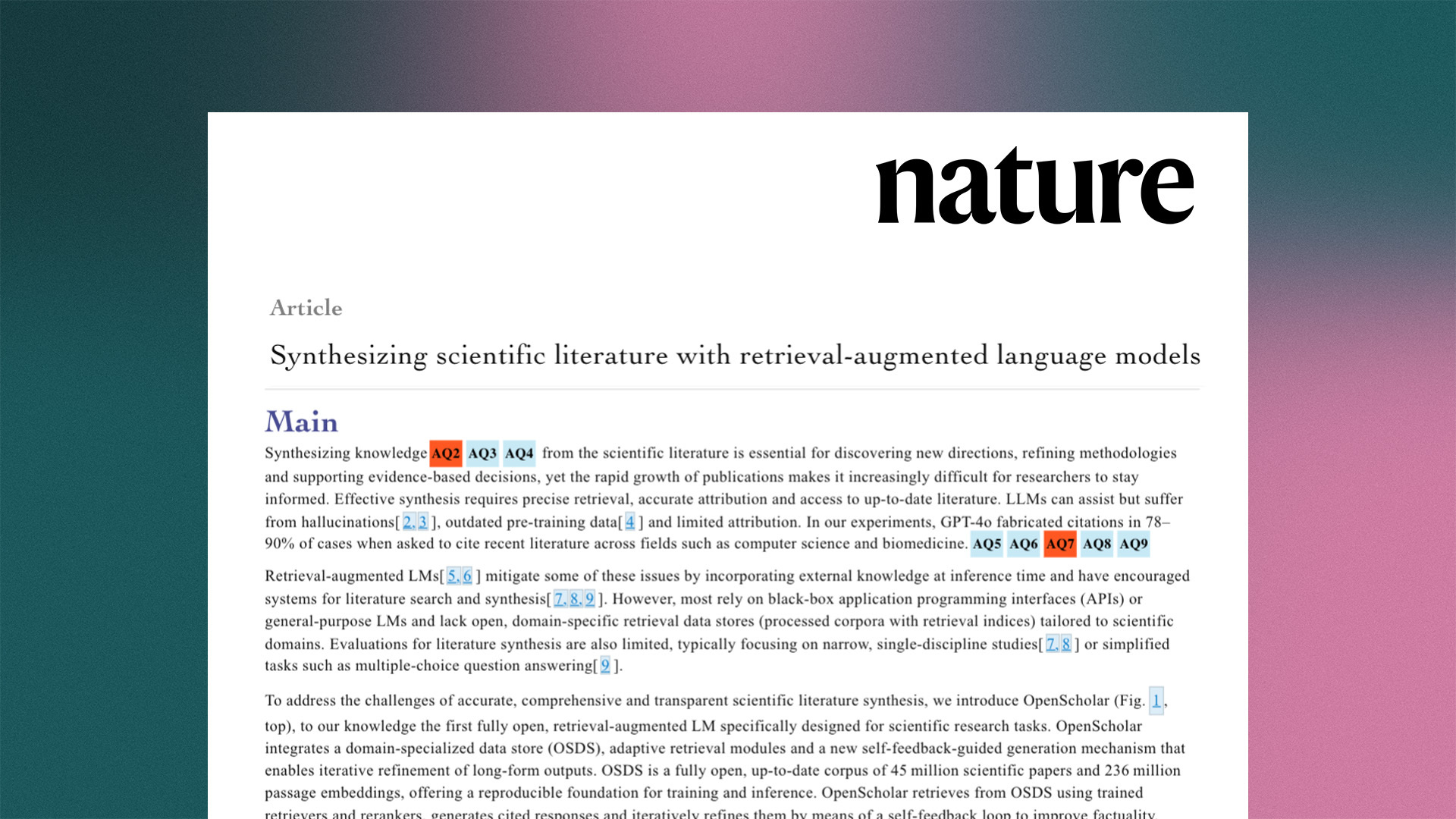
OpenScholar, an AI for reliable scientific synthesis, has been accepted to Nature.
TL;DR
OpenScholar is an open-source AI built to actually show its receipts—it synthesizes scientific literature with verifiable citations so researchers can move faster without trusting “made-up” sources.
Key Discoveries (10 total)
-
The article identifies a core failure of general-purpose AI for research: it often produces plausible summaries but cannot reliably ground claims with correct, relevant evidence (and may invent citations).
-
OpenScholar is introduced as an open-source model purpose-built for scientific literature synthesis with verifiable citations, prioritizing trust over “sounding right.”
-
OpenScholar combines a scientific-synthesis model with retrieval-augmented generation (RAG), meaning it searches a large paper collection and uses retrieved papers to support what it writes (RAG = “look up sources first, then write”).
-
The system was designed to incorporate relevant and newer papers by searching a large scientific corpus rather than relying only on what the model “remembers.”
-
The team constructed a corpus of 45 million open-access scientific papers to support grounding and retrieval at scale.
-
They developed a full-text snippet index so OpenScholar can retrieve specific passages from papers (snippet index = a searchable map of exact text chunks, not just titles/abstracts).
-
That retrieval infrastructure was later made available through the Semantic Scholar API, enabling broader access and reuse.
-
They created ScholarQABench, described as the first large, multi-domain benchmark to evaluate scientific synthesis systems specifically on both answer quality and citation quality (benchmark = a standardized test for comparing systems).
-
The computer-science portion, ScholarQA-CS, evolved into ScholarQA-CS2, a long-form scientific QA benchmark now included in AstaBench, extending evaluation toward longer, report-like answers.
-
The work reports that careful retrieval, ranking, and citation handling can significantly improve usefulness and trustworthiness of AI answers in scientific settings, and OpenScholar’s artifacts (checkpoints, index, data, demo) are publicly available to inspect, validate, and extend.
Why This Matters
Scientific publishing moves too fast for any person to read everything, but “confident-sounding” AI that can’t prove its claims is risky—especially in research, where a wrong citation can waste weeks or mislead entire projects. OpenScholar tackles this by making evidence a first-class requirement: it searches real papers, pulls relevant passages, and cites them so users can verify what’s being claimed.
Just as importantly, the project doesn’t only ship a model—it also ships infrastructure (a massive open corpus and snippet index) and measurement tools (ScholarQABench) so the community can reproduce results, compare systems fairly, and build better research assistants that show their work rather than bluff.
The Research Approach
The researchers treated “scientific answering” as an evidence-first workflow, not a pure text-generation task. Instead of asking a model to answer from memory, they built a system that behaves more like a careful research assistant: it looks up papers, pulls relevant passages, then writes while attaching citations you can check.
Here is the process in simple steps:
-
They started with a model trained for scientific synthesis. This is a language model tuned to do a specific job: read multiple research sources and produce a coherent explanation, rather than just generating fluent text.
-
They added Retrieval-Augmented Generation (RAG). RAG means the model does not rely only on what it learned during training. It first retrieves relevant documents from a large library, then uses those documents as the basis for its answer. Think of it like writing with an open-book exam instead of a closed-book exam.
-
They built the “library” at research scale: a corpus of 45 million open-access scientific papers. This matters because retrieval only works well if the system has broad coverage of the literature, including newer papers the model may not have seen during training.
-
They created a full-text snippet index. A snippet index is a searchable map of small chunks of paper text (not just titles and abstracts). This lets the system retrieve the exact paragraph or passage that supports a claim. In human terms, it is the difference between citing a whole book versus pointing to the exact page and lines.
-
They emphasized retrieval, ranking, and citation handling. Retrieval finds candidate papers/passages, ranking sorts them by relevance, and citation handling connects specific claims in the generated answer to the supporting snippets. The goal is not only to answer, but to show where the answer came from.
-
They made the infrastructure reusable and inspectable. They released model checkpoints (saved versions of the trained model), the retrieval index, and data, and they later exposed the snippet retrieval infrastructure through the Semantic Scholar API so others can build on it.
-
They built an evaluation system (ScholarQABench) to measure both answer quality and citation quality. This is important because a system can sound correct while citing the wrong sources. Their benchmark forces models to be judged on both dimensions.
How It Works in Practice
The article itself does not give a detailed walk-through of a single user query, but it does describe concrete “in practice” components that show the methodology operating end-to-end:
OpenScholar’s core use case is scientific literature synthesis with verifiable citations. In practice, that means when a scientist asks a question, the system is designed to:
- Search the 45M-paper corpus for relevant work (instead of guessing).
- Pull full-text snippets that contain the needed evidence (instead of relying on abstracts alone).
- Write a synthesized response that cites those snippets so the scientist can verify the grounding.
A second practical example is how the retrieval system was made available via the Semantic Scholar API. That is a real deployment outcome: the snippet index is not just an internal tool for one model, but a service other developers and researchers can query to retrieve supporting passages from papers.
A third example is the benchmark evolution:
- ScholarQABench was created to test scientific synthesis systems on both the quality of the answer and the quality of the citations.
- ScholarQA-CS (computer science subset) evolved into ScholarQA-CS2, which focuses on long-form scientific question answering, and was included in AstaBench. This shows the methodology being applied not only to build a system, but to continuously test it under more demanding conditions (short answers are easier to “fake” than long, structured reports).
What Makes This Different
The novelty is not just “using RAG,” but treating citation correctness as a first-class requirement and building the supporting infrastructure to make that feasible at scale.
Key differences from more traditional approaches:
General-purpose chat models often operate like confident narrators. They generate a plausible explanation first, and only afterward try to attach citations, which can lead to irrelevant or invented references.
OpenScholar is designed more like a librarian + analyst:
- It searches first, then writes.
- It retrieves exact supporting passages (snippets), not just paper metadata.
- It is evaluated on citation quality, not only on how good the prose sounds.
Another major difference is reproducibility. By releasing checkpoints, data, and the retrieval index, the researchers made it possible for others to inspect what the system is doing and to replicate results. In research tooling, this is the difference between a black-box product and a method the community can verify and improve.
Overcoming Challenges
The article highlights several obstacles implicitly, along with how the project addressed them:
A major challenge: models can produce convincing text without reliable grounding. The solution was to architect the system so grounding is built in: retrieval-augmented generation plus explicit citation handling, supported by a snippet index that can point to exact evidence.
Another challenge: scale and coverage. Scientific literature is enormous and fast-moving, so a small dataset or abstract-only search is not enough. The solution was building a 45 million open-access paper corpus and indexing full text into snippets so retrieval can work across many fields and include newer work.
A third challenge: evaluation was missing. If you only score “answer quality,” systems can look good while citing incorrectly. The solution was ScholarQABench, which explicitly evaluates citation quality alongside answer quality, and then extending to longer-form evaluation with ScholarQA-CS2 (because long-form synthesis is where weak grounding becomes more obvious).
Finally, there is a practical adoption challenge: if others cannot access the retrieval infrastructure, they cannot reproduce or extend the work. The solution was releasing artifacts publicly and making the snippet index available through the Semantic Scholar API, turning a research prototype into shared infrastructure.