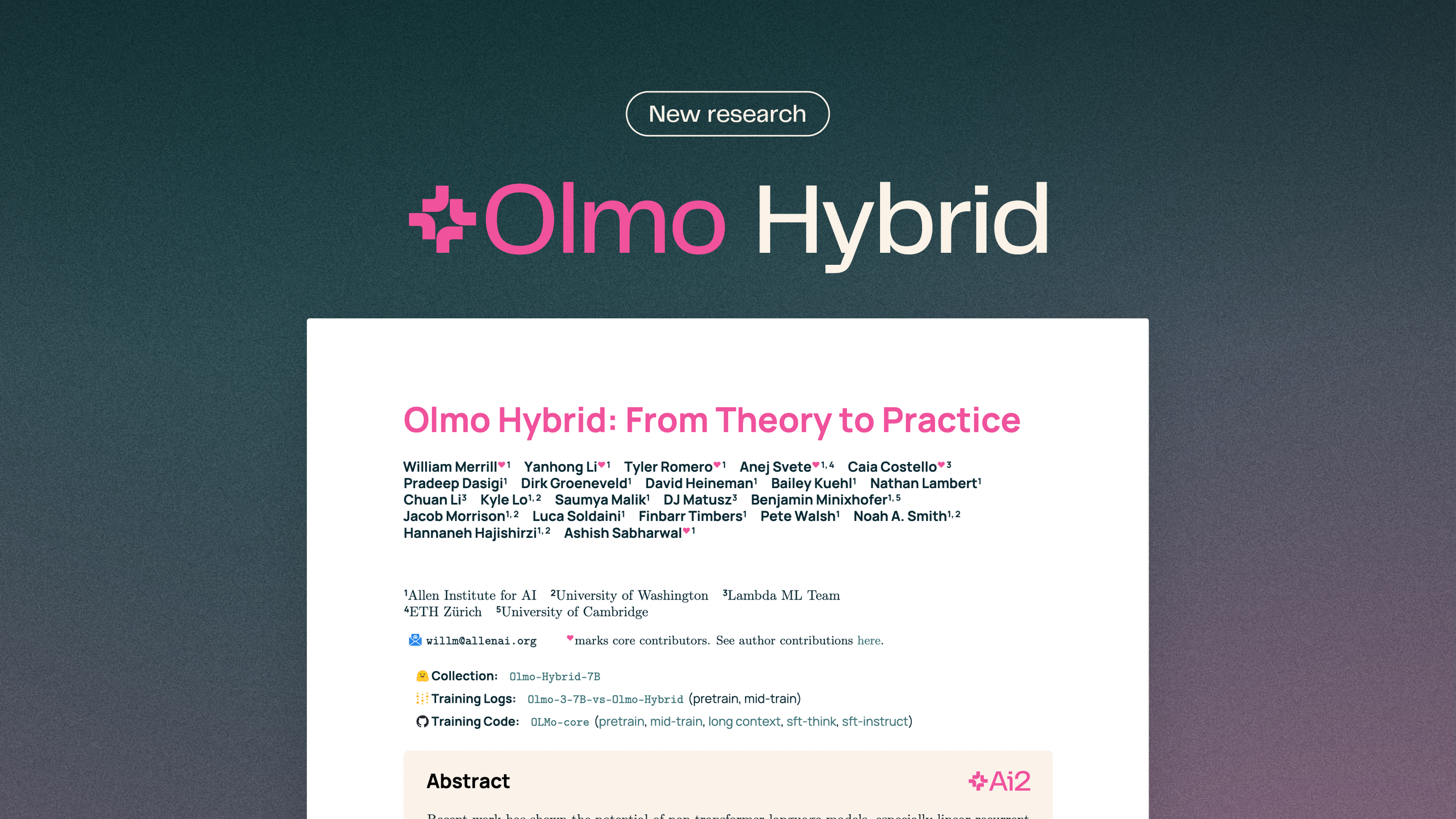
Olmo Hybrid combines transformers and RNNs, offering better efficiency and performance in scaling.
Concept 1: The Transformer Architecture (The Starting Point)
What it is: A transformer is the dominant type of AI language model since 2017. It processes text using a mechanism called self-attention.
How self-attention works:
- When predicting the next word, the model looks at every previous word simultaneously
- It decides which words are most relevant to the current prediction
- Think of it like having a perfect memory that can scan an entire book at once
Why it's powerful:
- Highly parallelizable → trains very fast on modern hardware
- Excellent at precise recall → can retrieve specific details from earlier in a sequence
Its key weakness:
- Attention scales quadratically with sequence length
- Double the sequence length → 4× the computation
- Gets very expensive at long contexts
🧠 Simple analogy: A transformer is like a student who reads the entire exam paper before answering each question — thorough, but slow when the paper gets very long.
Concept 2: Recurrent Neural Networks (RNNs) — The Alternative
What it is: An older approach where the model processes text one token at a time, maintaining a hidden state that gets updated with each new input.
How it works:
- Reads word 1 → updates internal state
- Reads word 2 → updates state again
- And so on...
- The state acts like a running mental model of what's been read
Why it's useful:
- Naturally good at state tracking — e.g., keeping track of a chessboard position as moves are made
- Scales linearly with sequence length (much cheaper than transformers at long contexts)
Its key weakness:
- Traditional RNNs are sequential → can't be parallelized → slow to train
- Compresses all past information into a bounded (fixed-size) state → can lose precise details from earlier in the sequence
🧠 Simple analogy: An RNN is like a student who takes brief notes as they read, updating a single notepad. Efficient, but details from early pages may get overwritten.
Concept 3: Linear RNNs — Making RNNs Trainable at Scale
The problem they solve: Traditional RNNs couldn't be trained efficiently because of their sequential nature.
What changed: Researchers redesigned recurrence to be parallelizable during training while still behaving like an RNN during inference.
Key examples mentioned:
- State-space models
- Gated DeltaNet (used in Olmo Hybrid)
The trade-off remains:
- Still efficient at long contexts (linear scaling)
- Still struggles with precise recall from far back in a sequence
- Because the state is bounded, old information can get "squeezed out"
🧠 Key insight: Linear RNNs revived interest in recurrent approaches by solving the training efficiency problem, but the recall limitation remained.
Concept 4: The Core Problem — Each Architecture Has a Blind Spot
| Feature | Transformer | Linear RNN |
|---|---|---|
| Precise recall | ✅ Excellent | ❌ Weak |
| State tracking | ❌ Weak | ✅ Excellent |
| Training speed | ✅ Fast (parallel) | ✅ Fast (linear RNN) |
| Long-context inference | ❌ Expensive (quadratic) | ✅ Cheap (linear) |
The insight:
- Neither architecture alone is optimal
- They have complementary strengths
- What if you combined them?
Concept 5: Hybrid Models — Combining the Best of Both
What a hybrid model is: A neural network that interleaves transformer attention layers with linear RNN layers throughout the architecture.
Why this helps:
- Attention layers handle precise recall tasks
- RNN layers handle state tracking tasks
- Together, they cover each other's weaknesses
Olmo Hybrid's specific design — the 3:1 pattern:
- 3 Gated DeltaNet (linear RNN) layers
- followed by 1 multihead attention layer
- This pattern repeats throughout the network
- Result: 75% of layers are RNN, 25% are attention
Why this ratio?
- Enough attention to prevent information from getting "stuck" in the bounded recurrent state
- Enough RNN layers to gain efficiency and state-tracking benefits
🧠 Simple analogy: A hybrid model is like a student who mostly takes running notes (RNN) but occasionally pauses to re-read the full text (attention) — getting the benefits of both strategies.
Concept 6: Expressivity — Why Hybrids Are Fundamentally More Powerful
What "expressivity" means: The range of computations or functions a model can represent. A more expressive model can learn more types of patterns.
The key theoretical claim:
- Pure transformers can express certain computations but not others
- Pure linear RNNs can express certain computations but not others
- Hybrid models can express computations that neither can alone
Why this matters practically: Language modeling involves learning many discrete subtasks (grammar, math, reasoning, facts, etc.)
- If a subtask is expressible by the architecture → the model can eventually learn it
- If a subtask is inexpressible → it contributes to irreducible loss (a floor the model can never get below)
The consequence: Hybrids can express more subtasks → lower irreducible loss → better performance per token of training data
Concept 7: Scaling Laws and Data Efficiency
What scaling laws are: Mathematical relationships describing how model performance improves as you increase:
- Model size (parameters)
- Training data (tokens)
- Compute
What Olmo Hybrid found: Hybrid models reach the same performance as transformers using significantly fewer tokens:
| Benchmark | Token savings |
|---|---|
| MMLU | 49% fewer tokens (~2× efficiency) |
| Common Crawl | 35% fewer tokens |
What this means in practice:
- Same capability with half the data, OR
- Same data → meaningfully better model
- Since training throughput is matched, fewer tokens = proportional compute savings
The scaling prediction: The token-savings advantage appears to grow with model size:
- ~1.3× savings at 1B parameters
- ~1.9× savings at 70B parameters
🧠 Key insight: The efficiency gain isn't just a training trick — it's a fundamental property of the architecture's greater expressivity.
Concept 8: The Quantization Model — Formalizing the Explanation
What it is: A theoretical framework (idealized model) for understanding scaling laws.
The core idea: Learning during pretraining can be modeled as progressively "unlocking" discrete subtasks as you add more data.
What Ai2 proved: Under this model, increasing expressivity mathematically translates to more efficient scaling trends.
This provides a theoretical foundation for why the empirical results make sense:
- Hybrids are more expressive (theory)
- More expressivity → more subtasks learnable (theory)
- More learnable subtasks → lower loss per token (theory)
- Lower loss per token → better scaling efficiency (observed in practice ✅)
Concept 9: Long-Context Performance
The additional benefit: Beyond expressivity, hybrids also show advantages at long context lengths.
Results on RULER (long-context benchmark):
- At 4k tokens: Hybrid slightly trails Olmo 3
- At 8k tokens: Hybrid overtakes Olmo 3
- At longer contexts: Gap widens in hybrid's favor
At 64k context length:
| Model | RULER Score |
|---|---|
| Olmo 3 7B (YaRN) | 70.9 |
| Olmo Hybrid (YaRN) | 76.9 |
| Olmo Hybrid (DRoPE) | 85.0 |
Why this happens: The RNN layers scale linearly with context length, making long-context processing fundamentally cheaper and more efficient.
Concept 10: Putting It All Together — The Full Picture
The complete argument for hybrid models:
More Expressive Architecture
         ↓
Can represent more subtasks in natural language
         ↓
Lower irreducible loss
         ↓
Better performance per training token
         ↓
2× data efficiency in practice
         ↓
Same compute → better model
         +
Linear scaling at long contexts → cheaper inference
What makes Olmo Hybrid's evidence compelling:
- Controlled comparison (same data, same training setup, same parameter count as Olmo 3)
- Gains observed at multiple scales (1B and 7B)
- Gains persist through pretraining, mid-training, and long-context extension
- Backed by theoretical explanation, not just empirical observation
Summary Table of All Concepts
| Concept | Core Idea |
|---|---|
| Transformer | Attention over full sequence; great recall, expensive at long context |
| RNN | Sequential state updates; great state tracking, poor recall |
| Linear RNN | Parallelizable RNN; efficient but bounded state |
| Hybrid Model | Mix of attention + linear RNN layers; covers both weaknesses |
| 3:1 Pattern | 75% RNN, 25% attention; balances efficiency and recall |
| Expressivity | Range of computable functions; hybrids express more than either alone |
| Scaling Laws | Performance vs. data/compute relationships |
| Data Efficiency | Hybrids reach same performance with ~2× fewer tokens |
| Quantization Model | Theory proving expressivity → better scaling |
| Long-Context | Hybrid advantage grows with sequence length |