Concept 1: The Core Problem — One Model for Everything is Wasteful
The situation today:
- About 60% of developers pick a single AI model and use it for everything
- This means simple tasks (like a small UI tweak) get sent to the same expensive, powerful model as complex tasks (like debugging a multi-system architecture problem)
Why this is a problem:
- It's like hiring a senior surgeon to put on a bandage — the capability is there, but you're massively overpaying for the task
- AI spend grows much faster than output quality improves
- Routine work gets completed at frontier (maximum) prices unnecessarily
Key Insight: Not every coding task needs the most powerful model. Matching task complexity to model capability is the opportunity.
Concept 2: What is a Model Router?
Definition: A model router is a system that sits between your request and the AI models. Before any model runs, the router classifies your request and decides which model should handle it.
Think of it like a hospital triage system:
| Patient Condition | Assigned To |
|---|---|
| Minor cut | Nurse |
| Broken bone | General doctor |
| Brain surgery | Specialist surgeon |
Applied to Cursor Router:
| Task Type | Routed To |
|---|---|
| Simple/routine work | Price-efficient models |
| UI updates | Model with best "taste" |
| Complex, long-horizon problems | Frontier reasoning models |
The router analyzes:
- Your query (what you're asking)
- Context (surrounding code, conversation history)
- Task complexity (how hard is this?)
- Domain (what kind of work is this?)
Concept 3: How Cursor Router Was Built and Trained
Training data:
- Trained on 600,000+ live requests from real developers
- Evaluated in online A/B tests across millions of live requests
What it optimizes for — the reward signal:
- User satisfaction (AFC): Did the user move forward, or did they correct the agent?
- ✅ Moving on to the next feature = strong positive signal
- ❌ Correcting the agent = strong negative signal
- Keep rate: How much of the AI-generated code stays in the codebase over time?
Why online A/B tests instead of offline benchmarks? Offline evals are small, artificial, and miss real-world nuance. Online tests capture real engineers writing real code, hitting real errors, across hundreds of requests per week — the actual conditions that matter.
Cache-awareness (an important technical detail):
- Switching models mid-conversation causes cache misses (extra cost)
- Cursor Router is trained on data where cache misses occur and evaluated including those costs
- This means the reported savings are honest — they already account for the switching overhead
Concept 4: The Cost-Intelligence Pareto Frontier
What is a Pareto Frontier? It's the set of best possible tradeoffs between two competing goals. Here, the two goals are:
- Higher intelligence/quality (costs more)
- Lower cost (may sacrifice some quality)
You can't improve both simultaneously — improving one comes at the expense of the other. The frontier represents the optimal tradeoffs.
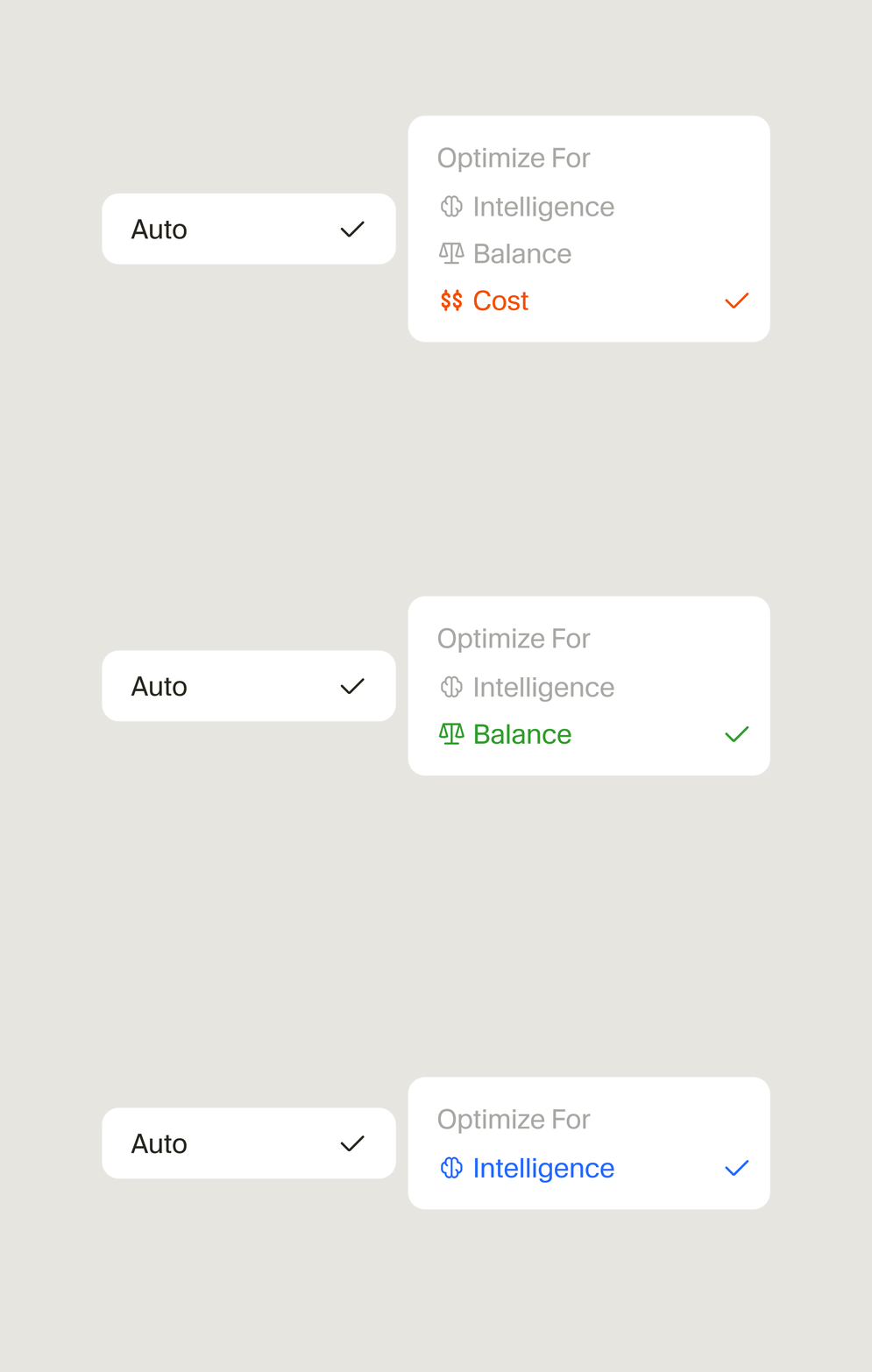
Cursor Router's three modes let you choose your position on this frontier:
QUALITY
  ↑
  |  [Intelligence] ← Matches most powerful frontier models
  |
  |  [Balance] ← Matches popular daily-driver frontier models
  |
  |  [Cost] ← Highest intelligence while minimizing token spend
  |
  └─────────────────────────────→ COST (lower is better)
| Mode | Quality Level | Cost Level | Best For |
|---|---|---|---|
| Intelligence | Frontier-matching | Lower than frontier | Teams needing top quality |
| Balance | Strong | Moderate savings | Most teams, daily use |
| Cost | Good | Maximum savings | High-volume, routine work |
Concept 5: The Real-World Results
Online A/B test results (millions of requests):
- Auto Intelligence ≈ Fable quality at ~60% lower cost
- Auto Balance > Opus 4.8 satisfaction at ~36% lower cost
Early access enterprise results (thousands of users):
- 30–50% cost savings vs. routing everything to Opus 4.8
- No decrease in quality
Cost per commit (the metric engineering leaders care about):
| Model/Mode | Cost per Commit | User Satisfaction |
|---|---|---|
| Cursor Router Balance | $4.63 | High |
| Cursor Router Intelligence | $6.76 | High |
| Opus 4.8 | $7.34 | High |
| Fable 5 | $12.69 | High |
| GPT-5.6 Sol | ~$6.76 | Lower |
Key Insight: Cost per request is only half the story. Cost per commit (actual shipped work) is what matters to engineering teams — and Cursor Router wins on that metric too.
Concept 6: Admin Control and Team Configuration
Who controls what:
ADMIN LEVEL
├── Enable/disable Cursor Router per team or group
├── Choose which modes (Intelligence/Balance/Cost) members can access
├── Set the default mode for the team
└── Allow or block specific underlying models

USER LEVEL
└── Select Auto mode in model picker → choose from available modes
This gives organizations top-down cost governance while still giving developers flexibility within set boundaries.
Concept 7: Router + Efficiency Improvements (The Bigger Picture)
Cursor Router is one piece of a larger token efficiency strategy. Choosing the right model only helps if the surrounding system is also lean.
Dynamic Tool Calling (a complementary optimization):
- Previously: All tool descriptions loaded into every prompt (wasteful)
- Now: Tools are looked up only when the model first needs them
- Common tools (read, edit) stay "hot" (cached/ready)
- Rare tools only enter the prompt when actually called
The combined effect:
Right Model (Router) + Lean Prompts (Dynamic Tools) = Maximum Efficiency
Summary: The Full Mental Model
Developer Request
       ↓
[Cursor Router Classifier]
  - Analyzes: query, context, complexity, domain
  - Trained on: 600k+ real requests
  - Optimizes for: user satisfaction + keep rate
       ↓
Routes to best-fit model
  ├── Simple task → Cheap, efficient model
  ├── UI work → Model with best taste
  └── Complex task → Frontier reasoning model
       ↓
Result: Frontier-quality output at 30–60% lower cost
The core value proposition in one sentence:
Cursor Router ensures you pay frontier prices only when you actually need frontier capability — automatically, on every request.