Concept 1: The Problem Agent Plugins Solves
Before understanding the solution, understand the pain point.
The situation before Agent Plugins:
- AI agents can be extended with two things:
- Agent Skills → reusable instructions/resources for agents
- MCP servers → tools and services agents can connect to
- These extensions already existed, but each client (ChatGPT, Cursor, VS Code, etc.) expected them packaged differently
- Same underlying component, repackaged multiple times just to satisfy different clients
Think of it like this:
Imagine writing one great song, but every music platform requires a completely different file format. You'd have to re-record it for each one — even though the song itself never changes.
Agent Plugins fixes this by giving extensions ONE standard package format that all compatible clients understand.
Concept 2: What the Standard Package Looks Like
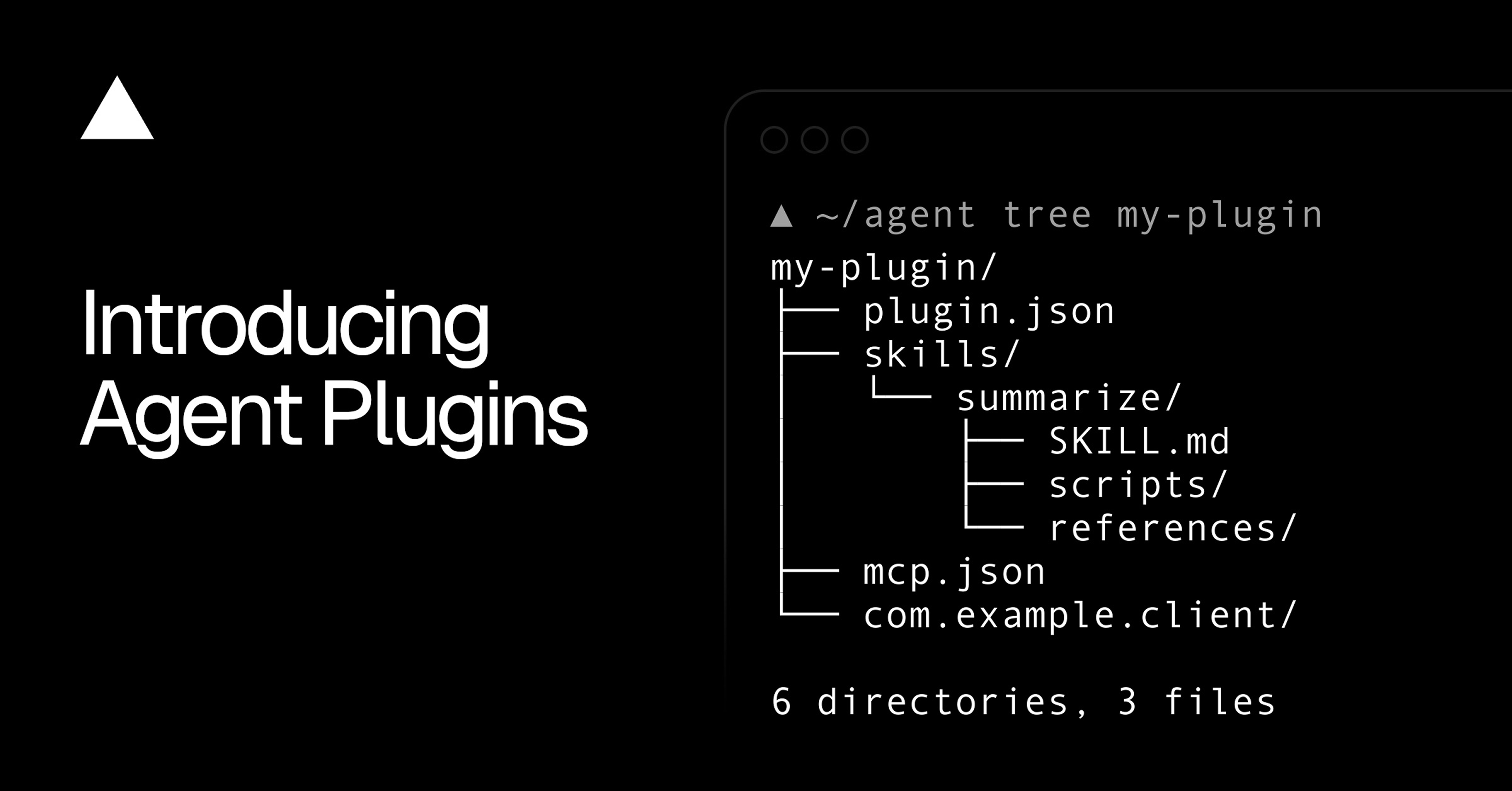
Agent Plugins defines a directory structure — a predictable "home" for your components.
my-plugin/
├── plugin.json          ← The manifest (required)
├── skills/              ← Agent Skills live here
│   └── summarize/
│       ├── SKILL.md
│       ├── scripts/
│       └── references/
├── mcp.json             ← MCP server config lives here
└── com.example.client/  ← Client-specific extras (namespaced)
Breaking this down:
| Item | Purpose |
|---|---|
plugin.json | The minimum required file — identifies the plugin |
skills/ | Where Agent Skills are discovered |
mcp.json | Where MCP server configuration is read |
com.example.client/ | Client-specific data (ignored by other clients) |
The minimal plugin.json looks like this:
{
  "$schema": "https://agent-plugins.org/schemas/1.0.0/plugin.schema.json",
  "name": "my-plugin"
}
Just two fields. That's the minimum requirement. The rest of the contract lives in the file structure itself.
Concept 3: How Clients Read the Package
Every compatible client follows the same discovery process:
Step 1: Check for plugin.json at the root → validates the plugin exists
Step 2: Look under skills/ → if client supports Skills, load them
Step 3: Read mcp.json → if client supports MCP servers, load them
Step 4: Validate each component independently
Key insight — independent validation:
If one component is broken or invalid, the other components still work. A bad
mcp.jsondoesn't disable your Skills, and vice versa.
A client doesn't need to support both component types. It can support:
- Only Skills ✓
- Only MCP servers ✓
- Both ✓
Concept 4: Why It's Intentionally Small ("Small on Purpose")
Agent Plugins deliberately covers only two component types:
- Agent Skills
- MCP servers
Why not include everything?
Because both of these already had:
- Their own existing specifications
- Meaningful adoption in the ecosystem
Agent Plugins doesn't redefine them — it only defines how clients find them together in one distributable package.
What's left OUT intentionally:
- Commands
- Hooks
- Agents
- Installation behavior
- Distribution mechanisms
- User experience decisions
Think of Agent Plugins as defining the shipping container standard, not what goes inside each box or how the truck delivers it.
The benefit of staying small:
- Easier to implement for client builders
- Gives the ecosystem room to evolve before locking in more standards
- Faster adoption across vendors
Concept 5: The Namespaced Extension Mechanism
Clients need freedom to innovate. Agent Plugins handles this with namespaced extensions.
How it works:
my-plugin/
└── com.example.client/   ← This is a client-specific namespace
- Each client defines its own namespace (like
com.cursor.client/) - Other clients completely ignore namespaced folders they don't own
- Client-specific behavior stays outside the portable contract
Why this matters:
Without namespacing:
Client A adds custom feature → bleeds into the standard → blocks Client B's adoption

With namespacing:
Client A adds custom feature → stays in its own namespace → Client B ignores it → standard stays clean
A client-specific capability stays client-specific until there's consensus to standardize it. This prevents premature standardization.
Concept 6: The Multi-Vendor, Open Governance Model
Agent Plugins isn't owned by one company. This is important for trust and adoption.
Who built it:
- Initiated by Vercel
- Refined collaboratively by: AWS, Anysphere, GitHub, Microsoft, OpenAI, and Vercel
Technical Steering Committee includes:
- AWS, Cursor, Microsoft, OpenAI, Vercel
What "open" means here:
- Openly licensed
- Public maintainers, contribution process, and technical decisions
- No single company's roadmap controls the direction
This is the same model that made standards like HTML and HTTP successful — no single gatekeeper.
Concept 7: The Value Proposition — Putting It All Together
For plugin authors:
Before: Package Skills for Client A → Repackage for Client B → Repackage for Client C
After:  Package once → Works across all compatible clients automatically
For client builders:
Before: Define your own discovery format, hope authors support it
After:  Follow the conformance checklist → automatically support all Agent Plugins
Clients supporting Agent Plugins at launch:
- ChatGPT and Codex
- Cursor
- GitHub Copilot
- Kiro
- VS Code
Summary: The Core Mental Model
Agent Plugins = A shipping container standard for AI agent extensions

┌─────────────────────────────────────────┐
│              plugin.json                │  ← Manifest (required)
│         (2 fields minimum)              │
├──────────────────┬──────────────────────┤
│    skills/       │     mcp.json         │  ← Portable components
│  (Agent Skills)  │   (MCP servers)      │
├──────────────────┴──────────────────────┤
│         com.client.namespace/           │  ← Client-specific (ignored by others)
└─────────────────────────────────────────┘

One package → Many compatible clients
The three-word contract: Package once, run anywhere.