Evaluation-First AI Agents: How Zepto Scales Customer Support on Databricks and MLflow
After studying this material, you should be able to:
- Explain the "evaluation-first" approach to building AI agents
- Describe the dual-loop model (development + production) and how they connect
- Identify the key components of a production-grade AI agent evaluation framework
- Apply evaluation strategies to real-world agentic systems
- Analyze why traditional monitoring fails for AI agents
Step-by-Step Study Material
Step 1: Why Evaluation-First Matters (The Problem)
The Core Challenge
Imagine running a customer support system handling 100,000 AI tickets per day.
1% error rate = 1,000 bad customer experiences DAILY
Traditional software thinking says:
"If the server is up and returning responses, everything is fine."
This is completely wrong for AI agents.
An agent can have:
- ✅ Zero server errors
- ✅ 100% uptime
- ❌ Repeating the wrong answer to every frustrated customer
Why AI Agents Fail Differently
Unlike simple software, an AI agent is a multi-step workflow:
Customer Query
      ↓
[Classify Intent]
      ↓
[Retrieve Knowledge]
      ↓
[Analyze Inputs]
      ↓
[Reason Through Decision]
      ↓
[Call Tools/APIs]
      ↓
[Generate Response]
Failure can happen at ANY step, not just the final answer.
This is called the Assurance Gap — the space between "the system is running" and "the system is working correctly."
Real-World Pressures That Expose This Gap
| Pressure | Example |
|---|---|
| Volume spikes | Diwali, weather events |
| Category expansion | Adding electronics, apparel to groceries |
| Diverse users | Multilingual customers, new request types |
| New failure modes | Fraud patterns, edge cases |
Key Insight: "Just ship the agent" works until it breaks at scale. Evaluation must be infrastructure, not an afterthought.
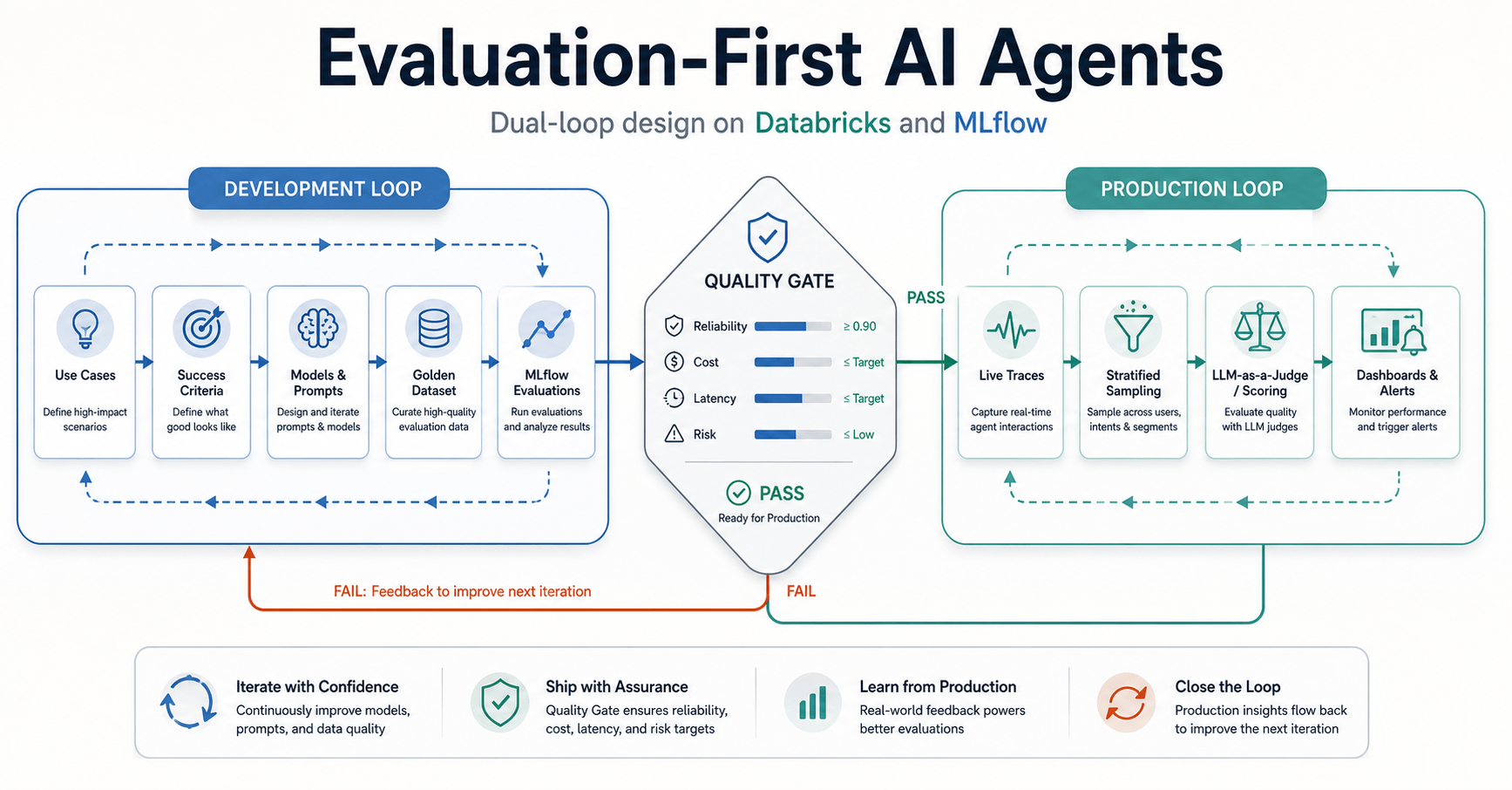
Step 2: The Dual-Loop Model (The Solution Architecture)
This is the central concept of the entire framework.
┌─────────────────────────────────────────────────────┐
│              DEVELOPMENT LOOP                        │
│                                                      │
│  Code Change → Golden Dataset Test → Scorers →      │
│  Quality Gate → Auto-Deploy (if passed)              │
└──────────────────────┬──────────────────────────────┘
                       │ Quality Gate
                       ↓
              [PRODUCTION ENVIRONMENT]
                       │
                       ↓
┌─────────────────────────────────────────────────────┐
│              PRODUCTION LOOP                         │
│                                                      │
│  Live Traffic → Traces → Online Evaluation →         │
│  Alerts → Failure Captured → Fed Back to Dev Loop   │
└─────────────────────────────────────────────────────┘
How the Loops Work Together
Development Loop asks: "Is this agent ready for production?"
- Tests against known examples
- Blocks bad changes before customers see them
- Automated regression on every change
Production Loop asks: "Is the live agent still working correctly?"
- Monitors real traffic continuously
- Catches new failure modes
- Feeds failures back into development
Key Insight: Every production failure becomes a test case. The system gets smarter over time automatically.
Step 3: The Five Building Blocks of the Framework
Building Block 1: Tracing (Observability)
What it is: Recording every step of every agent interaction
What gets captured:
- Prompts sent to the model
- Model completions/responses
- Documents retrieved
- Tool calls made
- Latency at each step
- Decision paths taken
How it works technically:
# One line enables automatic tracing
mlflow.<library>.autolog()

# Custom spans for specific steps
@mlflow.trace
def my_custom_step():
    # your code here
Why it matters: Without traces, you only see input and output. With traces, you see everything in between — where failures actually occur.
Building Block 2: Evaluation Pillars and Gates
What it is: Translating stakeholder needs into measurable thresholds
Instead of vague debates about quality, each stakeholder defines what success means numerically:
┌─────────────────────────────────────────────────────┐
│                EVALUATION PILLARS                    │
├──────────────────┬──────────────────────────────────┤
│ Customer         │ Response accuracy > 94%           │
│ Experience       │ Empathy score > threshold         │
│                  │ Resolution rate > X%              │
├──────────────────┼──────────────────────────────────┤
│ Operational      │ Automation rate > 80%             │
│ Efficiency       │ Escalation rate < Y%              │
│                  │ Latency P95 < Z ms                │
├──────────────────┼──────────────────────────────────┤
│ Risk &           │ Fraud detection rate > threshold  │
│ Compliance       │ Zero prompt injection pass-through│
├──────────────────┼──────────────────────────────────┤
│ Financial        │ Cost per ticket < $X              │
│ Impact           │ Refund accuracy within policy     │
└──────────────────┴──────────────────────────────────┘
Key principle: All gates must pass before deployment. This turns subjective quality debates into objective, shared contracts.
Building Block 3: The Golden Dataset
What it is: A curated collection of test examples that represents the full range of real-world scenarios
Requirements for a good golden dataset:
- Covers all intent types and edge cases
- Includes adversarial examples (fraud attempts, prompt injection)
- Has verified correct answers
- Contributed to by ALL stakeholders (including security team)
- Continuously updated with production failures
How it evolves over time (Zepto's journey):
Month 1:  500 examples  → 8-point dev/prod accuracy gap
Month 3:  2,000 examples → 2-point gap
Month 6:  5,247 examples → 0.4-point gap
The 10x Rule:
Every hour spent improving the golden dataset saves ~10 hours of production debugging.
Why the gap matters: If your agent scores 94% on development tests but only 86% in production, your dataset is missing 8 points worth of real-world scenarios.
Building Block 4: Scorers (The AI Jury)
What it is: Automated systems that evaluate agent outputs along multiple dimensions
Three types of scorers:
┌─────────────────────────────────────────────────────┐
│                    AI JURY                           │
├──────────────────┬──────────────────────────────────┤
│ Rule-Based       │ Use when: deterministic logic     │
│ Scorers          │ Example: Did agent call the       │
│                  │ correct API? (yes/no)             │
├──────────────────┼──────────────────────────────────┤
│ ML Model         │ Use when: pattern recognition     │
│ Scorers          │ Example: Sentiment classification │
├──────────────────┼──────────────────────────────────┤
│ LLM-Based        │ Use when: human-like judgment     │
│ Scorers          │ Example: Was the response         │
│                  │ empathetic? Was it grounded?      │
└──────────────────┴──────────────────────────────────┘
Best practices:
- Use LLM scorers only where necessary (they're expensive)
- Calibrate LLM judges against human labels (target: 80-90% agreement)
- Use multiple judges for high-stakes decisions (consensus rules)
- Use simple rules where deterministic logic is sufficient
Building Block 5: Stratified Sampling
The problem: Evaluating 100% of traffic is too expensive. But random 10% sampling misses most edge cases.
The solution: Sample strategically based on risk:
HIGH sampling rate for:
├── High-value customers
├── New or recently changed features
├── Negative sentiment detected
├── High escalation risk signals
└── Image-based or fraud-prone interactions

LOWER sampling rate for:
└── Routine, low-risk interactions
Results of this approach:
| Metric | Uniform Sampling | Stratified Sampling |
|---|---|---|
| Sample rate | 10% | 18-20% |
| Daily traces reviewed | ~10,000 | ~14,400 |
| Edge cases captured | Low | 45-60% |
| Issue detection time | Slow | 4-6 minutes |
| Cost per issue found | Baseline | 86% reduction |
| Edge case detection | Baseline | 9x improvement |
Step 4: The Agent Architecture That Makes Evaluation Work
Why Architecture Matters for Evaluation
A well-designed agent architecture makes evaluation easier by being decomposable — you can measure each piece separately.
Vertical vs. Horizontal Agents
                    Customer Query
                          ↓
              [Orchestrator / Router]
                          ↓
         ┌────────────────┴────────────────┐
         ↓                                 ↓
   VERTICAL AGENTS                  HORIZONTAL AGENTS
   (Specialists)                    (Oversight Layers)

   • WIMO Agent                     • Fraud Detection Agent
     (Where Is My Order)            • Image Validation Agent
   • Refund Agent                   • Quality Assessment Agent
   • Cancellation Agent             • Compliance Agent
   • Expiry/Quality Agent
Vertical agents = Deep expertise in one domain
- Measured on domain-specific metrics
- Example: WIMO intent classification F1 score
Horizontal agents = Cross-cutting concerns applied to all interactions
- Measured on cross-cutting metrics
- Example: Fraud detection precision across all ticket types
Why this separation matters for evaluation:
- Each vertical agent can be tested in isolation
- Horizontal agents can be evaluated independently
- Problems are easier to locate and fix
Step 5: The Development Loop in Practice
How a Typical Change Flows
Engineer makes a change
         ↓
Automated regression triggered
         ↓
Change tested against Golden Dataset
         ↓
Scorers evaluate across all pillars
         ↓
    ┌────┴────┐
    ↓         ↓
All gates   Any gate
passed?     failed?
    ↓         ↓
Auto-deploy  Block + Alert
to production engineer
Automated Prompt Optimization
Instead of manually writing and testing prompts:
1. Register initial prompt in MLflow
         ↓
2. Generate multiple prompt variants automatically
         ↓
3. Score all variants against golden dataset
   (using same scorers that gate deployment)
         ↓
4. A/B evaluate automatically
         ↓
5. Deploy best-performing variant
Cost-aware optimization trick: Use a powerful (expensive) model to generate candidate prompts, but use a cheaper model to score them. This keeps the search process affordable.
Step 6: The Production Loop in Practice
Alert Tiers
CRITICAL (checked every 5 minutes):
├── Intent accuracy drops below threshold
├── Groundedness violations detected
├── High escalation risk spike
└── P95 latency breach

HIGH/MEDIUM (monitored continuously):
├── Empathy score degradation
├── Cost per ticket spike
├── Tool failure rate increase
├── CSAT trend decline
├── Fraud detection rate change
└── Multimodal processing latency
Real Example: The Stuck Rider Problem
What happened:
- Rider was stuck in traffic
- Agent kept responding: "Your order is arriving in 10 minutes"
- Customer asked again → same response
- Customer asked again → same response
How evaluation caught it:
- Token-counter scorer detected repetitive responses
- Warning scorer flagged high escalation risk
- Traces showed stationary rider with unchanged ETA
- Detection time: 5 minutes
What changed as a result:
Old behavior: Repeat cached ETA indefinitely

New rule: If rider stationary > 10 minutes:
├── Give honest status update
└── Proactively offer cancellation + full refund
New features unlocked by this insight:
- Cancel-on-delay feature
- Proactive cancellation pitch during rider shortages
- Auto-cancel if no rider assigned within time window
- No-questions-asked cancellation for high-value customers
Step 7: Advanced Concepts
Multimodal Evaluation (Images)
When customers submit photos of damaged/expired products, evaluation becomes complex:
Challenge 1: Human disagreement
- Same mushroom photo: one rater gives 2/5, another gives 3/5
- Solution: Measure disagreement with Cohen's Kappa — this sets your reliability ceiling
- No AI model can be more consistent than the humans it learns from
Challenge 2: AI plays it safe
- AI clustered scores at 3/5 to avoid hard calls
- Humans peaked at 4/5 and 5/5
- Solution: Match the shape of the human score distribution, not just minimize average error
Challenge 3: Edge cases
- Curdled milk (packaged good but needs fresh-produce judgment)
- Taste/smell complaints (photo can't show these)
- Solution: Route these to separate handling paths
Fraud Detection Pipeline
For refund abuse (fake photos, edited images, reused images):
Image submitted
      ↓
Preprocessing checks
(blur, brightness, resolution)
      ↓
OCR validation
      ↓
Jury of 3 vision models
(consensus rules)
      ↓
Additional checks:
├── Blur detection
├── Screenshot detection
├── Duplicate image detection
├── Image vs. SKU matching
├── Image vs. stated reason check
└── Proof-of-delivery validation
      ↓
Auto-approve OR Route to human review
Step 8: Results and Key Principles
Zepto's Outcomes
| Category | Result |
|---|---|
| Tickets handled by AI | 80%+ |
| Support cost reduction | 65% |
| Payback period | Under 1 month |
| Dev/prod accuracy gap | Reduced from 8 points to 0.4 points |
| Edge case detection improvement | 9x |
| Review cost reduction per issue | 86% |
Core Principles to Remember
-
Evaluation is infrastructure, not a final check
- Build it first, not last
-
Traces are your foundation
- You cannot evaluate what you cannot observe
-
Golden datasets compound in value
- Every production failure makes future versions more robust
-
Use the right scorer for the right job
- Rules for deterministic checks, LLMs only for judgment calls
-
Sample strategically, not uniformly
- Risk-based sampling finds more problems at lower cost
-
Architecture and evaluation co-design
- Decomposable agents are measurable agents
-
The dual loop creates a self-improving system
- Production failures automatically strengthen development tests
Quick Reference Summary
EVALUATION-FIRST AI AGENTS
│
├── WHY: Assurance gap between "running" and "working correctly"
│
├── WHAT: Dual-loop model
│   ├── Development Loop: Test before production
│   └── Production Loop: Monitor in production
│
├── HOW: Five building blocks
│   ├── 1. Tracing (observe everything)
│   ├── 2. Evaluation Pillars (measure what matters)
│   ├── 3. Golden Dataset (source of truth)
│   ├── 4. Scorers/AI Jury (automated evaluation)
│   └── 5. Stratified Sampling (efficient coverage)
│
├── ARCHITECTURE: Vertical + Horizontal agents
│   ├── Vertical: Domain specialists (measurable in isolation)
│   └── Horizontal: Cross-cutting oversight layers
│
└── RESULTS: 80%+ automation, 65% cost reduction, <1 month payback