How Claude Is Accelerating Protein Design and Chemistry
After studying this material, you should be able to:
- Explain what protein binders are and why designing them matters for drug development
- Describe how AI (Claude) performed on protein binder design compared to human benchmarks
- Explain what NMR and LC-MS are and why they matter in chemistry
- Describe how Claude performed on analytical chemistry tasks
- Evaluate the broader implications, including dual-use safety concerns
Step-by-Step Study Material
Step 1: The Core Problem — Why Drug Discovery Is Slow
Before understanding what Claude did, you need to understand the bottleneck it addresses.
Drug development has two early-stage bottlenecks:
| Task | What It Involves | Traditional Time Cost |
|---|---|---|
| Protein binder design | Designing molecules that attach to disease targets | Weeks to months per target |
| Analytical chemistry | Confirming what molecule you made and how pure it is | Hours to days per sample |
Key insight: Both tasks are highly skilled, repetitive, and sequential — meaning one expert works through them one at a time.
Step 2: Understanding Protein Binders
What is a protein binder?
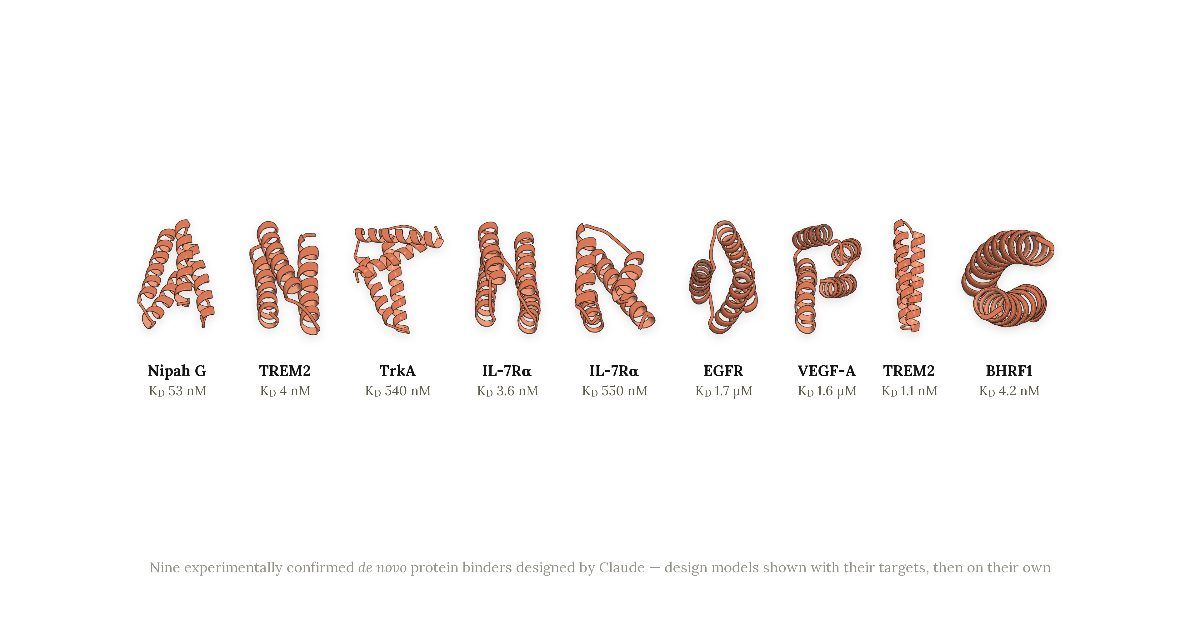
A protein binder (specifically a minibinder) is a small protein engineered to latch tightly onto a target protein.
Think of it like a key designed to fit a specific lock.
Why does binding matter for medicine?
Most modern drugs work by binding to a target protein and then:
- Inhibiting it (blocking its activity)
- Activating it (switching it on)
- Delivering something to it
Example from the article: TNFα is a protein that triggers inflammation. Blocking it is the basis for Humira, one of the most impactful drugs ever made.
What makes a good binder?
The key quality metric is affinity — how tightly the binder grips its target.
- High-affinity binders grip tightly → effective at lower doses → fewer side effects → cheaper to manufacture
- Low-affinity binders grip loosely → need higher doses → more risk
What is "de novo" design?
De novo means designing a binder from scratch, with no existing template. This is harder than modifying a known binder.
Step 3: The Traditional Protein Design Process
Before AI, here is what protein design required:
Select target protein
        ↓
Choose binding site on target
        ↓
Generate candidate protein structures (computational)
        ↓
Optimize sequences (weeks of computation)
        ↓
Screen candidates in silico (on computer)
        ↓
Wet lab validation (physically test in lab)
        ↓
Result: weeks to months per target
Key vocabulary:
- In silico = done by computer simulation
- Wet lab = physical laboratory testing with real chemicals
- Hit rate = percentage of designed proteins that actually bind successfully
- Typical industry hit rate: 10–15%
Step 4: What Claude Did Differently
The Setup
Claude was given:
- A detailed protein design prompt
- Internet access and scientific papers
- Access to GPUs running specialized protein design models
- No additional human guidance after starting
Claude then autonomously:
- Chose where on each target protein to design against
- Generated candidate structures using specialist models
- Ran multiple cycles of optimization
- Screened for novel, diverse candidates
- Submitted final designs for wet lab testing
The Two Modes Tested
| Mode | Description | Time | Targets |
|---|---|---|---|
| Multi-target | All 15 targets simultaneously | 48 hours | All at once |
| Single-target | One target per session, run in parallel | 24 hours each | One at a time |
Step 5: Claude's Protein Design Results
Overall Performance
| Condition | Hit Rate | vs. Industry Standard (10–15%) |
|---|---|---|
| Opus 4.8, multi-target | 22.6% | ~1.5–2× better |
| Mythos Preview, multi-target | 26.7% | ~2× better |
| Mythos Preview, single-target | 35.1% | ~2.5× better |
Result: 14 out of 15 targets successfully designed against
Notable Specific Results
1. RBX1 (competition benchmark)
- Claude hit rate: 40%
- Competition participants' hit rate: 3.7%
- Claude's top design outperformed the human competition winner
2. TNFα (therapeutically important, notoriously difficult)
- Multiple expert groups had struggled with this target
- Opus 4.8 succeeded where Mythos Preview did not
- Designed cross-reactive binders — worked across human, monkey, and mouse TNFα
- This matters because animal studies are required before human trials
Important lesson: A generally less capable model (Opus 4.8) outperformed the more capable model (Mythos Preview) on this specific target. This shows that AI capability is not always linear — complex tasks can have unexpected results.
3. β-sheet binders (structurally difficult)
- Most designed binders use α-helices (coiled structures — easier to design)
- β-sheets (flat, extended strands) are harder because they misfold easily
- Claude designed 15 confirmed β-sheet binders across 6 targets
Where Claude Struggled
MBP (maltose-binding protein):
- Large, flexible protein with a smooth, water-loving surface
- Gives a binder very little to "grab onto"
- Result: 0 out of 90 designs confirmed as binders
BBF-14:
- A β-barrel protein that was itself artificially designed (not found in nature)
- Used as a benchmark precisely because it's novel
- Claude produced 3 modest binders — not a failure, but not strong performance
Step 6: Understanding Analytical Chemistry — NMR and LC-MS
This is the second task Claude was tested on. You need to understand what these techniques do before appreciating Claude's performance.
Nuclear Magnetic Resonance (NMR) Spectroscopy
Purpose: Confirm the identity of a molecule you've made
How it works:
- The instrument detects hydrogen atoms in a molecule
- Produces a spectrum of peaks
- Each peak = a hydrogen atom (or group of equivalent hydrogens) at a specific location in the molecule
- Peak location → what the hydrogen is attached to
- Peak size → how many hydrogens it represents
The chemist's job: Match every peak to every hydrogen atom in the proposed structure — done by hand
Time cost: ~30 minutes to 1 hour per sample for a skilled chemist
Liquid Chromatography–Mass Spectrometry (LC-MS)
Purpose: Assess the purity of a compound
How it works:
- Sample flows through a column, separating its components
- UV absorbance measures how much of each component is present
- Mass spectrometry measures the molecular mass of each component
Time cost: ~10 minutes to run the instrument; hours to analyze the output
The Hidden Problem: File Formats
Both instruments produce raw files in proprietary, undocumented vendor formats — meaning you need the manufacturer's specific software to open them. This creates a bottleneck when trying to automate analysis.
Step 7: Claude's Analytical Chemistry Results
The Task
Claude was given:
- Raw NMR and LC-MS files from a contract laboratory
- A two-sentence plain-language prompt
- No vendor software
- No specialist operator
NMR Results
Claude:
- Converted raw data into a calibrated spectrum
- Produced a table of 18 peaks with hydrogen counts
- Flagged 4 peaks as likely nitrogen- or oxygen-attached hydrogens (which behave differently)
- Proposed adding heavy water to confirm — the exact same follow-up experiment the lab had independently run
- Self-corrected an error: initially reported all 4 flagged peaks disappeared, then caught that only 2 had
- Arrived at the same conclusion as the lab's human operator
Accuracy: Hydrogen counts within 0.08 ¹H of the lab's results
LC-MS Results
Claude:
- Decoded the undocumented vendor file format by working out the encoding
- Verified its reading by reproducing the instrument's own recorded totals for all 2,664 scans
- Delivered: separation trace, mass and UV spectra, purity table, molecular mass, reusable code for future files, and a list of caveats
Accuracy: Purity measured at 96.4% vs. lab's 96.33%
Time Comparison
| Task | Claude | Human Chemist | Lab Report |
|---|---|---|---|
| NMR processing | 23 minutes | 30–60 minutes | 4 days after sample |
| LC-MS processing | 19 minutes | ~2 hours | 4 days after sample |
| Both tasks | ~25 minutes (parallel) | Hours | 4 days |
Step 8: The Dual-Use Safety Problem
This is a critical concept the article raises explicitly.
What is "dual-use"?
A capability is dual-use when it can be used for both:
- Beneficial purposes (developing medicines, scientific discovery)
- Harmful purposes (developing bioweapons, dangerous pathogens)
Why does this matter here?
The same AI capability that can:
- Design a protein binder to treat cancer...
- ...could theoretically help design a pathogen or toxin
How is this being managed?
- Protein design capabilities are blocked in general-access models
- Access is being restricted to trusted researchers through a formal access program
- Analytical chemistry (lower risk) remains available in Opus 5
Key principle: Capability and safety must be developed together, not sequentially.
Step 9: Putting It All Together — The Bigger Picture
What these results mean for drug development
Traditional drug development timeline:
Target identification → Binder design (months) → Validation (weeks)
→ Chemistry analysis (days per compound) → Clinical trials → Drug

With AI acceleration:
Target identification → Binder design (days) → Validation (weeks)
→ Chemistry analysis (minutes) → Clinical trials → Drug
The bottlenecks being removed are early-stage — the article is careful to note that:
- Protein minibinders are not yet standard therapeutic drugs
- High-affinity binding is just the first step toward a drug
- Many other bottlenecks (policy, operations, clinical trials) remain
The broader pattern
Both tasks share a common structure that AI handles well:
| Feature | Protein Design | Analytical Chemistry |
|---|---|---|
| Highly specialized knowledge required | ✓ | ✓ |
| Repetitive, structured workflow | ✓ | ✓ |
| Proprietary/complex data formats | ✓ | ✓ |
| Verification is objective | ✓ | ✓ |
| Previously required expert weeks/hours | ✓ | ✓ |
Summary: Key Concepts to Remember
| Concept | Definition |
|---|---|
| Minibinder | Small protein designed to attach to a target protein |
| Affinity | How tightly a binder grips its target |
| Hit rate | % of designed proteins that actually bind |
| De novo design | Designing a protein from scratch |
| In silico | Computer-based testing |
| Wet lab | Physical laboratory testing |
| NMR | Technique to confirm molecular identity via hydrogen atom mapping |
| LC-MS | Technique to assess compound purity |
| Dual-use | Technology usable for both beneficial and harmful purposes |
| α-helix / β-sheet | Two common protein structural shapes; β-sheets are harder to design |
Self-Check Questions
- What is the typical industry hit rate for protein binder design, and how did Claude compare?
- Why are high-affinity binders preferable to low-affinity ones?
- Why did Claude struggle with MBP but succeed against TNFα?
- What is the purpose of adding heavy water during NMR analysis?
- Why are protein design capabilities restricted to trusted researchers while analytical chemistry is not?
- What does it mean that a capability is "dual-use," and why does it matter?